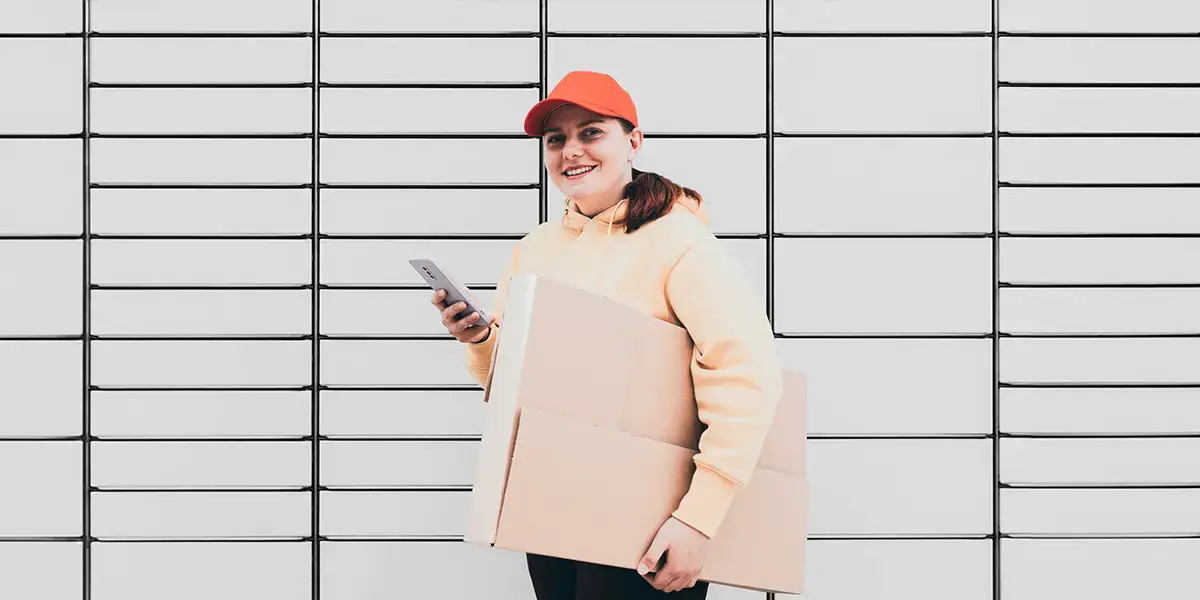
By the end of 2023, Europe had more than 155,000 parcel lockers in operation, a 29% jump in a single year. Nearly half of European shoppers (44%) choose out-of-home (OOH) delivery when offered. What began as a Polish and Nordic quirk is now a continental habit.
The drivers are simple but powerful: convenience, lower costs, and sustainability. For carriers, lockers cut last-mile expense. For shoppers, they mean certainty and 24/7 pickup. For regulators, they shrink the delivery footprint.
For retailers, that creates a fork in the road: adapt your delivery management software to include lockers, and you keep pace with customer expectations. Ignore it, and you risk being judged on your last mile rather than your product.
And the numbers suggest this isn’t just a blip, it’s the start of a structural shift. The next question is: how fast is the locker market scaling, and can home delivery keep up?
How fast is the parcel locker market growing in Europe?
Growth isn’t steady, it’s accelerating like compound interest.
Analysts forecast 11–12% annual growth in parcel locker deployments through at least 2027. But the real story is the speed-up in 2024–2025:
- Geopost (DPD) grew its network 63% to 31,000 lockers in 2024.
- DHL expanded its global locker footprint by ~50% to 36,000 locations in the same year.
- InPost added 11,500+ APMs in 2024, finishing with 46,977 lockers (+33% YoY), while UK parcel volumes via InPost jumped +58% in Q4’24.
- Germany plans to double Packstations from ~15,000 to 30,000 by 2030, with new carrier-neutral networks in play.
- The broader OOH market (lockers + PUDOs) is projected to grow ~15% CAGR to 2030.
Why the surge? Because the three forces behind lockers: cost, reliability, and sustainability get stronger as the networks get denser. Last mile still swallows 60–70% of total delivery cost, failed deliveries still waste time and fuel, and regulators are only tightening on emissions. The bigger the locker footprint, the more self-reinforcing those advantages become.
This isn’t slow, linear growth. It’s the point where infrastructure tips into inevitability: the more lockers appear, the more customers expect them, the more carriers must build them.
And once growth becomes self-fuelling, the real question isn’t whether lockers will expand, it’s which countries are sprinting ahead, and which are scrambling to catch up.
Which European countries have the most parcel lockers?
Adoption of parcel lockers isn’t evenly spread across Europe; some markets sprinted ahead, while others are still tying their shoelaces.
Poland is the clear frontrunner. Its out-of-home delivery market is the most developed in the region. By 2023, Poland had about 1.08 parcel lockers per 1,000 people, the highest density in Europe. That equated to roughly 47,000 lockers in total, and Polish shoppers have made lockers their preferred delivery method.
The Nordics aren’t far behind. Sweden has around 0.96 lockers per 1,000 people, nearly matching Poland’s per-capita rate. Finland is another standout: lockers are the most popular delivery method nationally, with over 150,000 individual locker doors installed (Cross-Border Magazine). In these countries, lockers are part of daily life, as ordinary as recycling bins.
Germany and France, by contrast, are playing catch-up. Germany, home to DHL’s Packstations, has over 15,500 units in 2025 (Cross-Border Magazine), but given the population, that’s only 0.18 lockers per 1,000 people. The UK shows a similar pattern: around 0.23 per 1,000 people, with just 10% of parcels delivered via OOH today. France trails further still, with only ~1,000 lockers nationwide by end-2024. Most of Southern and Western Europe remains under 0.2 per 1,000 inhabitants.
But momentum is shifting. Germany plans to double Packstations from ~15,000 to 30,000 by 2030, and carriers are rolling out new open, carrier-neutral networks. Sweden is adding ~1,000 new lockers in 2024 via DHL, while Italy’s postal operators target 10,000 lockers in the coming years (Cross-Border Magazine).
The pattern is clear: Central and Northern Europe embraced lockers early; Western Europe is only now racing to catch up. And as anyone who has watched retail before knows, once shoppers in Berlin, Paris, and London see what’s normal in Warsaw and Stockholm, expectations shift fast.
And when expectations shift, the real question for retailers isn’t if lockers will matter in your market, but how long you can survive without them showing up at checkout.
Why are parcel lockers so popular for deliveries?
Parcel lockers are growing because they fix the very things that make home delivery feel broken.
Convenience without compromise. Nobody likes waiting at home for a courier between “8 a.m. and 6 p.m.” Lockers give shoppers the freedom to collect a parcel when it suits them, on the commute, after the gym, even at midnight. Locations in supermarkets, transit hubs, and local centres make lockers part of people’s routines (Cross-Border Magazine). Freedom, disguised as logistics.
Reliability at the first attempt. In dense cities, up to 25% of home deliveries fail on the first try. Lockers eliminate that pain: the parcel is delivered once, securely, and is “home” whenever the customer is ready. For shoppers, that means peace of mind; for retailers, fewer re-delivery costs and fewer angry customer tickets.
Lower costs through density. The last mile eats 60–70% of total delivery cost. With lockers, a courier drops dozens of parcels in one stop. That’s why vans can handle 5–10× more packages per route compared to door-to-door. Cheaper for carriers, cheaper for retailers, and often faster too.
A greener last mile. By consolidating trips, lockers reduce emissions by 13–32% per parcel on average, and up to two-thirds in dense urban networks. As EU climate rules tighten, this is becoming a regulatory and reputational must-have.
In short, lockers win because they turn the worst part of delivery, waiting, missed drops, high cost, wasted miles, into a service that feels flexible, reliable, and sustainable.
And once customers discover that deliveries no longer mean waiting by the door, they don’t go back (?), which raises the next question: how should retailers adapt before lockers go from perk to expectation?
What does the growth of parcel lockers mean for retailers?
For retailers, lockers aren’t a side option anymore; they’re part of the decision to buy or bounce.
Choice = conversion. Cart abandonment doesn’t always happen because shipping is too slow; often, it’s because customers feel trapped. Research shows 14% of online shoppers abandon carts due to a lack of convenient delivery options, while 71% say having choice, including lockers, is important (nShift). By placing lockers side-by-side with home delivery, you give shoppers agency at the very moment they decide whether to trust you with their money.
Technology makes scale possible. Each market has its own locker champions. InPost in Poland, DHL Packstations in Germany, SwipBox in Denmark. Trying to integrate these one by one is chaos. That’s why multi-carrier platforms like nShift matter: 1,000+ carriers and 1.2M+ OOH locations in one connection. It means you can show the nearest available locker at checkout in real time, without rebuilding your stack every time a new network launches.
Returns get easier, too. Lockers aren’t just an outbound solution. They’re a low-friction returns channel, no printers, no queues, just a PIN or QR code. Directing returns into lockers smooths out the post-holiday spike and reduces customer service headaches.
Cross-border reach is now table stakes. A French shopper may expect a La Poste locker, while an Italian one prefers Poste Italiane. Offering the “wrong” option feels tone-deaf. Retailers that rely on multi-carrier tech can map the right locker network to the right shopper, making cross-border sales feel local.
Track, test, and negotiate. Uptake varies by market and season. Use your own data: push lockers more where adoption lags, and leverage volume where it’s high to negotiate better rates. Highlight reliability in your messaging: “Pick up from a nearby locker with near-guaranteed first-attempt delivery”, a promise home delivery can’t match.
For retailers, the real risk isn’t the added complexity of offering lockers, it’s the customer who leaves because they felt cornered at checkout.
And once competitors start presenting lockers as standard, the absence of choice won’t just lose you a sale; it’ll brand you as behind the curve.
Will parcel lockers become as common as home delivery in the future?
For years, we assumed doorstep delivery was the final form of convenience. But the data tells a different story.
Market projections suggest that by 2030, out-of-home (OOH) deliveries, locker, plus pick-up points could rival home delivery volumes in several European markets. In some countries, that future is already here: in Poland, half of all parcels are delivered via OOH, with lockers the dominant method. Finland and Sweden are on the same path, where lockers are already the preferred option.
Western Europe is catching up. Germany plans to double its Packstations from ~15,000 to 30,000 by 2030, Italy’s postal carriers are targeting 10,000 lockers, and France is rolling out solar-powered models to accelerate expansion. For retailers, this means that what looks like “emerging infrastructure” today is on track to become unavoidable infrastructure tomorrow.
The irony? What we once framed as "the pinnacle of service": the courier at your door may soon look like an inconvenience. Lockers flip the psychology: instead of waiting for the delivery, the delivery waits for you. And once shoppers have experienced that control, the idea of rearranging their day around a courier window feels almost absurd.
So the real question for retailers isn’t whether lockers will match home delivery. It’s how many sales you’ll lose before you adapt to a world where waiting by the door is history.
Frequently asked questions
What is delivery management software?
Are parcel lockers more sustainable than home delivery?
Which delivery carriers in Europe offer parcel locker services?

About the author
Thomas Bailey
Thomas Bailey was Product Innovation Lead at nShift. The role focused on making new features and platform improvements deliver real value to customers. With a background in product, tech and go-to-market strategy, Thomas wrote about checkout, returns and delivery experience from a practical angle. The articles reflect nShift's thinking when they were published.