Last update: 17.09.2026
Parcel lockers and pick-up points are out-of-home delivery locations where a carrier leaves a parcel for the shopper to collect: an automated locker opened with a code, or a staffed counter in a shop, kiosk, or post office. Both take the missed doorstep delivery out of the process and let carriers consolidate many parcels at one stop, which is why the format has moved from a niche option to a mainstream delivery option across Europe.
In this blog:
- Evolving delivery preferences: Beyond home delivery
- Sustainability: The powerful upside of shared delivery points
- Convenience in motion: When pick‑up points outperform doorstep delivery
- Operational advantages: Efficiency, cost savings, and sustainability
- Location matters: Strategic positioning of lockers & pick‑up points
- Why are open locker networks growing?
- How to evaluate locker providers
- What is a kiosk pick-up point?
- The road ahead: Why integration matters now
- Further reading: Pick‑up points & lockers trend FAQs
Evolving delivery preferences: Beyond home delivery
During the pandemic, most people became very familiar with ordering deliveries to their home, as working-from-home grew as a trend. However, now that the world has opened up again, and everyone’s beginning to enjoy the beginning of spring, and the freedom of the outside world, we’re looking to the future, in order to understand what life will look like after the pandemic.
When it comes to pick-up points, and lockers, these options are expanding across various countries, with companies such as Amazon increasing their delivery options. What role do these alternative delivery locations play in the future of shipping?
During the pandemic, most people became accustomed to receiving deliveries at home. But as life opens up again, we're shifting focus to what comes next. In this post, we'll explore how pick‑up points and lockers are becoming central to the evolving delivery landscape—and why retailers should take notice.
Sustainability: The powerful upside of shared delivery points
One of the main benefits of pick-up points, and lockers, is the sustainability of these methods. Whilst plenty of customers are open-minded to click and collect from a variety of locations, such as shops or lockers, a key angle for both retailers, and consumers alike, is the benefit that this method has on the environment.
Lockers and pick‑up points aren’t just convenient—they're eco-friendly. By centralizing multiple deliveries, drivers can reduce fuel usage and emissions compared to stopping at individual homes.
This aligns with consumer preferences: 60‑80% say they’d choose a carbon‑friendly delivery alternative if available—demonstrating the strategic importance of sustainable options.
Convenience in motion: When pick‑up points outperform doorstep delivery
In our home delivery survey, with IMRG, we asked 1,000 UK consumers which delivery option would be preferred, when excluding home delivery. This was to find out what key trends might emerge in the future, and how retailers can stay ahead of customer demand. Interestingly, the most popular answer was to click and collect from a shop (38%), followed closely by ‘other’ (37%). Almost 15% of people would like to try delivery to work, or collecting from a locker, or another location. Consumers may be more open minded to different delivery locations in the future, than we think.
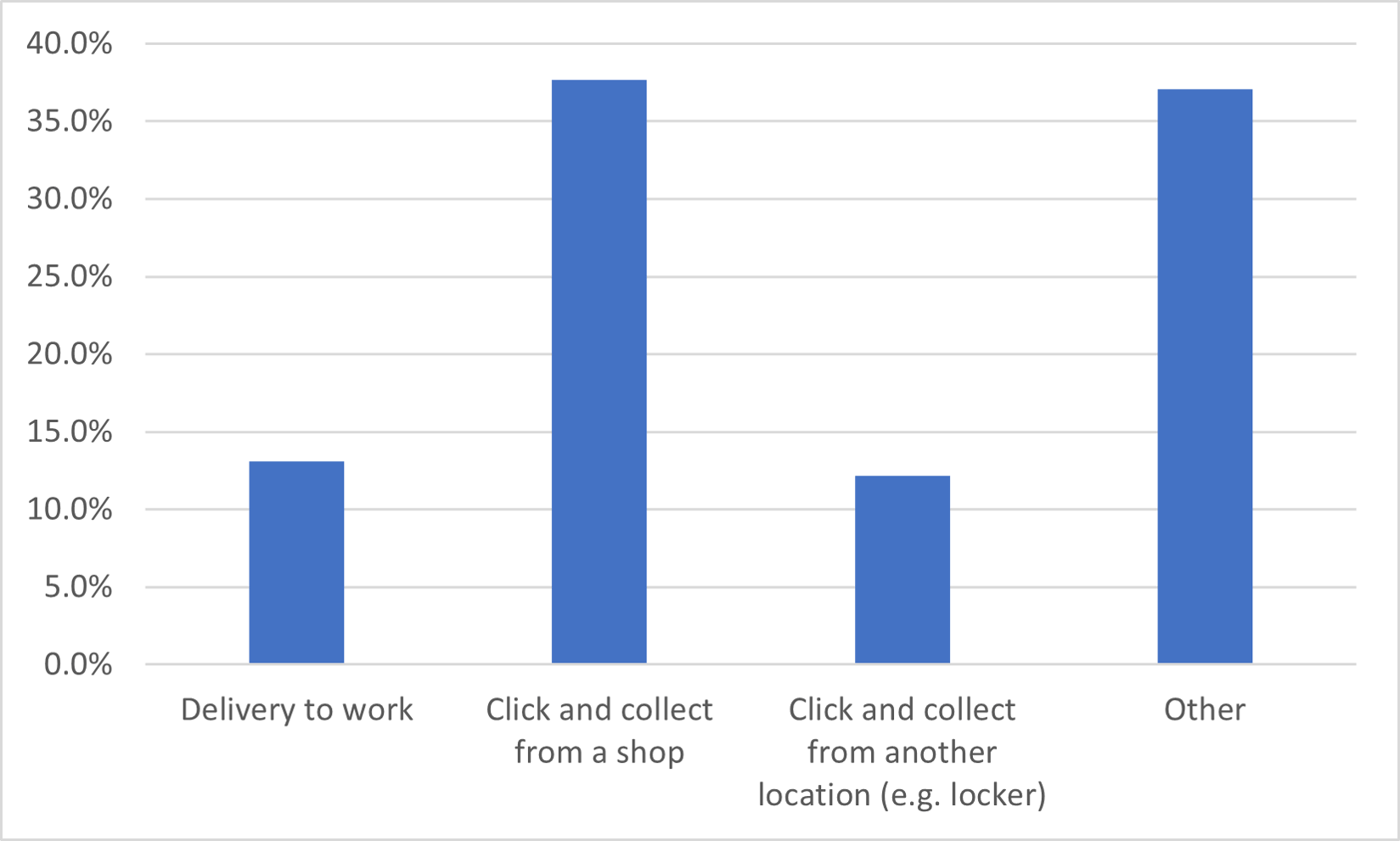
And looking ahead to the future what delivery option do you think will be your most preferred option?
(Source: Maru, nShift and IMRG Home Delivery Report)
The role that pick-up points play in the future could be a big one, as they offer customers a more sustainable alternative to deliveries to their home. This is because the driver doesn’t need to drive to each individual person’s house, but instead, can leave many packages at one location, therefore saving fuel.
nShift and IMRG's survey of 1,000 UK consumers revealed that when home delivery isn't an option, 38% prefer click-and-collect from a shop, while 15% are open to collecting from work, lockers, or other locations. This shows a growing comfort with self-service and alternative delivery formats.
Delivery lockers offer unmatched flexibility—and availability. For instance, in Germany, DHL's Packstations are used by 90% of the population within 10 minutes of home.
Moreover, over 70% of shoppers cite delivery choice—including locker or collection options—as a key factor that could reduce cart abandonment.
Operational advantages: Efficiency, cost savings, and sustainability
We asked 1,000 UK consumers about their attitudes to carbon-friendly shipping, with the question, ‘If a carbon–friendly delivery alternative was available, would you choose it over a traditional method?’. Across the many years we’ve conducted this survey, the majority has always been firmly ‘yes’, as between 60-80% of people would opt for a more environmentally conscious option.
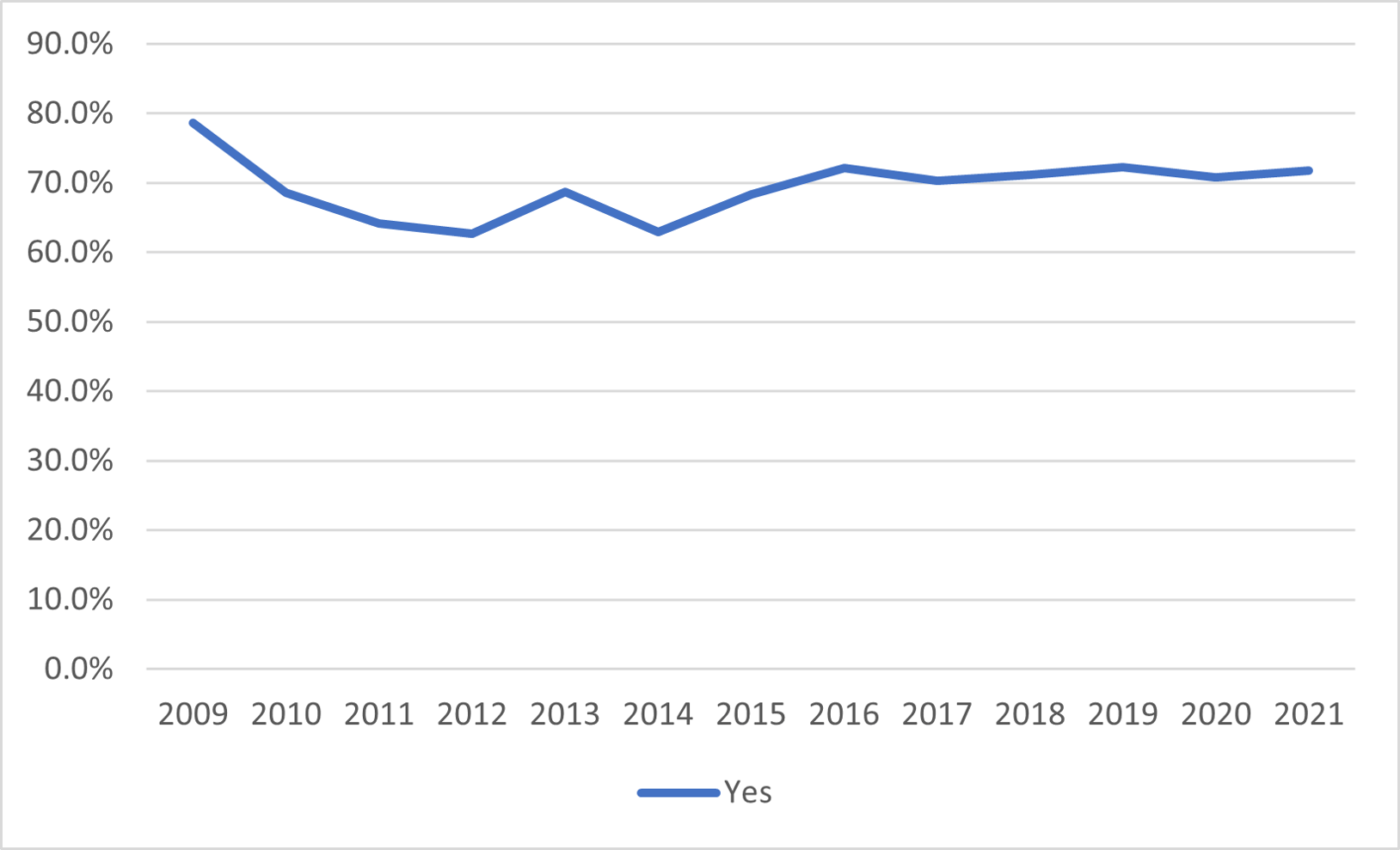
If a carbon–friendly delivery alternative was available, would you choose it over a traditional method?
(Source: Maru, nShift and IMRG Home Delivery Report)
There are also other numbers that prove the operational advantages:
- 600 vs. 60 deliveries/day: Lockers allow vans to deliver 10× more parcels.
- €121,000 saved per year: Realized in Amsterdam through locker use.
- Up to 59% lower costs: Compared to home delivery with reduced emissions.
- 1,300 deliveries/day: Possible via centralized pick‑up points.
Location matters: Strategic positioning of lockers & pick‑up points
It’s not enough to have many lockers—they must be well‑placed. For optimal impact, they should be:
- Visible at checkout and near common routes (supermarkets, transit hubs)
- Accessible without excessive detours for consumers
However, the reality of whether customers are willing to travel to get their delivery, or by doing so are burning more fuel themselves, could complicate the issue. Pick-up locations and lockers are a great option for those going to their offices, or where the locker is en-route to their destination anyway. This delivery option is definitely one to watch, as we live increasingly fast-paced lives, consumers may be looking for easy, and sustainable pick-up of their goods.
Why retailers should embrace OOH (out‑of‑home) delivery? Pick‑up points and lockers offer a trifecta of benefits:
- Boost conversions: More delivery choices lower cart abandonment.
- Increase loyalty: Customers value flexibility.
- Improve logistics: Fewer failed deliveries, lower costs.
nShift enables seamless integration of pick-up point and locker options directly at checkout:
- Connect to 1.2M+ PUDO locations across 1,000+ carriers.
- Achieve near 100% first-time delivery success.
- Improve route efficiency x5.
Why are open locker networks growing?
Open locker networks are growing because several carriers can share the same locker estate, which raises the parcel volume each site can serve and removes the need for a separate cabinet per carrier. Europe counted roughly 184,000 automated parcel lockers by 2025 (Last Mile Experts, 2025), and the operators building the next wave are adding capacity on two models at once: carrier-owned estates, such as the 30,000 own-branded lockers GLS has targeted by 2030, and open networks that sell compartment space to multiple participating carriers.
For a retailer the open model changes one thing: the shopper can pick the locker without being tied to one carrier, as long as the carrier the shipping rules select is connected to that network. For a carrier it means a presence in towns and sites where its own volume would not justify a locker. For the site owner, a supermarket or a petrol station, it means one cabinet instead of three side by side.
The operational challenge is interoperability. An open network has to pass compartment availability, drop scans, and collection scans to every carrier that uses it, and on to the retailer's tracking, so the shopper sees one consistent status whichever carrier delivered.
How to evaluate locker providers
Evaluate a locker provider on where its lockers are, which carriers can deliver to them, whether the compartment sizes fit your parcels, how long parcels can wait, how returns are handled, and what data comes back to you.
- Coverage where your customers are. Ask for the locker map by postcode and compare it with where your orders ship, not with the national total. A network dense in city centres can be thin in the suburbs where most parcels go.
- Carrier access. Check which of your carriers can deliver to the network today, and whether the lockers are open to others. A locker only your smallest carrier can reach is a locker few of your orders will use.
- Compartment sizes against your parcel profile. Match the size classes to your actual parcel dimensions and weights. If a large share of your orders exceeds the biggest compartment, the locker option will show at checkout and then fail at the sortation stage unless your checkout filters it by size.
- Dwell time and reminders. Confirm how many days a parcel can wait, whether the shopper is reminded before the window closes, and what happens to a parcel that times out.
- Returns. Ask whether the same locker accepts return drop-offs with a code, and how the return scan reaches your returns system.
- Data and reporting. Ask for the events the network sends (delivered to locker, collected, expired, returned) and how they reach your tracking and customer service tools. A network that scans but does not share the scan leaves your team answering "where is my order?" by phone.
Connecting is the last question. Direct integrations can mean separate API work for each network, and sometimes for each market. A delivery platform with pre-built carrier and PUDO connections reduces that integration work and makes the supported collection points available in the checkout. For the collection and returns process, see how PUDO lockers work.
What is a kiosk pick-up point?
A kiosk pick-up point is a small staffed shop, such as a newsagent, convenience store, or petrol station counter, that a carrier or a pick-up network contracts to hold parcels for collection and to accept drop-offs. The shopper shows the collection code from the carrier's message, or a form of ID, and the counter staff scan the parcel out.
Kiosk pick-up differs from a locker in two ways. Opening hours apply, so a kiosk that closes at six in the evening serves a narrower slice of shoppers than a locker on the forecourt outside. Staffed points can also handle parcels a locker cannot: oversized items and, where the carrier's service allows it, a signed handover. Across Europe, staffed pick-up points still outnumber lockers (462,000 PUDO locations against 184,000 lockers by 2025, Last Mile Experts 2025), and in markets where lockers are still sparse the kiosk is the format that gives a network national reach.
The road ahead: Why integration matters now
The delivery landscape is shifting. Offering locker/pick-up options helps retailers:
- Stand out at checkout
- Drive higher satisfaction
- Reduce delivery costs and environmental impact
Quick summary: Benefits of locker & pick‑up point delivery
| Benefit | Details |
|---|---|
| Convenience | Shopper control, 24/7 access |
| Efficiency | Higher delivery volume per route |
| Sustainability | Lower fuel usage, fewer emissions |
| Customer Appeal | Better conversion and satisfaction |
| Strategic ROI | Reduces delivery costs, boosts loyalty |
It’s all in the delivery
From checkout to emissions, nShift gives you full control of delivery management at every step — with branded experiences, smarter shipping, and access to 1,000+ carriers.
Explore the nShift platform