
In this blog:
- The overlooked moment that shapes greener choices
- Why does checkout design matter for sustainability delivery?
- What are smart defaults and behavioral nudges?
- How does nShift Checkout support sustainable delivery?
- What are the business benefits of sustainability by design?
- What does sustainability by design look like in action?
- Is your checkout helping or hindering your sustainability goals?
- Turn sustainability to the easy choice
The overlooked moment that shapes greener choices
Sustainability is no longer a fringe concern. It’s now widely recognized as a corporate responsibility, and consumers are increasingly aware and expectant of brands to reflect these values. While much of the conversation focuses on packaging, emissions tracking, or last-mile innovations, there’s one often-overlooked moment in the shopping journey that quietly shapes sustainability outcomes: the checkout.
A 2021 study conducted in the Netherlands by Thuiswinkel.org and the Ministry of Infrastructure and Water Management revealed how checkout design directly influences delivery decisions. Clear presentation and default selection increased adoption from 8% to over 30% (source). This blog explores how smart design and behavioral insights can turn the checkout page into a powerful lever for low-emission logistics.
Why does checkout design matter for sustainable delivery?
At the checkout stage, customers are presented with a set of delivery choices. Research shows that how these options are framed -- the order in which they’re presented, the labels they use, the default selections -- can significantly influence which option a shopper picks. Many consumers say they would prefer sustainable delivery, yet only a fraction select it when checking out. This isn’t due to a lack of intent; it’s a result of how those choices are presented.
What are smart defaults and behavioral nudges?
Behavioral science tells us that most online shoppers don’t scrutinize every option at checkout. Instead, they rely on defaults or choose the option that feels quickest or cheapest. This is where smart defaults come in.
A smart default sets the most sustainable delivery method as the pre-selected option. Rather than forcing a customer to opt in, it invites them to opt out, a subtle but powerful shift. Nudges, such as visual cues or carbon-saving labels, can further guide decisions without compromising choice.
These small changes respect customer autonomy while dramatically improving sustainable delivery uptake.
How does nShift Checkout support sustainable delivery?
nShift Checkout enables retailers to embed sustainability directly into the delivery experience using rule-based configuration. Retailers can:
- Set low-emission options as the default for specific geographies or basket values
- Display eco-friendly options, including fossil-free methods and carrier certifications
- Adapt delivery options based on customer profiles or delivery windows
These tools turn complex logistics choices into smooth customer experiences, and because the system is rules-driven, it remains agile as business needs or sustainability targets evolve.
What are the business benefits of sustainability by design?
Sustainable checkout design is more than an ethical win; it’s also smart business. Here’s why:
- Improved conversion: Clear, value-aligned delivery choices reduce friction and increase checkout completion
- Customer loyalty: Shoppers increasingly favor brands that reflect their values
- Operational efficiency: Consolidated, rule-based delivery reduces failed deliveries and route inefficiencies
Moreover, sustainability by design positions retailers for future regulation, as more governments move toward mandatory carbon transparency in e-commerce.
What does sustainability by design look like in action?
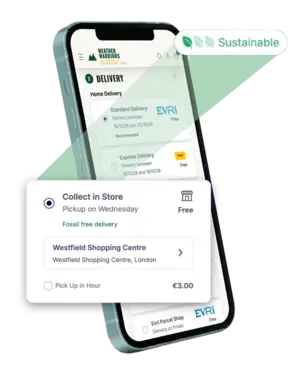
Retailers are starting to offer checkout flows that frame delivery choices in clear, value-based terms. For example:
- Default to eco-friendly choices, while still allowing faster options if customers prefer
- Offer clear, easy-to-choose sustainable delivery options, such as combining deliveries, using eco-friendly transport, offering slower low-emission options, or providing PUDO (pick-up and drop-off) solutions.
- Label low-emission methods with visual cues such as sustainability certifications, green icons, CO₂ savings, or bicycle delivery markers.
These approaches simplify the decision-making process without removing choice, allowing customers to act on their intentions.
When Pikkuvihreä moved to nShift Checkout on WooCommerce, its checkout matched the right transport to every product automatically, from an envelope to a pallet, and processed orders 10x faster. See sustainability by design in action.
Is your checkout helping or hindering your sustainability goals?
If your low-emission delivery option is buried in a long list or framed as a delay, you may be unintentionally discouraging sustainable choices. With simple design changes, sustainability can be an attractive and effortless option.
Turn sustainability into the easy choice
With nShift Checkout, sustainability isn’t an afterthought. It’s embedded in the shopping journey. By applying behavioral insight and smart configuration, you empower your customers to make greener choices without extra clicks or confusion.
Learn more about how nShift Checkout can elevate your delivery experience. Ready to take the next step? Request a demo and see how we help you drive change at the moment it matters most.
It’s all in the delivery
From checkout to emissions, nShift gives you full control of delivery management at every step — with branded experiences, smarter shipping, and access to 1,000+ carriers.
Explore the nShift platform
References:

Author
Fredrik Lindhagen
Product manager
Fredrik has 15+ years of experience within the shipping industry. At nShift his responsibility is in developing our Transport Management Solution as well as evolving the Emissions Dashboard allowing customers to keep track of and reduce their CO2 emissions.