
nShift analysed 115,000+ end-consumer delivery ratings captured in a Nordic tracking-feedback dataset.
In ecommerce, the last mile is the only part of the customer journey that literally shows up at someone’s door. Customers treat it that way: when delivery feels smooth, the praise is short and warm; when it breaks, the language turns blunt and final.
To understand what drives post-purchase satisfaction, nShift analyzed more than 115,000 customer ratings submitted in December 2025. The dataset includes post-delivery feedback with separate scores for the retailer and the carrier, offering a rare, unfiltered look into what customers reward and what they penalize in the final mile.
This matters commercially because post-purchase trust isn’t “nice-to-have.” When certainty drops, two costs tend to rise: “Where is my order?” contacts and hesitation to buy again.
What nShift analysed
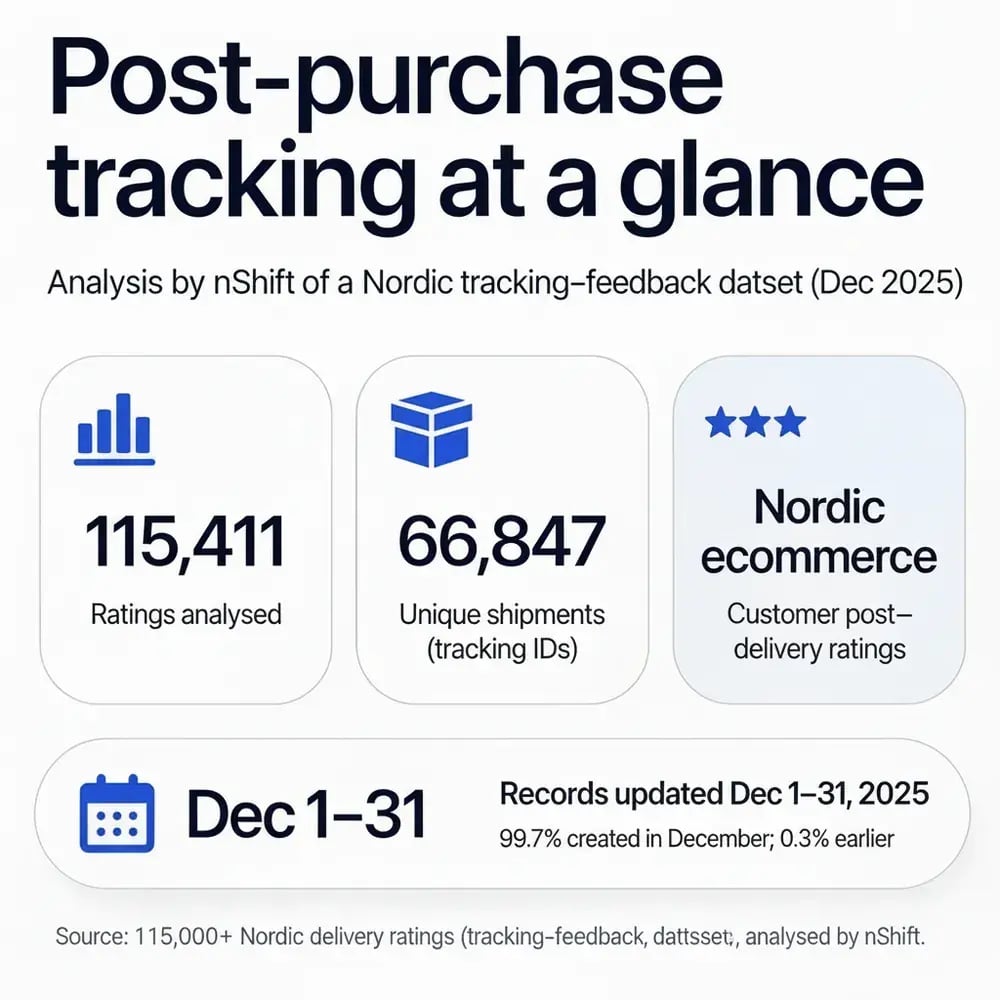
Source and structure
Feedback from Nordic tracking data. Each shipment can produce two ratings: one for CARRIER and one for RETAILER.
Rating scale
Ratings are recorded only as 1, 3, or 5 (a 3-point sentiment scale rather than a 1–5 ladder).
Delivery mode proxy
A “pickup point” field is populated for out-of-home deliveries; about 68% of entries have a pickup point (suggesting pickup is the dominant mode in the sample).
Free-text comments
Only ~12% of entries include a written comment (“Description”), which means quantitative patterns are more representative than text themes (text still helps explain why a rating happened).
Important to consider: because the extract includes entries updated in Dec 2025, you should treat this as a high-signal peak-season lens, not a “typical month” baseline.
Six signals from 115k ratings, and what to do with them
These are customer perceptions captured in a peak-season snapshot, using a simple positive/neutral/negative scale (1/3/5). Results are shaped by shipment mix, geography, and service type, so we treat them as directional signals, not a league table.
1) A strong baseline, and a meaningful “neutral wedge” to win
Across the dataset, roughly 85–88% of ratings are positive (5★), ~9–10% neutral (3★), and ~3–5% negative (1★).
That’s an impressive baseline for peak season. The opportunity is the neutral middle: at scale, moving even a few points from “fine” to “great” can affect repeat purchase and support load. After all, a small percentage can mean thousands of customers.
2) Customers separate the retailer and delivery experience, and the last mile carries more volatility
Carrier-tagged feedback shows ~85% 5★ / ~5% 1★, versus retailer-tagged feedback at ~88% 5★ / ~2.4% 1★.
This is less “fault” and more visibility: the delivery handover is the final, tangible moment, so any friction is felt most sharply there. That’s also why delivery-partner trust shows up as a conversion variable in broader research.
85–88% satisfaction looks strong. But at scale, the remaining 12–15% of ‘not delighted’ deliveries is where most of the commercial leakage sits, through repeat purchase loss, support cost, and concessions. For SMEs this adds up to hundreds of thousands per year; for larger ecommerce businesses, it quickly reaches the millions.
3) Pickup-point deliveries dominate, and rate slightly lower than home delivery
In this sample, pickup-point deliveries are common (again: ~68% show a pickup point). They also score slightly lower on top ratings: about 86% 5★ for pickup-point vs 88% 5★ for home delivery.
The gap is small, but it points to a real mechanism: out-of-home delivery can be great when it’s predictable and convenient, and frustrating when it becomes a surprise “extra trip,” a wrong pickup location, or a missing notification.
4) Performance varies by carrier network, enough to matter at volume
In this December snapshot, five-star rates range roughly from ~78% to ~93% across carriers present in the data.
Most sit in a strong mid-band, and differences likely reflect service mix, footprint, and peak constraints as much as “quality.” Practically: retailers can route by rules, and carriers + retailers can use the largest improvement opportunities as a shared improvement agenda (exceptions, notifications, pickup accuracy).
5) Peak season changes tolerance, not just throughput
Average daily satisfaction dips slightly from about ~4.67/5 early December to ~4.58/5 by Dec 27, with a visible late-December sensitivity spike.
This matches the broader pattern that on-time within the promised window matters more than “fastest possible.”
So peak planning is also promise management: tighter ETA logic, earlier exception alerts, and clearer “what happens next.”
When trust drops, two things usually rise: ‘Where is my order?’ contacts and hesitation to buy again, the operational cost and the revenue cost of uncertainty.
6) The language is short, because customers are scoring certainty
Positive comments cluster around “fast”, “smooth”, “good”, “perfect” and “thanks”.
Negative comments cluster around “delayed”, “no notification”, “damaged”, “wrong pickup” and “failed attempts”.
The common thread isn’t speed obsession; it’s reliability plus clarity.
In the Nordics, precision beats speed
Leaders sometimes talk about post-purchase as a service layer. Customers experience it as certainty (or lack of it). When updates are unclear, the product may still be perfect, but the experience feels careless.
Nordic expectations are now built around certainty, not just speed. In PostNord’s E-commerce in the Nordics 2025 (Autumn) interview, nShift’s Anna Norstedt, Associate Product Manager, nShift Checkout describes ETA visibility and delivery flexibility as baseline expectations: shoppers want precise, data-driven delivery times early in checkout (not vague “1–3 days”), with consistent wording across every delivery option. And crucially, the work doesn’t stop at checkout: she flags the post-purchase experience as a reassurance job, noting that tracking emails and tracking pages are among the most frequently viewed customer communications, a high-leverage moment to reduce anxiety and re-engage customers after purchase.
That maps cleanly onto what the tracking data comments punish: the frustration isn’t only the delay; it’s being left guessing.
Implications for retailers and carriers. How to turn tracking into trust
Principles and questions, not rigid rules.
For ecommerce and digital leaders
-
Co-own the communication layer: carriers provide the operational truth; retailers provide the customer promise. Carriers already generate the most accurate tracking events. Retailers can add value by translating those events into consistent, brand-level expectation management (tone, timing, and clear “what happens next”), especially when exceptions occur.
-
Segment carrier strategy by what customers actually penalise.
If your negative feedback clusters around pickup-point surprises, failed attempts, or “no notification,” consider routing rules that prioritise carriers/services with stronger performance on those failure modes in high-stakes cohorts (gifts, VIPs, regulated goods, rural addresses). Carrier spreads in the dataset suggest this is not theoretical. -
Design pickup as a product, not a fallback.
Given pickup-point prevalence in the data and its slightly lower top-rating rate, consider: clearer pickup selection, better pickup-point convenience logic, and proactive “ready for pickup” confirmation, especially during peak. -
Plan for peak as an expectation problem, not only a capacity problem.
The late-December dip and the post-Christmas negative spike suggest that when timing matters, tolerance collapses. Consider making promise windows more conservative, pushing proactive delay alerts earlier, and offering self-serve re-routing options when networks tighten.
For logistics and carrier leaders
-
One of the most preventable trust-breakers is when delivery events don’t translate into timely, customer-facing updates. The dataset’s negative themes repeatedly include missing notifications and poor tracking updates. Consider treating proactive exception messaging as a core service KPI.
-
Pickup-point accuracy is a trust lever.
When a delivery ends up at an unexpected pickup point (or the customer believes a home attempt didn’t happen), it’s experienced as unfair or confusing. The shared fix is clearer intent-setting at checkout, plus clearer exception messaging in-flight. -
Damage is low-frequency, high-penalty.
Because damage is low-frequency but high-penalty 1★. It's worth joint root-cause work across packaging standards, handling hot spots, and exception workflows (photos, claims, fast resolution).
Turn tracking into trust
The Nordic tracking data, 115,000+ post-delivery ratings submitted in December 2025, split by retailer and carrier, points to a consistent mechanism: customers reward reliability and clarity, and penalise uncertainty.
The interesting part isn’t that most deliveries score highly. It’s that when satisfaction drops, the reasons are repeatable: missed expectations, pickup friction, and exceptions where customers don’t feel guided through what happens next. That’s good news for operations teams - repeatable failure modes can be reduced.
Because the dataset separates retailer and carrier scores, it also gives a practical lens for improvement conversations: not “who’s at fault,” but which moments create the steepest trust drop, and what each party can do to remove them from the journey.
Post-purchase is a performance layer. When retailers, carriers and platforms work from the same signals, you can remove the small set of failure modes that repeatedly turn ‘delivered’ into ‘disappointed’, and protect repeat purchase.
Johan Hellman, VP Product Management