
 Peak season is make-or-break for eCommerce. Black Friday, Cyber Weekend, and Christmas put retail operations under exceptional strain. Customers expect reliable, flexible, and fast delivery; brands who get it right can turn logistics into a competitive advantage.
This blog series is adapted from nShift’s Fail-proof peak season report, designed to help retail and eCommerce leaders move from reactive problem-solving to disciplined planning and performance. Each article tackles one dimension of peak readiness, with practical insights you can put to work right away.
The new market reality:
Dynamics in Europe, the UK, and the Nordics
Cross-border is now a major share of European online sales, 36% in 2024 (≈€275.6 bn), so international demand is core to Q4, not fringe. In 2025, 59% of global online shoppers buy from abroad, and 35% do so monthly, raising the bar for trust, delivery, and returns. At that scale, pre-arrival customs data (ICS2) and pre-paid VAT via IOSS/OSS become practical necessities to avoid peak-season holds, surcharges, and poor CX; note that IOSS applies to consignments ≤ €150, while ICS2 requires Entry Summary Declarations before arrival.[1] [2] [3]
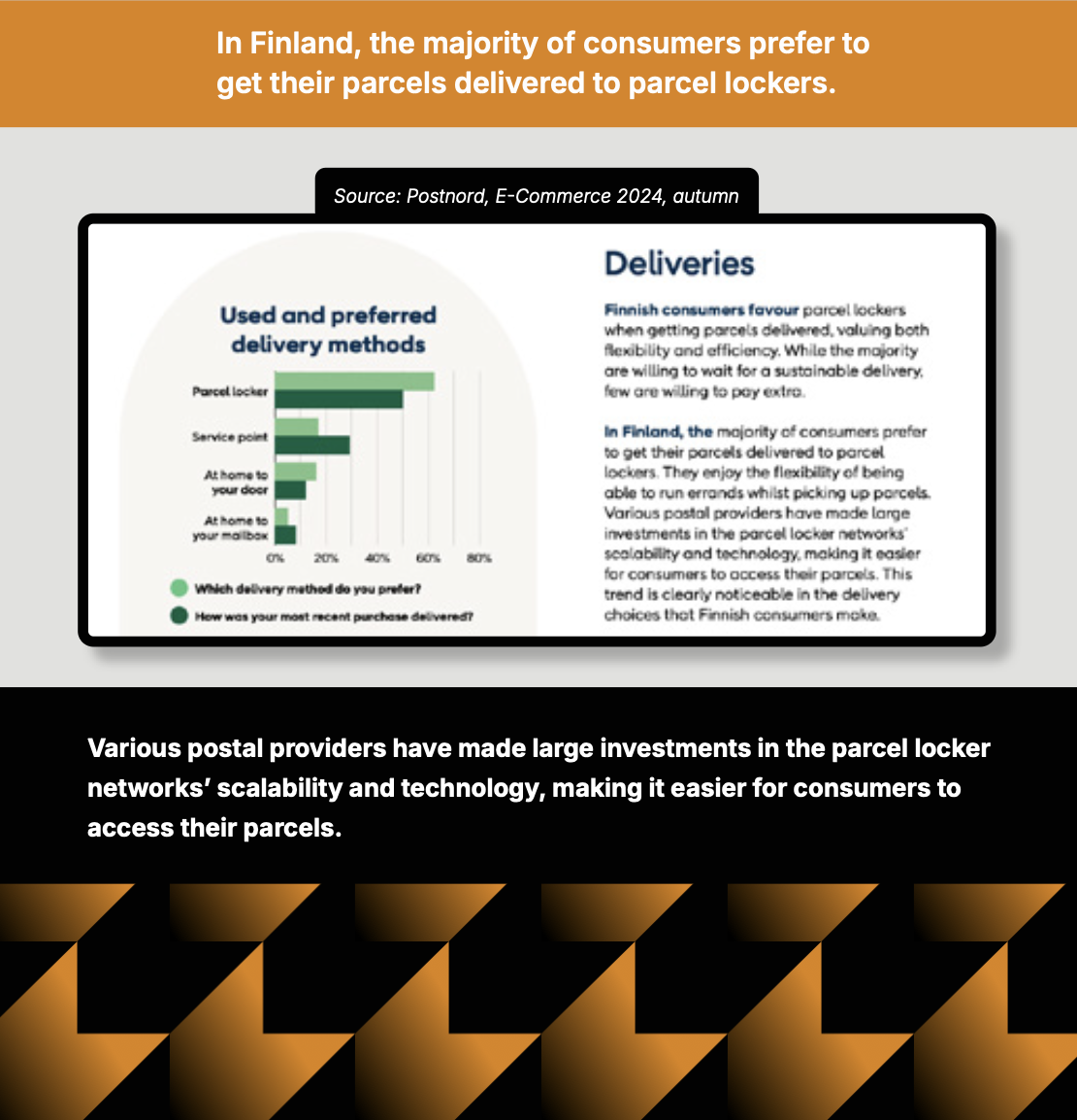 Q4, including Black Friday and the Christmas period, drives a disproportionate share of annual volume as shoppers anticipate promotions and gifting. Nordic markets lead in OOH (lockers/PUDO) adoption and continue to innovate on convenient delivery; the UK and wider European hubs are expanding OOH infrastructure as well.[4]
The pandemic-era surge has stabilised, but Europe’s digital baseline remains high: around 77% of EU internet users purchased online in 2024, with near-saturation in markets like Ireland and the Netherlands and faster growth in parts of Southern and Eastern Europe.[5]
Finland now reports parcel lockers as the most common delivery method, illustrating the region’s OOH leadership.[6]
Shifting consumer behavior:
The demand for flawless fulfillment
Consumers show increasingly sophisticated expectations in peak periods; trusting retailers that offer transparent, reliable delivery promises; flexible, convenient delivery and returns options, and clear pricing without surprises. Mobile shopping and digital wallets continue to gain ground, reflecting a mobile-first and frictionless mindset. The rise of livestream commerce adds a new dimension of engagement and immediacy, influencing buying decisions, especially among younger demographics.
Cross-border now accounts for over a third of Europe’s online sales, 36% in 2024 (≈ €275.6 bn), so international demand is core to Q4, not fringe. In 2025, shopper behavior reinforces the trend: 59% of global online shoppers buy from abroad, and 35% do so monthly. At that scale, pre-arrival customs data (ICS2) and pre-paid VAT via IOSS/OSS are practical necessities to avoid peak-season holds, surcharges, and poor CX.[7] [8] [9] [10]
The core challenges:
Identifying the five points of peak failure
Despite infrastructure improvements, peak periods reveal persistent pain points for retailers. Each challenge, if not addressed proactively, can become a major operational failure.
- Delivery promise accuracy: Vague or unmet delivery expectations are a leading cause of high cart abandonment during Q4 surges. Shoppers are less tolerant of uncertainty and expect real-time, precise information.
- Last-mile failure: Failed first delivery attempts waste resources and erode customer trust. Out-of-home (OOH) pickup adoption directly mitigates this, but requires expanded locker and shop networks.[11]
- Returns volumes: Returns spike dramatically, especially in apparel, where online return rates can be up to three times higher than in-store. Efficient handling is vital to retain margin and customer loyalty.[12]
- Cost pressure & packaging compliance. The last mile is where costs pile up: on average, it absorbs about 41% of total supply-chain spend. Pressure has intensified, too: through 2024, 84% of EU/UK e-commerce businesses saw last-mile costs rise, and 39% reported increases of >10%. New rules raise the bar as well: Regulation (EU) 2025/40 (PPWR) introduces a 50% empty-space cap for grouped/transport/e-commerce packaging from 2030. In practice, packaging right-sizing and smarter carrier/rate selection aren’t optional—they’re immediate levers to keep Q4 orders profitable.[13] [14] [15]
- Cross-border complexity: Customs and VAT compliance issues frequently cause shipment delays and customer dissatisfaction, particularly for trade between the UK and the EU.
***
Read the next article in this series: The foundational playbook for Black Friday success
Or get the full report now to access every strategy in one place:
Fail-proof peak season: Practical delivery management insights to navigate complexity & risk
***
Peak season doesn’t reward those who just “hold it together.” It rewards those who build precise promises, resilient operations, and customer trust. At nShift, we help over 22,000 retailers and brands scale fast, stay resilient, and deliver exceptional experiences all year round. Book a demo to see how we can help you turn delivery into your biggest advantage this peak season.
Win Black Friday & beyond
Browse expert insights, stats, and resources curated to help you win peak season.
Get the insights
[1] https://ecommercenews.eu/european-cross-border-ecommerce-worth-275-6-billion-euros/
[2] https://www.cbcommerce.eu/blog/2025/04/12/top-500-b2c-cross-border-retail-europe-an-annual-ranking-of-the-top-500-european-cross-border-online-shops/?srsltid=AfmBOoraZjZiCtnpoEeTRBYYJ-UiUYfVxY8QbUu-VFKad2ptwKl2_AGJ&utm
[3] https://www.dhl.com/global-en/microsites/ec/ecommerce-insights/insights/e-commerce-logistics/cross-border-trends.html
[4] https://dhl-freight-connections.com/en/trends/e-commerce-trends-report-2025/
[5] https://ec.europa.eu/eurostat/statistics-explained/index.php?title=E-commerce_statistics_for_individuals
[6] https://dhl-freight-connections.com/en/trends/e-commerce-trends-report-2025/
[7] https://www.cbcommerce.eu/blog/2025/04/12/top-500-b2c-cross-border-retail-europe-an-annual-ranking-of-the-top-500-european-cross-border-online-shops/
[8] https://www.dhl.com/global-en/microsites/ec/ecommerce-insights/insights/e-commerce-logistics/cross-border-trends.html
[9] https://taxation-customs.ec.europa.eu/news/eu-import-control-system-2-ics2-extends-rail-and-road-transportation-april-2025-2025-02-03_en
[10] https://taxation-customs.ec.europa.eu/news/continued-growth-revenue-and-registrations-confirms-success-reformed-eu-vat-rules-e-commerce-2025-07-23_en
[11] https://www.dpd.com/wp-content/uploads/sites/218/2024/02/Geopost_E-shopper-barometer-2023_European-Report_VDEF.pdf
[12] https://www.eea.europa.eu/en/analysis/publications/the-destruction-of-returned-and-unsold-textiles-in-europes-circular-economy
[13] https://www.capgemini.com/wp-content/uploads/2019/01/Report-Digital-%E2%80%93-Last-Mile-Delivery-Challenge1.pdf
[14] https://www.dssmith.com/contentassets/b3820bef3f674751a3a3f9ae9ddc5772/ds-smith_ecomm_last-mile_report2025.pdf Direct Download