
Last week, I joined Growth Summit 2025, part of the eCommerce Expo in London. It was a full day of roundtables, data insights, and discussions with retailers and technology providers. Unlike many large events, this one was deliberately small and interactive - no endless slideshows or sales pitches, but honest conversations around a table.
For me, the main purpose was to talk to people and bring back learnings that can help shape how we at nShift build and create value for our customers through our products.
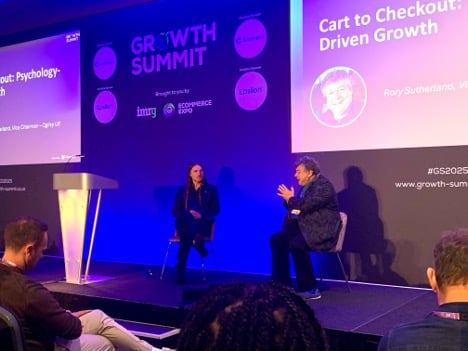
The event kicked off with a lively intro from the excellent Rory Sutherland, Vice Chairman, Ogilvy who as usual, was sharing ideas that question norms:
Finance vs. creativity
When every new initiative must look "predictably successful" in Excel, businesses end up doing slightly cheaper versions of what they’ve always done instead of trying anything genuinely new.
Rent-seeking monopolies
Too often, brands pour budgets into advertising just to "pay rent" to monopolies. The real opportunity lies in finding ways to create value and acquire customers without being locked into these platforms.
Defining distinct value
When companies measure success against the same narrow benchmarks, they become indistinguishable. Real differentiation comes when a brand defines its own unique measure of value - just as individuals do, whether that’s wealth, pleasure, or quality of life.
Efficiency vs. opportunity
New technology can be used to cut costs or to create entirely new forms of value. The finance mindset tends to push for efficiency, but overemphasis on cost-cutting risks killing creativity and growth.
Options becoming obligations
Technology often starts as a liberating option and ends up as a burdensome obligation. Email felt revolutionary at first But now it’s an endless inbox to manage. Parking apps were convenient - until they became mandatory, excluding people and creating new problems (like getting a signal in a underground car park)
Escaping "metrical capture"
Benchmarking against competitors’ metrics drives sameness. Distinctive brands resist this trap by defining success differently, carving out unique space in the market.
The explore/exploit trade-off
Like algorithms, businesses must balance exploiting what already works with exploring new ideas. Finance often demands too much certainty, starving exploration. But real growth requires risk-taking and experimentation.
Roundtable discussions
The roundtable discussions were a highlight, and especially invaluable for me. Rather than a string of presentations, they created space for open conversations with people tackling the same challenges we see every day - cart abandonment, costly returns, overloaded call centers, and more.
It’s easy to get stuck in your own perspective when you work on a platform day to day. Spending a day in those discussions gave me a chance to test assumptions, hear frustrations directly from retailers, and learn where their priorities are shifting.
A few themes that came up repeatedly across the sessions and conversations:
Checkout still decides conversions
We talked a lot about checkout experience. Everyone has seen how even small friction points - too many fields, unclear error messages, lack of trust signals - can lead to abandoned baskets. Retailers who invested in streamlining checkout, offering flexible payment and delivery options, and making guest checkout seamless were seeing strong results.
Retention is the new growth lever
A big shift I noticed was the focus on retention and loyalty. Acquisition costs are high, and most retailers agreed that keeping customers is far more cost-effective than constantly finding new ones. Whether through reward schemes, better post-purchase communication, or reactivation campaigns, retention came up as the area with the most untapped opportunity.
The delivery experience plays out in reviews
One point that came up more than once was how delivery can make or break customer perception. Even when the online store experience is smooth, delays or poor communication at the delivery stage often show up directly in reviews. Several retailers said they feel this pain acutely - you can do everything right, but if the carrier doesn’t deliver on time, it’s your brand that takes the hit.
Stories beat slides
The most useful insights didn’t come from formal sessions, but from hearing what others had tried. Successes, failures, and honest reflections were worth far more than theory.
For example, Waterstones had tried personalized recommendations at checkout. However, books are very popular gift items, so when buying books as gifts, the algorithm gets a misleading signal as to the buyers own preferences and interests going forward. Instead, they make sensible recommendations based on popularity and trends.
The data story
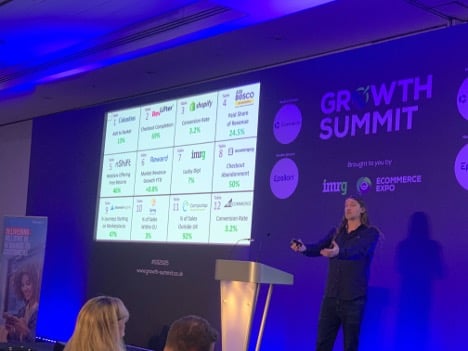
Because the event is run with IMRG, you get treated to a wealth of data and benchmarking. There was more shared than you could possibly digest in the time but a few points really stuck with me:
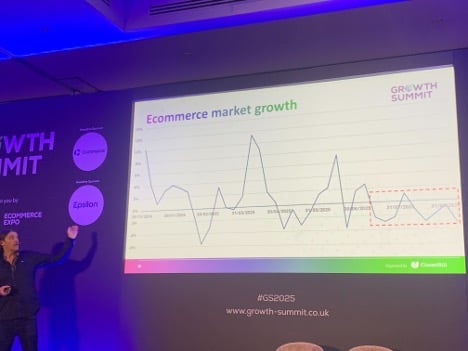
- Ecommerce market growth is bumpy. Looking at the trend lines, you see just how volatile growth has been over the past year - sharp peaks around promotions and equally sharp drops afterwards. It reinforced the point that growth isn’t “steady” anymore; retailers need to plan for swings and be ready to adapt fast and the last three months have been challenging.
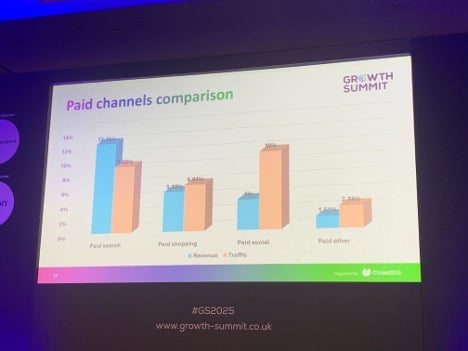
- Paid channels aren’t equal. Paid search continues to deliver the most revenue relative to traffic, but paid social is still skewed the other way - driving traffic but not always converting. This sparked a good discussion at our table about the reasons – perhaps because social is impromptu, a lucky scroll, whereas search is deliberate.
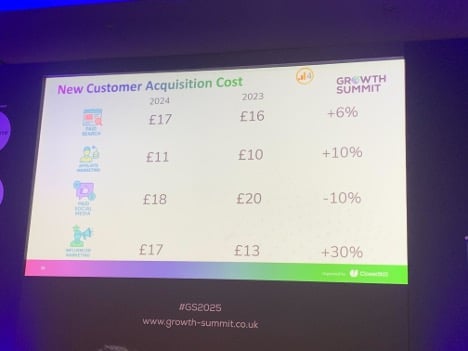
- Customer acquisition costs are climbing. The numbers on new customer acquisition costs showed steady increases across most channels, with influencer marketing jumping the most (+30% year-on-year). For retailers, that underlines why retention and loyalty are becoming so central - the price of “buying” new customers keeps rising and you need to make sure your cart converts.
What this means for nShift
One of the clearest messages from Growth Summit was that delivery isn’t just the end of the journey - it’s the moment when a brand promise is either kept or broken. Retailers can invest heavily in paid channels, refine their checkout, and perfect their acquisition strategies, but if the delivery experience disappoints, the fallout is immediate - abandoned carts, negative reviews, and damage to customer trust.
That’s exactly where we come in. Our role is to help retailers:
- Make checkout and delivery options seamless, so customers feel in control right from the start.
- Keep communication clear and proactive, so expectations are managed and there are no unpleasant surprises.
- Support smooth returns, because a well-handled recovery can turn a potential detractor into a loyal customer.
The conversations at Growth Summit confirmed that delivery has moved to the center of the growth equation. It’s no longer just operational plumbing in the background - it’s a direct driver of customer perception, loyalty, and lifetime value.

Author
Thomas Bailey
Product Innovation Lead, nShift
Thomas plays a key role in shaping how new features and platform improvements deliver real value to customers. With a background spanning product, tech, and go-to-market strategy, he brings a pragmatic view of what innovation looks like in practice and how to make delivery experiences work harder for your business.