
Cross-border shopping is becoming normal behaviour for European consumers. The expectation is also clear: international orders should feel local. Pricing should be predictable. Delivery should be trackable. Returns should be straightforward.
The problem is that the external environment is moving the other way: trade friction is rising, routes are more volatile, and customs changes are landing directly in the customer experience.
In 2026, the border becomes an experience design problem.
If you want the full picture across the 2026 retail delivery trends, capabilities, constraints, and blueprint, explore our new report: The new retail reality: Trust, proof, and the delivery experience in the AI era.
Quick links
- Why cross-border feels harder in 2026
- Route volatility is now a day-to-day factor
- The July 2026 shift for low-value parcels into the EU
- DDP vs DDU: why landed-cost clarity is now conversion-critical
- What retailers should do now
- The takeaway
- Get the full picture
- Frequently asked questions
Why cross-border feels harder in 2026
The customer wants a simple outcome: one price, one promise, one tracking story, one clear returns path.
Cross-border logistics adds moving parts that customers should not have to interpret. Multiple carriers. Multiple handovers. Multiple policy environments. More exceptions. More opportunities for a promise to drift.
That is why the winners in 2026 are building what you could call “invisible logistics.” The complexity still exists, but it is handled before it reaches the customer.
For the wider delivery experience blueprint, explore /retail-ecommerce-delivery-strategy-2026.

Route volatility is now a day-to-day factor
The World Bank reports that more than 2,500 trade restrictions were imposed worldwide in the first ten months of 2025. That is not background noise. It is the new operating condition.
The WTO also reports that accumulated G20 import-related measures cover nearly 17% of world imports. When trade measures accumulate at that scale, cross-border flows become more sensitive to disruption.
UN Trade and Development (UNCTAD) describes how Red Sea disruptions and rerouting extended voyage times, reduced effective capacity, and increased operating costs. Even if your business is not shipping containers, the ripple effects travel through networks. Capacity tightens. Service levels shift. Exceptions increase.
The practical implication for retail teams is simple. Your promise logic needs to adapt without chaos. Your customer story needs to stay coherent even when routes and handovers change.
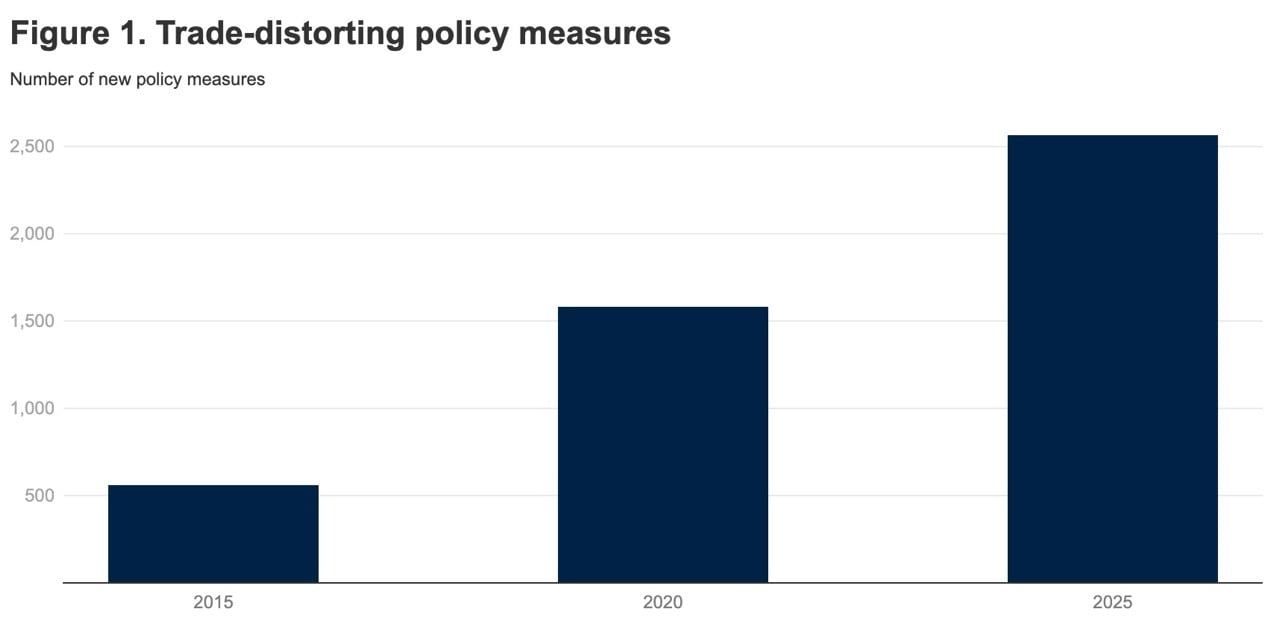
Source: worldbank.org
The July 2026 shift for low-value parcels into the EU
A major change arrives on 1 July 2026 for goods entering the EU in small consignments under €150.
The EU Council confirms a fixed €3 customs duty will apply, covering 93% of all ecommerce flows into the EU. This matters for conversion because customers respond badly to late surprises. It also matters for operations because it increases the cost of weak customs data and unclear responsibility.
For the operational side, our guide to the EU customs changes in 2026 walks through the customs documentation, HS codes, and DDP choices that keep low-value parcels clearing cleanly.
In practice, this pushes retailers toward two design requirements:
- landed-cost clarity early enough to prevent doorstep shock
- customs data that is accurate and complete before the parcel moves
DDP vs DDU: why landed-cost clarity is now conversion-critical
Most customers abandon cross-border baskets not because they dislike international delivery, but because they dislike uncertainty.
This is where DDP vs DDU becomes a commercial decision, not a shipping detail.
- DDP (Delivered Duty Paid) means duties and taxes are handled upfront, with clearer total cost at checkout.
- DDU (Delivered Duty Unpaid) means duties and taxes may be collected later, often at delivery.
In 2026, the experience baseline is moving toward predictable total cost. When customers can see the full cost early, the purchase feels safer. When costs appear late, the experience feels like a trap.
Even when you do not offer full DDP, you still need cost clarity. The customer should know what will be charged, when, and by whom.
What retailers should do now
Cross-border success in 2026 comes from tightening the few failure points that create uncertainty. Here are four practical priorities:
1) Make landed cost clear at checkout
Customers should understand total cost early. This includes duties, taxes, fees, and returns implications. If duty responsibility sits with the customer, make it explicit.
2) Keep promises editable by market
Volatility makes fixed promises fragile. Build the ability to adjust options, fees, and delivery windows by market without inconsistent updates across channels.
3) Make the tracking story coherent across handovers
Cross-border multiplies partners. That increases the risk of status mismatch and vague exception messages. The customer needs one clear narrative with the next step.
4) Treat returns as part of the cross-border offer
Cross-border conversion improves when returns feel local. Make eligibility, method, and timeline obvious, and keep proof of drop-off and refund progress visible.
If you want the broader blueprint for how delivery, tracking, and returns hold up at scale, explore /retail-ecommerce-delivery-strategy-2026.
The takeaway
Rather than simply reaching more customers, cross-border logistics in 2026 means delivering a domestic-standard experience under tougher external conditions.
Route volatility, customs change, and cost uncertainty are not going away. Retailers that win are the ones who make complexity invisible and outcomes predictable.
Get the full picture
 This article is part of our research on “The new retail reality: Trust, proof, and the delivery experience in the AI era”, which covers what’s changing in retail delivery, the shifts in customer expectations, and what to do to make your delivery strategy hold up at scale.
For the complete picture, download the full report: The new retail reality 2026.