In 2026, delivery and returns are part of the product, not just a back-office detail.
Recent studies show more than 8 in 10 shoppers will abandon a cart if their preferred delivery option is missing. Almost the same share walk away if they cannot use the returns method they trust. At the same time, out-of-home (OOH) networks have exploded across Europe, with hundreds of thousands of lockers and PUDO points now in operation and growing.
Put simply: customers have seen what good looks like. They expect to switch between home delivery, lockers, service points, timed slots, and greener options depending on the day. When that flexibility is missing, it shows up directly in conversion, cost-to-serve, and loyalty.
This article looks at delivery choice and customer-centric fulfillment as a core 2026 delivery trend: what is really changing, how it connects to the rest of the logistics trends in our report, and what different players in the chain can do now.
From “shipping method” to product feature
A few years ago, “delivery” meant a shipping line on the checkout page.
In 2026, several structural shifts are making delivery choice a product feature in its own right:
- Customer expectations have normalized upwards. Lockers and PUDO are no longer a novelty. In some European markets, around half of consumers choose OOH when it is offered, with even higher adoption in dense urban areas and among Gen Z and Millennials.
- OOH networks and greener methods are operationally attractive. Lockers and pick-up points reduce failed attempts, cut van miles per parcel, and help retailers and carriers make progress on emissions and congestion targets.
- Returns are part of the decision, not an afterthought. Shoppers increasingly scan returns options before they click “Buy”. If the returns path looks complex or inconvenient, they leave, even if outbound delivery is fast.
In this context, a static “one size fits all” delivery setup is no longer neutral. It is a strategic disadvantage.
The winners in 2026 treat delivery and returns menus as levers for:
- Revenue (conversion and repeat purchase)
- Margin (cost-to-serve by channel and geography)
- Sustainability (shift to OOH and greener services where it makes sense)
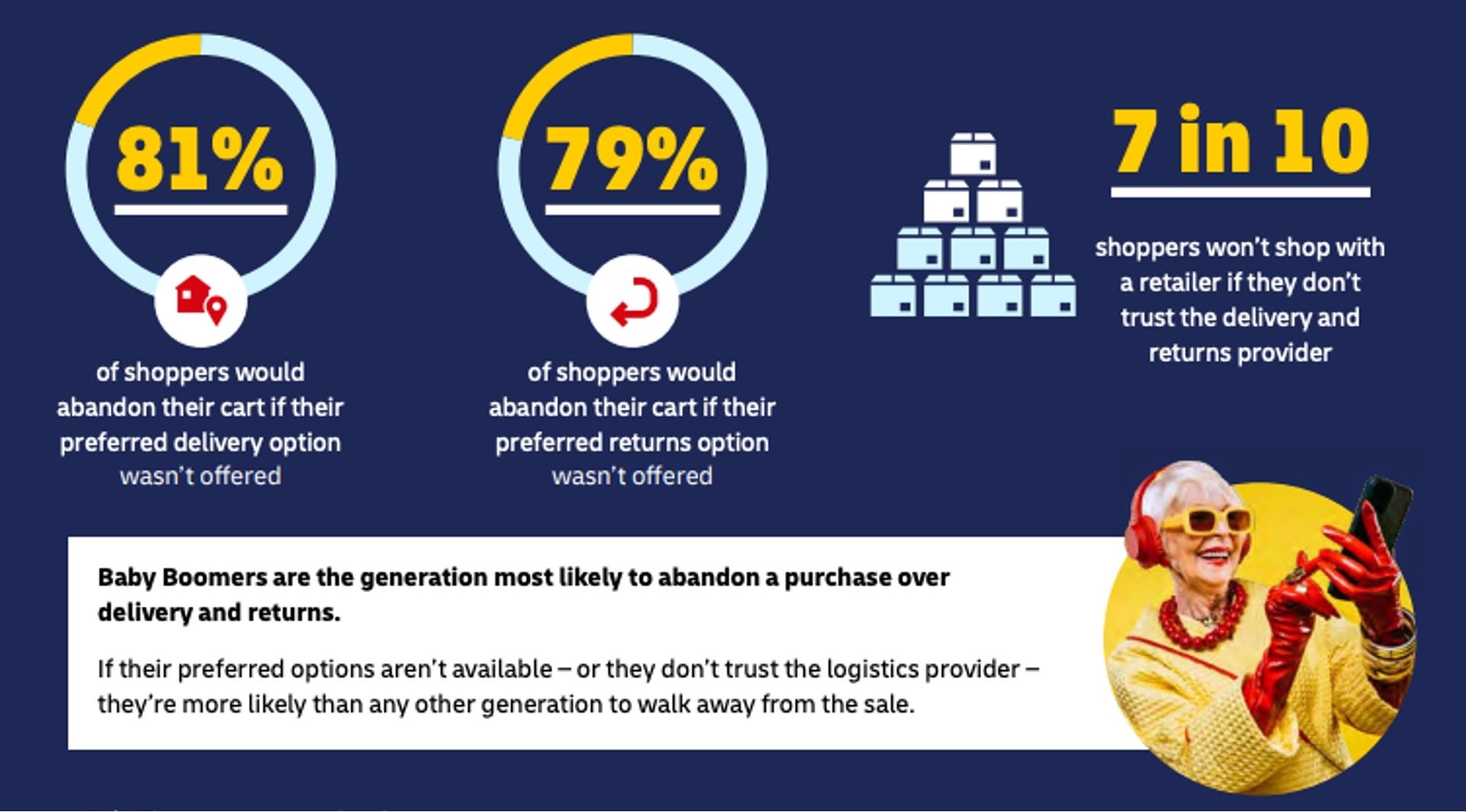
Source: DHL e-commerce trends
How delivery choice connects to the other 2026 logistics trends
Delivery choice lives downstream of several other 2026 delivery and logistics trends:
- AI and autonomous decision-making. AI-driven ETAs, promise accuracy, and service recommendations determine which options you can safely show at checkout without over-promising.
- Predictive analytics and digital twins. Forecasting and simulation help decide where to expand lockers, which postcodes to steer toward OOH, and how to design cut-off times without breaking the network.
- Platformization and API ecosystems. Rich delivery choice relies on multi-carrier connectivity and standard APIs for options, locations, and tracking across many services.
- Last-mile innovation & urban logistics. City policies on emissions, access, and curb space shape which options are feasible in each area – and which ones you should highlight to customers.
- Regulatory backbone & data. Laws that require multiple options or sustainable choices make delivery menus a compliance question as well as a CX one.
That is why delivery choice shows up in board-level discussions: it is where customer, cost, sustainability, and regulation collide on a single screen.
Retail and ecommerce: design delivery menus like assortments
2026 reality
For retail and ecommerce leaders, delivery and returns are now part of the commercial proposition.
The same way you manage product assortments, you need to manage delivery assortments by country, postcode, basket value, and category. Every option you show has a profile: cost, reliability, sustainability impact, and appeal to specific segments.
Moves to make now
- Treat delivery options as a managed portfolio.
Start by mapping the current menu: home, OOH, timed, express, economy, greener options, returns routes. For each, track:
- Adoption and conversion impact
- Cost-to-serve and failed-delivery rates
- Usage by segment, device, and market
Then deliberately prune and tune: remove options that add complexity without value; elevate options that blend high adoption with acceptable cost and sustainability profiles.
- Personalize by context, not vanity.
Use simple rules before advanced personalization:
- Urban postcodes → show OOH and lockers more prominently
- High-value baskets → offer tracked, more reliable options by default
- Segments that over-index on sustainability → surface greener options early
You do not need a full recommender system to move the needle; you need basic segmentation wired into your checkout platform.
- Make returns as simple as the outbound promise.
Ensure that:
- Returns options are visible before purchase, not hidden in FAQs
- Flows support OOH, in-store, and postal returns where each makes sense
- Status and refunds are trackable in the same place customers track orders
When returns feel safe and easy, customers are more willing to try new categories or higher basket values – even if they never actually return anything.
Where nShift fits
A delivery & experience platform like nShift makes this practical by:
- Exposing multi-carrier delivery options and OOH networks through one integration
- Letting you configure delivery rules and menus by market, segment, and basket
- Linking outbound and returns flows so customers see a consistent experience from checkout to return
Marketplaces and ecommerce platforms: orchestrate complexity without confusing buyers
2026 reality
Marketplaces and ecommerce platforms sit between many sellers and many carriers. Their job is to turn that complexity into a simple, trustworthy promise for buyers, while still giving sellers enough flexibility.
If the platform gets delivery and returns wrong, it feels chaotic: inconsistent options, surprise fees, and unclear responsibilities when something goes wrong.
Moves to make now
- Standardize how delivery is described, even if services differ.
Create a small set of normalized delivery “archetypes” (e.g., “Next-day home”, “Locker 24–48h”, “Economy home”, “Greener OOH”) and map carrier services into those archetypes.
Buyers see familiar patterns; sellers can still choose the underlying services.
- Give sellers powerful tools, keep buyers’ view simple.
In seller tools, expose:
- Richer configuration by market, carrier, lead time, and product type
- Guardrails on cut-offs and promises to prevent over-aggressive commitments
On the front end, show no more than 3–4 clear options with transparent timing, price, and sustainability cues.
- Make OOH and greener choices the normal, not the exception.
Bring lockers, PUDO, and greener services into:
- Default recommendation logic
- Onboarding templates for new sellers
- Marketplace-wide promotions where appropriate
This positions the platform as convenient and responsible by design.
Where nShift fits
Platforms that integrate with nShift can:
- Access 1,000+ carriers and extensive OOH networks through a single API
- Normalize service descriptions and tracking events across carriers
- Offer sellers configurable, yet governed, delivery menus without re-building integrations for each new carrier or market
Carriers and logistics service providers: make your services easy to choose and trust
2026 reality
Carriers and LSPs are no longer judged only on rates and transit times. Visibility, convenience, and compatibility with retailers’ delivery menus are now core selection criteria.
If it is hard to present your services cleanly at checkout or in returns flows, you are less likely to be promoted – even if your underlying performance is strong.
Moves to make now
- Design services from the checkout backward.
For each product (home, OOH, timed, express, greener):
- Define clear SLAs, ETAs, and conditions that retailers can safely display
- Ensure location data for lockers and PUDO is accurate, frequently updated, and easy to ingest via APIs
- Provide simple messaging templates for tracking and exceptions
Retailers will favor services they can describe confidently to customers.
- Make integration a commercial asset.
Expose:
- Well-documented APIs for booking, labels, tracking, and OOH location data
- Event streams with consistent status codes and timestamps
- Emissions data where available, especially for greener products
When tenders include questions about ease of integration, OOH coverage, and emissions transparency, you want those to be strengths, not caveats.
- Use data to prove which options deserve top billing.
Share:
- Comparative performance between home and OOH in specific cities
- Failed-attempt rates and emissions profiles
- Case studies where shifting volume to lockers or PUDO improves cost and reliability
This helps retailers justify promoting your services in their delivery menus.
Where nShift fits
Carriers plugged into nShift’s network:
- Become instantly available to thousands of merchants and platforms already using nShift’s delivery & experience tools
- Benefit from standardized events and options, making them easier to configure, test, and scale in customer checkouts and returns flows
Get the full picture
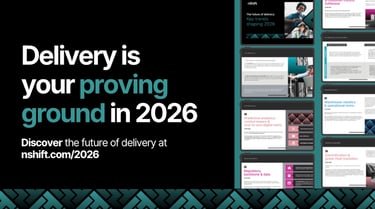 This article is part of our research on “The future of delivery: Key trends shaping 2026”, which covers ten interconnected trends across AI, platforms, regulation, resilience, and retail demand.
For the complete picture, with detailed data, references, and recommendations for each stakeholder group, download the full report: Future of delivery 2026.