Quick links
- Agentic commerce in brief
- Zero-click shopping: AI agents and agentic payments
- Universal Commerce Protocol (UCP)
- Agentic payments
- Why delivery becomes part of agent visibility
- What should retailers change for agentic commerce in 2026?
- The takeaway for 2026
- Get the full picture
- Frequently asked questions
Last updated: September 2026
In 2026, your most important customer might not even have a heartbeat. They’ll have a budget, a set of preferences, and a high-speed API.
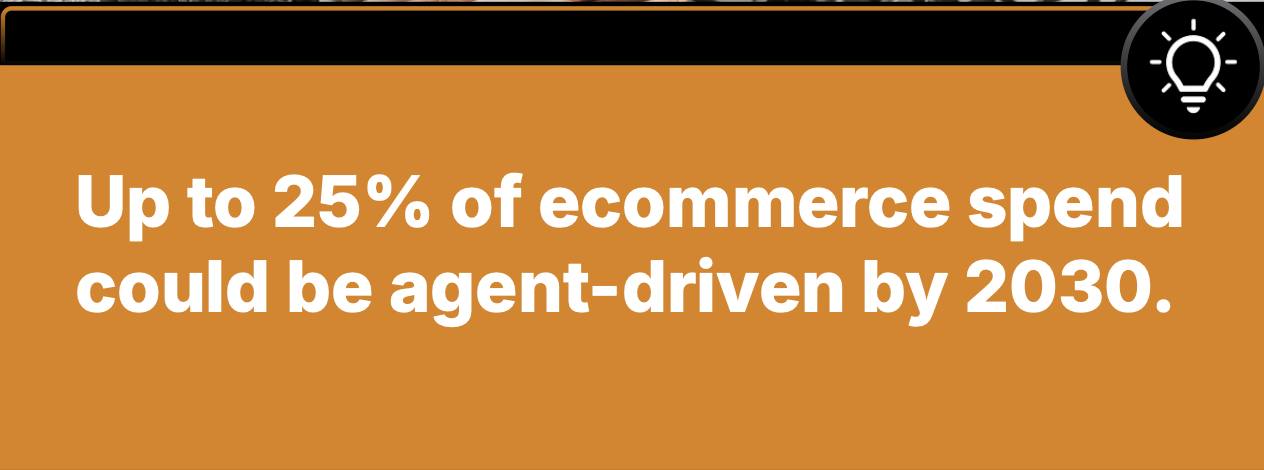
Agentic commerce is moving from recommendation to execution. In 2026, AI shopping agents will increasingly compare offers, choose what to buy, and complete purchases with lighter human involvement.
For retailers, this changes how you win: no longer only by being persuasive, but also by being selectable by systems that optimise for clarity, certainty, and ease of execution. That shift changes what “good ecommerce” looks like, especially for delivery and returns.
This article focuses on agentic commerce and what it means for selection. For the broader 2026 blueprint across delivery experience, explore our new report: The new retail reality: Trust, proof, and the delivery experience in the AI era.
Agentic commerce in brief: delegated shopping
Agentic commerce means delegated shopping. A customer sets intent and guardrails, then an AI agent handles discovery, comparison, and purchase on their behalf.
For the full definition and where the model is heading, read what agentic commerce is and where it is heading.
“Zero-click shopping” is the clearest expression of this shift. The customer is still in control, but the work shifts from browsing to delegation. The agent does the heavy lifting, then the customer approves or reviews.
This is already showing up in behaviour. Research cited in our 2026 report found that 58% of consumers have replaced traditional search with generative AI tools for product recommendations.
Zero-click shopping changes what “good ecommerce” looks like
Humans tolerate ambiguity. They can interpret delivery terms, skim returns policies, and make judgment calls under uncertainty.
AI shopping agents struggle with ambiguity because they need to compare and act quickly. If delivery windows, shipping costs, and returns terms are unclear or inconsistent, the agent can skip the offer without a human ever seeing it.
This is why “agent legibility” matters. Your offer needs to be comparable to machines, not only attractive to people.
Explore the delivery implications in the report: /retail-ecommerce-delivery-strategy-2026
Universal Commerce Protocol (UCP) is the standardisation layer
Agentic commerce needs a common language. If every merchant requires bespoke integrations, adoption slows.
That is the role standards like the Universal Commerce Protocol (UCP) are aiming to play. UCP is positioned as an open standard that allows AI agents to interact with commerce backends more consistently across the shopping journey.
Why it matters for SEO and discoverability: “being findable” increasingly overlaps with “being executable.” Structured product data and structured fulfillment terms become part of what determines selection.
Agentic payments are what make agents operational
An AI agent can only shop end-to-end if payments can support:
- verified consent
- clear spending limits
- traceability and auditability
- fraud controls suitable for non-human initiators
In our report, we highlight how quickly payment networks and major platforms are moving on agentic payment protocols. The key implication for retail teams is simple: the payments layer is evolving to support delegated buyers, which will accelerate real-world adoption.
Why delivery becomes part of agent visibility
In agentic commerce, delivery is no longer only post-purchase: it becomes part of the selection decision.
To choose well, an AI shopping agent needs delivery and returns information that is structured and comparable, including:
- total cost, including delivery fees
- delivery window quality and constraints
- cutoff times
- location-dependent options like lockers or parcel shops
- returns eligibility and timeframes
If this information is missing or inconsistent across channels, the agent is more likely to default to an offer that is easier to execute.
What should retailers change for agentic commerce in 2026?
For agentic commerce in 2026, retailers should change two things: make delivery and returns terms machine-readable, and treat promise accuracy as a selection signal. You do not need to redesign your entire stack to prepare for agentic commerce in 2026.
1) Make delivery and returns terms machine-readable

Start with the inputs an agent needs to decide and execute, then standardise them across channels:
- delivery options and fees
- delivery windows and cutoff times
- location constraints
- returns eligibility and timeframes
2) Treat promise accuracy as a selection signal
When agents compare offers, consistency matters. If your promises regularly drift, the system learns that your offer is higher risk. Tightening promise accuracy is both a conversion lever and a selection lever in an agent-mediated world.
For the broader blueprint, including capabilities and constraints beyond agentic commerce, explore the full report: /retail-ecommerce-delivery-strategy-2026
The takeaway for 2026
Agentic commerce will not replace human shopping overnight. It will show up first in repeatable purchases and controlled automation, then expand as standards and payment protocols mature.
The practical move now is to make your offer legible. The easier it is for systems to interpret your delivery promises and returns terms, the more often you will be considered.
Get the full picture
 This article is part of our research on “The new retail reality: Trust, proof, and the delivery experience in the AI era”, which covers what’s changing in retail delivery, the shifts in customer expectations, and what to do to make your delivery strategy hold up at scale.
For the complete picture, download the full report: The new retail reality 2026.