Delivery configuration changes are often small and commercially urgent, but they slow down because knowledge is fragmented and guardrails sit in specialist workflows. In-platform AI assistants like nShift Companion shorten the loop from “what we want to change” to “what we can safely deploy” by putting contextual guidance inside the platform where changes are made.
The real cost of slow delivery configuration
A carrier changes a cut-off time. A trading team wants to move the free-shipping threshold for a two-week campaign. A new market requires a different service mix.
None of these changes are technically complex. They become slow because delivery logic is configured through a mix of rules, exceptions, and operational safeguards, and the people who need the change are rarely the same people who know how to apply it safely.
The cost shows up as small problems distributed across the week: an option missing from checkout, an ETA that looks optimistic, a service shown to the wrong postcode band. With checkout abandonment sitting at roughly 70% globally, those minor mismatches are rarely minor in outcome.
Why the pressure is growing
Delivery operations are scaling into a less forgiving market. Here is some industry context:
US parcel volume reached 22.37 billion shipments in 2024, up 3.4% year-on-year, with revenue growth lagging volume. That dynamic pushes shippers toward efficiency and control, not just speed.
On performance, McKinsey notes that last-mile on-time percentages were 85-90% pre-pandemic, dropped to roughly 72% in May 2020, and have not fully recovered, partly because promised windows became tighter and product mixes more complex.
On expectations, DHL’s 2024 report highlights the gap between what shoppers want and what they will pay for: 61% of global shoppers want next-day delivery but do not want to pay extra. 41% say they will only buy from retailers offering free returns.
In practice, this creates a delivery-design problem that looks like a configuration problem. Operators need to shape delivery choice, cost, and reliability inside real constraints, and they need to change those settings as conditions change.
Where delivery rules get stuck
Two things tend to make delivery-rule changes slow.
First, delivery configuration is rarely a single switch. It is a system of conditions. Even when the requested change is straightforward (“make express available above a certain value” or “turn off a service for region Y”), applying it safely requires understanding knock-on effects across the configuration.
Second, the knowledge is buried. Teams end up searching through menus, documentation, or specialist notes when they simply need the right setting and the safest path to update it.
That gap between intent and governed change is where in-platform AI assistants can add the most value: compressing the time from decision-making to implementation.
How nShift Companion works inside Checkout
nShift Companion is an AI-powered assistant embedded in nShift Checkout, designed to help ecommerce teams understand delivery setup and suggest improvements through plain language.
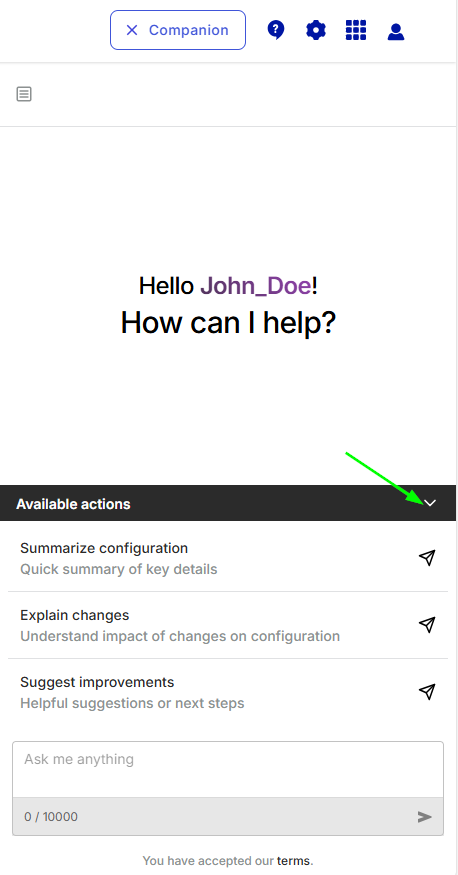
Today, Companion appears on the Configurations page when you create or edit a configuration. It offers three predefined actions plus a free-text question field:
- Summarize configuration creates a readable baseline of the current setup, useful before peak, a market launch, or a pricing experiment.
- Explain changes connects commercial intent (“why we are doing this”) to configuration outcomes (“what will change at checkout”), which matters during change review.
- Suggest improvements generates candidates for a controlled backlog, which teams can then validate against service constraints, capacity posture, and margin rules.
The free-text field handles questions such as clarifying rules and expressions, understanding how settings affect checkout, and getting best-practice guidance (nShift Help Center).
Companion works within business rules, operational safeguards, validation rules, and operational constraints rather than bypassing them. It is initially available in nShift Checkout, soon to be rolled into more nShift products.
Why in-platform guidance changes iteration speed
There are two productivity problems in delivery operations. Execution productivity covers how efficiently deliveries are completed: routes, scans, handoffs. Decision productivity covers how quickly a team can make and apply the right delivery trade-off without breaking the promise.
Route-optimization tools and driver apps tend to attack execution productivity. Configuration assistants target decision productivity. Both show up in KPIs, but through different pathways.
A useful reference: UPS has publicly described Dynamic ORION as providing re-optimized routes based on changing conditions and adding turn-by-turn directions, with initial results indicating an additional 2-4 miles saved per driver per day (UPS Investor Day, 2021). That example is about route execution, not checkout configuration, but it illustrates the mechanism: bring decision support into the workflow people already use, and you remove lag between “what should happen” and “what does happen”.
nShift Companion applies the same principle upstream, inside delivery configuration, by putting contextual guidance, configuration interpretation, and recommendations where changes are actually made.
A practical adoption path
Teams that want to use Companion without weakening governance can treat it as a layer for interpretation and review, not autopilot.
Before peak or a market launch: use Summarize configuration to create a shared baseline that commercial and operations stakeholders can both read. This reduces the gap between “what I think the configuration does” and “what it actually does.”
During change review: use Explain changes so the reasoning behind a configuration update stays visible. When multiple people touch the same setup, this keeps commercial intent connected to technical implementation.
For continuous improvement: use Suggest improvements to surface opportunities, then validate each candidate against service constraints and margin rules before promoting it to a live change. The assistant generates options; the team applies governance.
Why now
Customers are signaling that they want better delivery experiences, but not at any price: fast delivery without surcharge, free returns, and more flexible pickup and drop-off options.
Meanwhile, the system is getting more complex: higher parcel volumes, rising costs, and promised windows that are harder to meet.
In that setting, delivery rules are a form of operational policy. The organizations that can change policy safely, quickly, and repeatedly tend to outperform those that can only change it occasionally.
nShift Companion is designed to make that change cycle more conversational and more accessible inside nShift Checkout, while keeping controls intact.
Ready to see how Companion works inside your Checkout configuration? Explore nShift Companion