Summary
When a human shopper selects a delivery option, they weigh speed, cost, and convenience based on what they can see on screen. When an AI agent makes the same decision, it queries APIs, processes structured data, and applies a ruleset optimised for the consumer's stated preferences. The logic is consistent, instantaneous, and scale-free. Understanding what agents evaluate is the first step to building a delivery operation they will recommend.
Real-time delivery accuracy
Agents do not guess at delivery windows. They query your carrier APIs and expect machine-readable, accurate, real-time data. A vague "3–5 business days" response is a disqualifying signal. Agents need exact delivery date commitments tied to current carrier availability, origin warehouse location, and service-specific cut-off times. A delivery management platform that maintains live carrier data and exposes it through structured APIs is a prerequisite.
Carrier breadth
Agents optimize for each individual consumer's preferences, which vary significantly: same-day delivery in their city, a carbon-neutral option, a specific carrier they trust, or simply the lowest available cost. A retailer operating with two or three carrier connections will be filtered out of a large share of agent evaluations. Breadth, meaning access to carriers covering every delivery preference, is now a competitive necessity, not a premium feature.
Returns policy as a ranking signal
Returns ease is increasingly a binary filter in agent decision-making. McKinsey's research on agentic commerce identifies clear, automated, low-friction returns as a measurable signal of retailer reliability. An agent advising a consumer on a discretionary purchase will weight returns policy heavily, because a poor returns experience damages the consumer's trust in the agent as much as in the retailer.
Checkout API compatibility
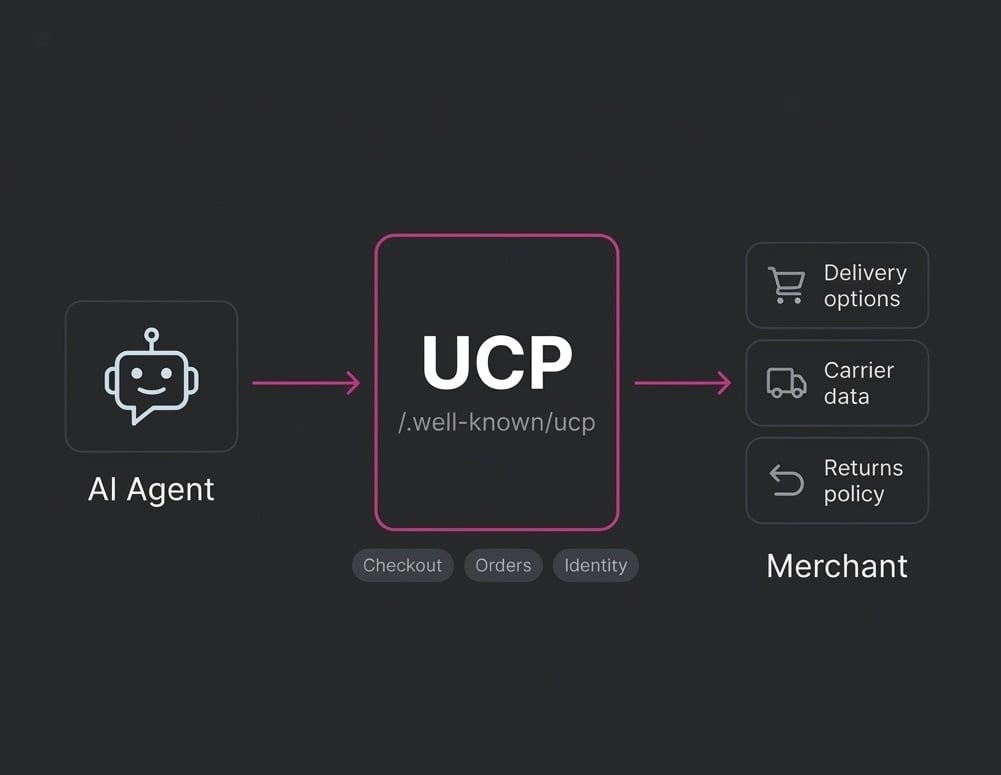
Agents interact with your checkout via APIs, not via your website's visual interface. OpenAI's agentic commerce checkout specification uses five REST endpoints (create session, update session, get state, complete purchase, and cancel) with all responses returning JSON including line items, totals, and structured delivery options. If your checkout does not expose this data in a machine-readable format, agents cannot complete purchases through your store, regardless of how strong your product offering is.
Post-purchase visibility
Agentic commerce does not stop at checkout. After purchase, agents also need reliable, machine-readable shipment status and delivery events, which makes post-purchase visibility a critical part of the agent-ready stack.
Sustainability signals
Eco-conscious delivery is increasingly weighted in agent decisions, particularly in European markets where consumer preferences and regulatory pressure point in the same direction. Agents can filter for lower-emission delivery options, and retailers who surface carbon data through structured APIs have a measurable competitive advantage. The nShift platform surfaces sustainability data alongside carrier options, enabling both agents and consumers to make informed choices.