
A shopping agent picks a delivery option on a buyer's behalf. A chatbot reads an order status and writes the reply. A model decides which carrier service shows up at checkout for a Rotterdam postcode at 4 p.m. Each one is a place where someone, at some point, will ask a fair question, such as: who decided this, what data did they use, and was the customer told?
AI disclosure means telling customers, regulators, and partners where AI is influencing a commercial interaction. AI governance is the internal control that makes those disclosures honest and consistent. For retailers, the practical work sits in three areas: customer-facing AI in checkout, support, and tracking; machine-readable signals for AI shopping agents; and the operational AI that decides delivery, returns, and emissions routing. The EU AI Act and existing UK ICO guidance already touch most of this. The retailers preparing earliest are treating it as a checkout and post-purchase design question.
Table of contents
The two forces that made AI disclosure a checkout problem
Two shifts happened at once, and the combination is what caught most retailers off guard.
The first is agentic commerce. AI shopping agents are now choosing carriers, picking pickup points, and accepting delivery promises on behalf of buyers. Our own analysis of the agentic commerce shift describes a market where the readable signals you send at checkout decide whether an agent transacts with you at all. If a delivery promise is vague, the agent moves on. If your post-purchase data is private or unstructured, the agent has nothing to trust. Disclosure becomes part of how you appear in this layer.
Gartner predicts that by 2027, 40% of customer service issues will be fully resolved by unofficial third-party AI tools, including consumer AI assistants that bypass first-party service entirely. Customers arriving at your checkout or post-purchase flow will increasingly have already attempted a resolution elsewhere. The clarity of your AI disclosures and the quality of your structured data determine whether your own systems meet that expectation.
The second is regulation catching up. The EU AI Act phased in obligations through 2025 and 2026, and most direct-to-consumer retailers in the Netherlands are now inside its scope by virtue of using AI-driven personalization, automated decisioning at checkout, or AI in customer service. The UK has chosen a sector-led approach so far, with the ICO publishing detailed guidance on automated decision-making and AI-driven customer interactions. Both jurisdictions converge on the same point. If AI is influencing a commercial outcome, the customer should be able to tell.
AI disclosure is no longer a compliance memo. It is a piece of how your storefront, your checkout, and your post-purchase flow are designed.
The pressure is also building from inside organisations. A Gartner survey of 321 customer service and support leaders found 91% reported executive pressure to implement AI in 2026, with more than 80% planning to expand human agent responsibilities in parallel.
Three questions your customers, regulators, and AI agents will ask
Every retailer using AI in the buying or post-purchase flow will face three questions. The readiness gap is less about whether you can answer them and more about whether the answer is consistent across your checkout, tracking, and returns experience.
Is AI involved in this interaction?
This is the visible part: achatbot, an AI-generated product description, an automated refund decision, a personalized delivery option ranked by a model. If a human would reasonably assume a person made the call, AI disclosure rules expect you to say otherwise.
The expectation is already mainstream. Salesforce research covering more than 16,000 consumers globally found that 72% say it is important to know when they are communicating with an AI agent.
72%
say it is important to know when they communicate with AI
Salesforce, 16,000+ consumers globally
74%
expect to be told they are interacting with AI before or at the start
Ada / NewtonX, 2,000 consumers across NA, Europe, APAC
57%
would stop using a company's AI service without a path to a human
Ada / NewtonX global AI customer service survey
What is the AI doing with my data?
This is the GDPR and AI Act overlap. The customer should be able to see, at a reasonable level of clarity, what data the system used and how it influenced the outcome. For retailers, this almost always touches order data, address data, delivery preferences, and returns history.
The third question is newer and less settled: can a non-human buyer get the same answer? When an AI shopping agent reads your checkout or your tracking page, the information it can extract becomes a kind of disclosure too. Retailers who structure delivery promises, ETA confidence, and returns terms in machine-readable ways are quietly already complying with a disclosure pattern that agents trust. No regulator has codified this yet, but the direction is visible enough that early movers are treating it as governance work rather than waiting for the rule.
Most retail brands have at least one piece of each. Few have all three connected to a single owner.
The business case for getting this right: COPC research found that customers who knew they were interacting with AI reported satisfaction 34 percentage points higher than those who were not told. When AI resolves the issue without further steps, satisfaction rises above 90%. When AI fails to resolve, NPS can drop by up to 70 points. Disclosure is what makes the interaction work.
+34pp
satisfaction lift when customers know AI is involved
COPC AI Customer Experience Research 2025
90%+
satisfaction when AI resolves the issue without further steps
COPC AI Customer Experience Research 2025
-70 NPS
drop when AI fails to resolve and no escalation path exists
COPC AI Customer Experience Research 2025
The ungoverned layer is the one setting every delivery promise
Governance is the part that makes disclosure honest. Without it, what the customer sees and what the system actually does drift apart. In most retail businesses, AI sits in three distinct layers, and each one needs a different kind of control.
Customer-facing AI
Your customers interact with this layer every order. Chatbots, AI-written product copy, generative search inside your site, automated refund replies, and personalized delivery options at checkout. The governance question is, who reviewed this output before it shipped, and who is accountable if it goes wrong. Many retailers in this space are now adding a brief, plain-language label when AI has produced or influenced a customer-facing message. The ICO endorses this pattern in the UK, and Dutch consumer protection bodies have signaled the same direction.
Agent-facing data
Most retailers have not deliberately built this layer yet, but agentic commerce is building it for them. When an AI buying agent reads your site, what does it find? Is the delivery promise structured? Is the ETA confidence visible? Is the return window machine-readable? These signals are how agents decide whether to transact, and they are also a disclosure in their own right. The retailers that already do this well tend to think of their tracking and checkout data as published commercial inventory, not internal operational state.
Operational AI
Here is where the governance work gets complicated, and where it returns the most value per hour spent. AI in delivery configuration, returns routing, fraud screening, demand forecasting, and carrier selection. These models rarely face the customer directly, but they shape every promise the customer sees. Governance here is about model versioning, change control, and being able to explain a routing decision to a partner carrier or a regulator months after it happened. Our piece on AI-led delivery rule changes covers what change control looks like when delivery logic is being adjusted at the model level rather than by a rule editor.
When the three layers are governed together, disclosure stops being a one-off legal exercise. It becomes a recurring product decision.
Customer-facing
Chatbots, AI copy, refund replies, personalized checkout options
Agent-facing
Structured delivery promises, ETA confidence, machine-readable returns terms
Operational
Carrier selection, returns routing, fraud screening, demand forecasting
AI governance for retailers: what to put in place
AI governance for retailers comes down to four things: an inventory of every AI use across checkout, tracking, returns and support, a disclosure point for each use, a human-review path, and a record of decisions. Together, they determine where AI is allowed to act in the customer journey, who is responsible for each decision, and how a customer or regulator can see what happened. They support the disclosure work above, because a chatbot label is only accurate when someone inside the business knows what the model behind it does. One person owns all four across ecommerce, CX and operations. When governance is split across three departments, you end up with three inventories and no shared record of decisions.
Start with the inventory of AI uses. Write down every point where a model influences what the customer sees or receives: the delivery options ranked at checkout, the ETA on the tracking page, the refund approved or refused in the returns portal, and the reply a support bot sends. For each entry, record the vendor or internal team responsible, the data the model reads, and whether a customer could tell it was automated. Carrier selection and delivery promise logic are rarely labeled as AI, so operations needs to take part in the inventory alongside ecommerce and CX.
The disclosure points are the exact places in the journey where the customer is told that AI is involved. Map each inventory entry to a screen and a sentence: a line at the start of the chatbot conversation, a note at checkout where a model ranks or personalizes delivery options, and a statement in the returns portal that explains when a refund decision was automated and how to request a review. For chatbots, Article 50 of the EU AI Act requires people to be informed no later than their first interaction. For the other disclosure points, the same timing is a sensible standard.
A refused refund, a withheld delivery option or a stalled support conversation: each needs a human-review path, so a person can look at the case and overturn the decision where needed. The path has to be visible at the point of decision, with someone assigned to answer it. A review button that nobody responds to is a disclosure failure in its own right.
The record of decisions closes the loop. Log each change to delivery rules, carrier selection logic, returns routing and bot behavior with the date, the previous state, who approved it and why. Also log the individual automated outcomes that affected a customer, at least for the categories where customers are likely to complain.
A governance checklist for the delivery and post-purchase stack
This is where most teams stall. The delivery and post-purchase stack is where AI disclosure becomes operational fastest, but it is also where ownership is least clear, because the touchpoints span ecommerce, CX, and operations.
A short checklist worth running through with your ecommerce, CX, and operations leads:
- Map every AI touchpoint. List every place an AI model influences a customer-facing outcome: checkout ranking, delivery promise generation, refund approval, tracking updates, returns routing, chatbot responses, and personalized recommendations. Include models that shape outcomes indirectly, such as demand forecasting that affects stock allocation and therefore delivery options.
- Assign a business owner to each. Every AI touchpoint needs a named person accountable for what it does and how it is disclosed. A vendor name or an IT team is not enough. The owner should be able to explain a specific decision to a customer or regulator.
- Write customer-visible labels in plain language. Decide which interactions need a disclosure label and draft the wording. Keep it short, specific, and free of legalese. "This delivery estimate was generated by an AI model using your address and stock location" is better than "AI-assisted service."
- Align your data across the journey. Confirm that your tracking page, order confirmation, and returns portal tell the same story about a single order. If the checkout says "next day" but the tracking page shows a two-day window, fix the data layer before the disclosure layer.
- Version and review every AI-driven change. Any change to delivery rules, carrier selection logic, or returns routing that is made by or recommended by an AI model should be logged with a timestamp, the previous state, and the reason. This is the foundation for explainability if a regulator or partner carrier asks.
- Structure post-purchase data for external readability. Your tracking, ETA, and returns data should be structured enough that an AI shopping agent reading it externally would reach the same conclusion as a customer reading it internally. Unstructured or private post-purchase data is a disclosure gap that agentic commerce will expose.
- Rehearse a regulatory response. Agree, with legal and CX, on the answer if a customer or regulator asks why an automated decision went a particular way. Write the answer for one real scenario and practice delivering it. Most teams find the first rehearsal reveals gaps in their documentation.
Two widely adopted standards give this work a formal backbone:
-
The NIST AI Risk Management Framework requires that AI systems are tested before deployment and monitored regularly in operation, with post-deployment oversight covering user feedback, appeal and override mechanisms, incident response, and change management.
-
ISO/IEC 42001, the first international standard for AI management systems, covers continual improvement, performance monitoring, lifecycle governance, and transparency requirements.
Neither is mandatory for most retailers in 2026, but both provide a practical reference when a regulator, partner, or customer asks how your AI governance works.
None of this requires a new platform, but it does require a single owner for AI governance across commerce and operations, which is often the missing piece.
Your tracking page is already a disclosure. It just does not say so.
Before writing a new policy, look at what your customer experience already discloses.
Your branded tracking page already discloses model output every time it shows a delivery window, names the carrier, or explains a delay. Order confirmations do the same for personalisation when they tell a customer why a particular delivery option was offered based on stock location and address. And if your returns portal shows a refund decision with the policy reference behind it, that is automated logic on display, whether or not anyone has labelled it that way.
Branded tracking page
Delivery windows, carrier names, and delay reasons already disclose model output
Order confirmation
Delivery option reasoning based on stock and address signals personalisation
Returns portal
Refund decisions with policy references disclose automated logic
The work, in most cases, is less about adding new disclosures and more about making the existing ones consistent across the journey. Our analysis of how standardized tracking data feeds AI agents covers why structured, consistent post-purchase data is now the practical foundation for both compliance and agent readiness. The same data that helps a customer trust your tracking page helps an agent trust your storefront.
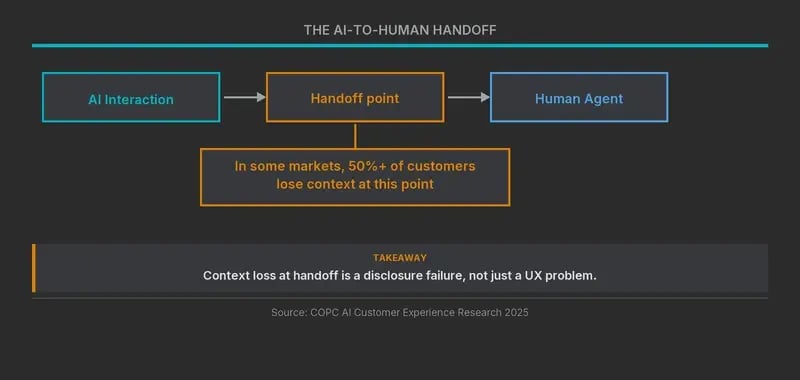
One disclosure pattern that is consistently underbuilt is the path to a human. Research from Ada and NewtonX covering 2,000 consumers across North America, Europe, and APAC found that 74% expect to be told they are interacting with AI before or at the start of the interaction, and 57% say they would stop using a company's AI service if they could not reach a human when needed. Only 14% of businesses currently offer frictionless escalation. That gap is itself a disclosure failure. COPC's research found that in some markets, more than half of customers lose context when transferred from AI to a human agent, signalling to those customers that the AI is not connected to, or accountable to, the rest of the business.
57%
of consumers would stop using a company's AI service without a path to a human
Ada / NewtonX global survey, 2,000 consumers
14%
of businesses currently offer frictionless AI-to-human escalation
Ada / NewtonX global AI customer service survey
If your tracking, returns, and checkout each speak a slightly different version of the truth, that gap will become a disclosure problem long before it becomes a customer service one.
What the EU AI Act and UK ICO already require from retailers
The full text of the EU AI Act runs to several hundred pages, and most retailers do not need to read it. The parts that affect retail commercial operations come down to a few categories.
Transparency obligations for AI-generated content and chatbots. Article 50 of the EU AI Act is explicit: providers must ensure that people interacting directly with an AI system are informed they are doing so, unless it is obvious from context. In practice, this covers chatbots, AI-written product copy at scale, and AI-generated images used commercially.
What applies as of 2 August 2026. The Act's general application date is 2 August 2026, and the Article 50 transparency duties have been enforceable across the EU since then. Providers of chatbots and other AI systems that interact directly with people must inform them that they are dealing with an AI system, unless this is obvious from context. The information must be clear and reach them no later than the first interaction. Providers of systems that generate text, images, audio or video have to mark the output as artificially generated in a machine-readable format.
The Digital Omnibus on AI, Regulation (EU) 2026/1744, entered into force on 27 July 2026. It left those duties unchanged but added a transition period: providers of generative systems already on the market before 2 August 2026 have until 2 December 2026 to comply with the marking rule. The same amendment moved the high-risk regime to 2 December 2027 for the Annex III use cases and to 2 August 2028 for AI built into regulated products. For retailers, the chatbot disclosure applies now, while the high-risk regime has been pushed back. The AI literacy duty in Article 4 has applied since 2 February 2025; it now refers to measures that support the AI literacy of the staff who operate AI systems. If you use a vendor's chatbot or copy generator, check whether the vendor has built in the disclosure and the marking. The duty sits with the provider, but customer complaints come to you. For the current timeline, see the European Commission's AI Act page.
Risk classification for automated decisioning. Systems that make or materially influence decisions about credit, employment, or access to services receive heavier obligations. Most pure retail use cases sit in the lower-risk band, but cross-border ecommerce that touches financial services, delivery insurance, or buy-now-pay-later flows can shift into a higher category.
Record keeping and explainability. Retailers using AI in decisioning need to be able to describe, at a reasonable level, what the model does and how it reached a given outcome. This is where most retail compliance work will focus between now and the high-risk application dates of 2 December 2027 and 2 August 2028.
In the UK, the ICO has built on the existing UK GDPR framework rather than waiting for a dedicated AI law. Its guidance on automated decision-making and on AI-driven advertising and personalization gives retailers a workable template right now. Dutch retailers can use the EU AI Act timeline directly, with the Autoriteit Persoonsgegevens active on AI enforcement and consumer-facing transparency.
The practical answer for a UK or Dutch retailer is that you do not need to wait for clarity. The major obligations are already legible: label AI-facing interactions visibly, document your decisioning logic, and be able to explain a specific automated outcome when a customer or regulator asks.
Where the disclosure becomes operational
nShift's delivery management platform sits in the part of the retail stack where AI disclosure becomes most concrete: checkout, tracking, returns, and carrier selection are where models touch the customer most often.
nShift Checkout is where delivery options are ranked, priced, and offered. The same logic that helps a buyer see relevant options also produces structured signals that AI agents can read.
Post-purchase data needs to tell the same story to two audiences. nShift Track structures it so a customer checking a delayed parcel and an AI agent evaluating your reliability read the same thing. If that data is vague or inconsistent, both lose confidence.
Returns is where automated logic meets a sensitive customer moment. Clear routing, visible policy, and reviewable decisions through nShift Returns are the practical form of disclosure here.
nShift Companion, the AI layer across the platform, is built so the changes it suggests to delivery configuration, carrier selection, and operations are versioned and explainable. That governance frame is what makes AI in delivery operations usable in a regulated, customer-facing context.
For retailers in the UK and the Netherlands, the practical step is to work through the three layers above and name an owner for each one. Most teams find that the operational AI layer, the one quietly setting every delivery promise and routing every return, has the most ungoverned surface area and the quickest wins once someone is responsible for it.