At the start of 2026 we published ten predictions for delivery and logistics. Six months later I sat down with three colleagues to go through every one of them out loud: which we got right, which we underweighted, and which we simply did not see. We booked an hour and used all of it.
Between them, they cover the product, commercial and research angles. Aleksandar Milovanovic works across our Checkout, Track and Returns products and spends his week inside customer implementations. Frederick Hultman leads growth strategy for the Nordics, so he hears what retailers are actually budgeting for. Vanja Eriksson is an independent ecommerce strategy advisor who studies what retailers do after checkout for a living.
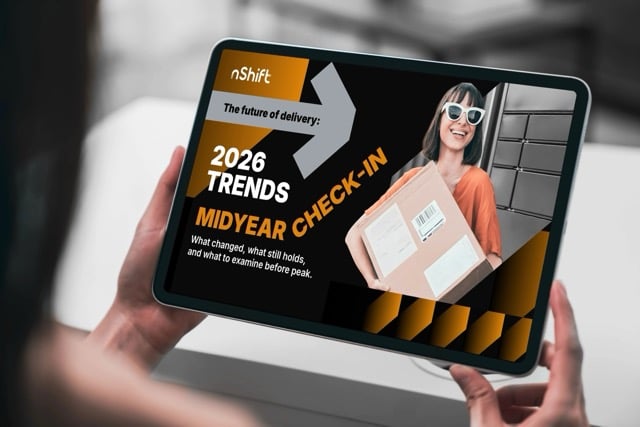
The 2026 trends mid-year check-in already grades all ten predictions against the market data. The conversation added what could not fit in the report, including the points where three people who work on this every day flatly disagreed.
Key takeaways in one glance
-
The predictions that held up best were the least exciting ones. Incremental adoption beat transformational change across almost every trend.
-
We had the resilience theme right and the cause wrong. Trade policy, rather than fuel or weather, reshaped European flows in the first half.
-
The genuine surprise was ownership. Who runs the locker and pickup network now affects capacity, data access and rates.
-
A control tower earns its place when it changes a decision. Most dashboards still stop at reporting what went wrong.
-
The group split on whether customers care who delivers their parcel, and the disagreement revealed two different business questions.
-
Nobody could settle the search-versus-AI-discovery question yet. That uncertainty is worth recognizing before committing a budget.
Watch the full discussion
Aleksandar, Frederick, Vanja and I go through all ten predictions in a little over an hour, with the arguments left in.
The predictions that held up were the less dramatic ones
Where we predicted steady, unglamorous adoption, we were close. Most of the step changes expected across the wider industry have not arrived on schedule.
AI is the cleanest case. Gartner's May 2026 survey of senior supply chain leaders found 17% of organizations pursuing an immediate, transformational redesign around AI. The other 83% are applying it use case by use case, or scaling gradually. That is more restrained than much of the 2026 coverage and close to what we wrote in January.
Frederick tracks this in customer conversations rather than surveys, and his read was the same:
“Six months ago everyone was talking about AI, what can AI do? And today they're asking what measurable business outcomes can AI get me now.”
He followed it with the line I have quoted three times since:
“Good AI shouldn't be visible. It should simply make the customer experience feel effortless.”
It is a useful test for the next vendor conversation. An impressive demo has limited value if the operator still has to work around it. Vanja pushed the same point one layer down, to the data. In her experience, much of the AI work that fails to pay back began before anyone cleaned and structured the inputs. We identified data and integration as constraints in the original report, and six months of evidence suggests we understated them. There is more on where the constraint bites in our deep dive on AI in logistics.
We had the resilience theme right and the cause wrong
In January we argued that businesses would need flexible, multi-carrier, multi-route networks, and we illustrated the point with fuel and climate disruption. The theme held, but a different source of disruption rearranged European flows in the first half of 2026: trade policy. The US de minimis withdrawal, the postal suspensions that followed, Temu and Shein pivoting volume into Europe, and the EU's three-euro duty on small parcels from 1 July all changed the operating picture.
Aleksandar made the most operational point of the hour. The real difference between suppliers, he argued, is how fast a backup carrier can be switched on when a lane closes, and he measures that switch in days.
“It's kind of a window of opportunity. And when that is closed, it's gone.”
Another line from the session sharpened the idea and belongs in a procurement review:
“Resilience is no longer just about having another supplier. It's about having systems that are capable of adapting quickly when those regulations change.”
That changes the procurement question. Instead of asking whether a second carrier exists on paper, ask how long it takes to switch the carrier, the documentation and the customer promise together. We work through what that costs and what it protects in supply chain resilience in 2026.
The surprise we had not written down was ownership
One development was missing from everyone's list: who owns the network. A FedEx and Advent consortium agreed a 7.8 billion euro takeover of InPost in February. DHL completed its merger with Evri. DPD Germany and GLS, direct competitors, agreed to share out-of-home infrastructure. Geopost's out-of-home volumes grew 31% in 2025.
We called the growth and missed the consolidation. Vanja saw concentration risk: once a large share of your parcels flows through one third-party network, that operator controls the final customer handoff and much of your negotiating room. Her advice was familiar, applied somewhere new: keep your eggs in more than one basket.
Frederick looked at it from the customer's side:
“Customers don't really care who's delivering the parcel. What they care about is a promise kept.”
They are answering different questions. Your customer may not know or care which network runs the locker. Your finance team will care when the rate card moves and there is no second option ready. Retailers can manage this by treating locker access as a commercial dependency rather than a feature to switch on. We map how the networks are shifting in out-of-home delivery in 2026.
Visibility only matters when it changes a decision
Our control tower prediction is where the group was hardest on our own framing. We described a move from reporting the past to predicting the future. Frederick's response was that most retailers already have the dashboards and are no better off for them:
“Visibility alone isn't enough. Most retailers already have these fancy dashboards telling them something has gone wrong.”
“Ultimately customers don't pay for visibility, they pay for reliability.”
The correction from the discussion was organizational rather than technical. A control tower creates value when it changes a decision: pulling a delivery option at checkout before the network misses it, moving volume off a carrier whose performance is drifting, or warning a customer before they have to ask. That requires logistics, ecommerce and customer service teams to work from the same information and have the authority to act. Software alone cannot supply that operating model.
The question none of us could answer
The last stretch of the conversation remained unresolved. AI and agents drove 20% of retail sales over the 2025 holiday season according to Salesforce, and AI-referred traffic to US retail sites grew sharply through the first quarter. Discovery is moving toward AI, while merchants still own the transaction and the delivery promise behind it. We unpack that inversion in AI shopping in 2026.
Vanja put the risk in practical terms. An agent can only recommend what it can parse:
“If you have an awesome website but you haven't organised it, it isn't standardised, then the AI is not going to pick your side because it doesn't understand what you're trying to communicate.”
She expects agent-native payment to normalize faster than most retailers are planning for, and raised the question none of us could close: whether preparing for this is search optimization, generative engine optimization, or both. Nobody in the room pretended to know. I said during the recording that delivery options a machine cannot read are at risk of disappearing from consideration. I still think that is the safest point to act on while the rest gets settled. For the mechanics of exposing a delivery promise a machine can actually read, start with logistics APIs in 2026.
What each of us expects for the rest of the year
I asked everyone for one call to revisit in December.
Aleksandar expects out-of-home to keep climbing. Lockers, pickup points and the general convenience habit, he thinks, still have room to run before anyone hits a ceiling.
Vanja expects manual workflows to disappear quickly. Processes still run over email today will look strange within a year, and businesses that retain them will increasingly fall out of step.
Frederick closed with the broadest claim of the session:
“Logistics has fundamentally changed its role within businesses. It used to be viewed as a back office function, whereas today it's directly influencing conversion, customer loyalty and profitability.”
Then he added the qualifier that makes it useful:
“The companies that are succeeding aren't necessarily investing the most.”
If you take one thing from the hour
Six months of evidence favors the trends a business can absorb without a transformation program: cleaner shipment data, a carrier that can be switched quickly, delivery options tuned by market, and a promise that machines and people can both read. These practical investments are the ones showing up in the first-half results.
The prediction I would defend hardest is the one we made in the original 2026 delivery trends report and repeated at mid-year: delivery stopped being a back-office cost line and became part of what wins the sale. Six months on, the evidence for that case is stronger.
Watch the full discussion, get the 2026 trends mid-year check-in, or see how the nShift platform keeps delivery choice, carrier execution, tracking and returns working from one place.
See the evidence behind every verdict.
The 2026 trends mid-year check-in grades all ten predictions against market, regulatory and platform data, and names the four developments that caught the industry off guard.
Get the report