The sixth of ten deep-dives in our 2026 delivery trends mid-year check-in: resilience kept its place, and trade policy took the lead role.
Our 2026 trends report argued that resilience had become a design requirement alongside cost and service, and that companies would combine dual sourcing, selective nearshoring, regional hubs, and buffers rather than abandon global networks.
What we said in early 2026:
Resilience has become a design requirement alongside cost and service. Companies will combine dual sourcing, selective nearshoring, regional hubs, and buffers rather than abandoning global networks. The test of a resilient supply chain: how quickly plan B becomes the operating plan.
Fast track to mid-year: the direction held, but we underweighted the cause. The force that moved networks most in the first half of 2026 was trade policy, ahead of the climate events and physical disruptions the report emphasized.
What supply chain resilience means
Supply chain resilience is the ability to keep delivering when part of the network fails, by having alternatives ready: other suppliers, other lanes, other carriers, other fulfillment points, and the data to switch between them quickly. It is measured less by how rarely something breaks than by how fast plan B becomes the operating plan when it does.
Trade policy became the main disruption
The clearest evidence is what trade professionals now worry about most.
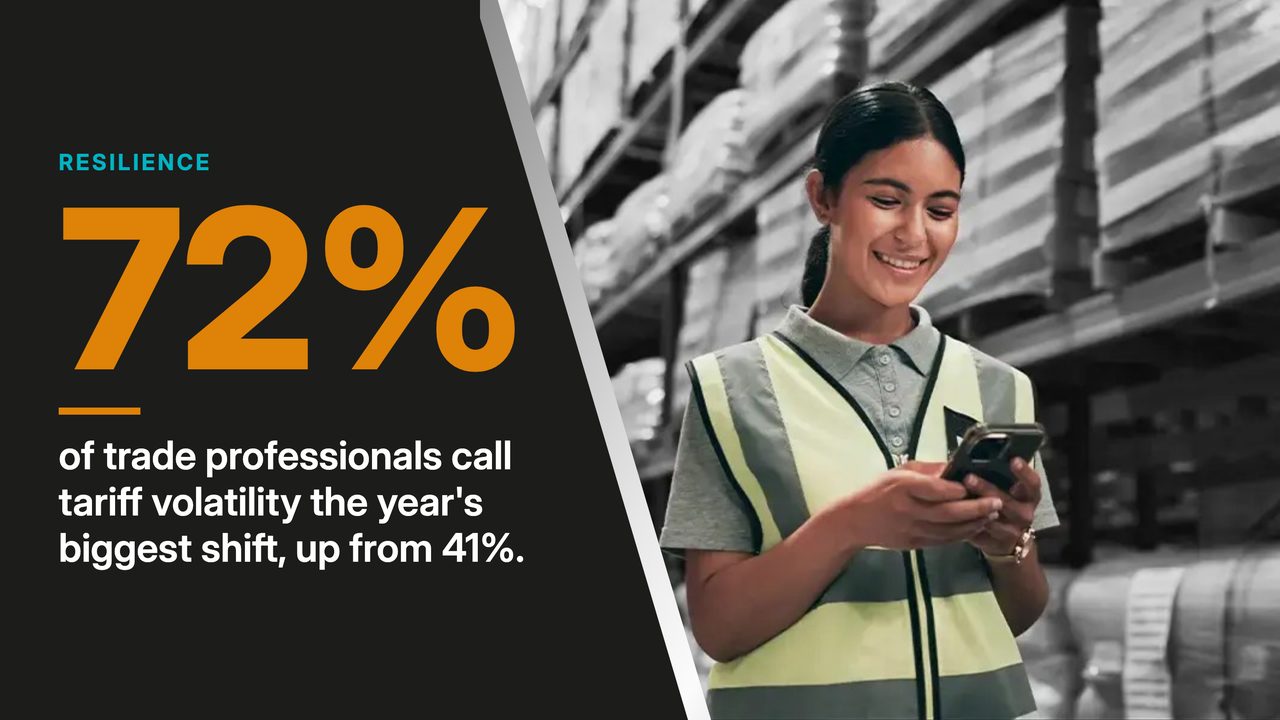
In Thomson Reuters' survey, 72% named US tariff volatility the most impactful regulatory change of the year, up from 41% a year earlier. Their top responses were:
-
changing sourcing patterns (65%)
-
renegotiating supplier contracts (57%)
-
nearshoring or reshoring (51%)
When the US ended its $800 de minimis exemption in late August 2025, postal operators across Germany, Denmark, Sweden, Italy, and later France and Austria suspended US-bound goods shipments amid customs uncertainty, with restrictions lingering into 2026. A peacetime suspension of transatlantic postal flows makes the case for carrier diversification and dynamic routing more plainly than any hypothetical could.
For the shipper, thats a concrete and immediate shock: parcels bound for the affected destination stop moving through the usual postal channel, and keeping the promise means re-routing through other carriers, with the customs documentation they require, at short notice. A network that can add or switch to a carrier in days keeps shipping; one that treats each carrier as a separate integration project waits while the backlog builds. The de minimis change was a customs decision, but shippers felt it first as a delivery problem.
Trade-policy disruption also behaves differently from the disruptions resilience planning was built around. A storm or a port closure tends to be unpredictable but bounded in place and time. A tariff or a customs rule is announced in advance, yet it can change the economics of a lane for the long term, sometimes across a whole trade corridor at once. Planning for the sudden and physical kind does not automatically prepare a network for the deliberate and structural kind.
72%
name US tariff volatility the year's most impactful regulatory change
Up from 41% a year earlier (Thomson Reuters)
65%
are changing sourcing patterns in response
The most common response reported (Thomson Reuters)
51%
are turning to nearshoring or reshoring
Selective adjustment, not a wholesale move home
A selective, targeted response
Networks largely kept their global sourcing and adjusted selectively. Capgemini's 2026 reindustrialization research shows planned investment becoming more targeted, with nearshoring within the EU receding from 2025 levels while reshoring rose only modestly. Maersk's European resilience survey found more than three quarters of businesses had experienced disruptive delays in the previous year, with new sourcing locations under consideration in and near Europe. The sea lanes stayed cautious too: Red Sea transits began resuming into 2026, but Cape routing still adds 10 to 14 days when used, so many networks kept structural slack rather than assuming normal service had returned.
Companies added optionality where a specific risk had shown itself and left the rest of the network in place, which is more affordable and more reversible than relocating a supply base.
Nearshoring itself became more disciplined. Rather than relocating a whole supply base closer to home, companies are adding a nearer-shore option for the highest-risk components or markets while keeping lower-risk sourcing where it is. Capgemini's finding that EU nearshoring receded while reshoring rose slightly fits that reading: the appetite is for targeted, reversible moves rather than a structural retreat from global sourcing, which tends to be slow and expensive to undo.
Customs and trade data became part of resilience
Trade-policy shocks land as data problems as much as sourcing ones. A tariff change, a new duty, or a suspended lane alters the customs information a shipment needs, the landed cost shown to the customer, and sometimes the carrier that can legally move it. A network that holds customs values, commodity codes, and shipment data in one place can often adjust to a rule change with a configuration change, where one holding them across disconnected systems faces more of a project.
The EU's temporary €3 customs duty on goods under €150 from non-EU IOSS sellers, applying from 1 July 2026, is the current test of this, and the networks that treated the de minimis shock as a warning have less to scramble for now that it applies.
Resilience is layered flexibility, and it runs on coordination
In practice, resilience is several kinds of flexibility stacked together: supplier flexibility, lane flexibility, carrier flexibility, node flexibility, inventory flexibility, and data flexibility. Each depends on the others, and all of them depend on coordination. A company may have a second supplier lined up, but if the logistics network cannot onboard the new lane, connect the carrier, handle the customs data, and update the customer promise quickly, the resilience exists on paper only.
Data flexibility tends to underpin the others: if shipment, carrier, customs, and emissions data sit in one connected model, re-routing volume to a new carrier or lane is closer to a change of configuration. If they are spread across separate systems, every switch also means rebuilding the data flows behind it, which is what can turn a quick re-route into a drawn-out project.
What separated networks that absorbed the tariff shock from those that did not was the speed of switching, more than the number of alternatives on a list. Re-routing volume, activating a different carrier, and re-promising to the customer within days is an orchestration problem before it is a sourcing one. The alternatives have to be connected and ready, not just identified.
Test where switching is slower than the disruption
The useful diagnostic is to find the places where switching takes longer than the disruption it is meant to absorb: lanes served by a single integrated carrier, markets with one customs setup, products with one fulfillment path. Those are the single points of failure that a tariff change or a suspended lane exposes first.
Pre-integrate the alternatives before they are needed. A carrier already present in the platform's library onboards as a configuration change rather than a fresh build, so it can be brought online far faster than one that needs a new integration; the actual time is worth measuring in your own environment. Then rehearse the switch the way warehouses rehearse peak, so that moving volume to a second carrier or lane is a practiced step rather than a first attempt under pressure.
Rehearsing a switch is concrete work: pick the alternative carrier or lane for a given market, pre-integrate it, run a small volume of real shipments through it, and confirm that labels, customs data, and tracking events all come through correctly. The output is a known activation time and a short list of what breaks, so that when a real disruption hits, the switch is a decision rather than a discovery. Networks routinely rehearse peak volume; the equivalent rehearsal for losing a carrier is far less common.
Model the disruption before it lands
Because trade-policy changes are usually announced before they take effect, they can be planned for in advance. A useful exercise is to model a coming duty change: which lanes it would make uneconomic, which carriers could still move the goods, what the landed cost becomes, and which customer promises would need to change. A network that has run that scenario is in a better position to activate an alternative lane or carrier and adjust the affected promises when the rule lands, instead of discovering the exposure once parcels stop.
What to weigh before peak and budget season
The tariff shocks of 2026 rewarded speed of adjustment more than breadth of network. A supply chain optimized tightly around one configuration can be more fragile than a slightly more expensive one that can be reconfigured in days. That is a budget-season trade-off worth making explicit: the cheapest single setup and the most adaptable setup are rarely the same, and 2026 raised the value of the second.
The practical version is to price adaptability as a line item rather than a hope. What does a second pre-integrated carrier on a key lane cost to maintain, set against the cost of a week of stranded volume when the primary one is disrupted? On a high-volume lane, that maintenance cost is usually small against the cost of stranded volume, though the comparison is worth running lane by lane. The same logic extends beyond carriers to customs setups and fulfillment paths: a market served by a single customs broker, or a product shipped from one site, is a concentration risk a policy change can expose, and arranging the second option in advance usually costs less than arranging it under pressure.
The question to carry into peak: how quickly the network can change shape when the next policy decision lands. The disruptions that mattered this year were announced ahead of time, and the networks that coped were the ones already able to switch.
For the full mid-year check-in across all ten trends, read the report. Keeping volume moveable across carriers and lanes depends on carrier connectivity and, for industrial freight, nShift TMS.
More from the mid-year check-in:
- Supply chain compliance in 2026: one data backbone, not ten projects
- Out-of-home delivery in 2026: the networks behind it are being reshaped
- AI shopping in 2026: the agentic inversion and what it does to your delivery promise
Ten trends. One mid-year evidence check.
Get the full 2026 delivery logistics mid-year check-in, with the data and recommendations behind all ten trends.
Get the report