The fifth of ten deep-dives in our 2026 delivery trends mid-year check-in: the practical last-mile mix won, then €7.8 billion changed who owns it.
Our 2026 trends report predicted the urban last mile would be won by a practical mix, lockers, pickup points, cargo bikes, electric vans, and micro-hubs, rather than by drones or pavement robots.
What we said in early 2026:
The last mile still represents roughly 60 to 70% of parcel delivery cost, and cities are tightening access, emissions, and curb-space rules. In 2026, real innovation looks less like drones and more like dense out-of-home networks, cargo bikes, compact EVs, microhubs, and routing that reduces failed attempts in complex urban environments.
Fast forward six months and, in short, our prediction held. What the report did not anticipate is how quickly the networks behind that mix would be reshaped, through acquisition, merger, corporate separation, and regulation.
In the first half of 2026, the structure of European out-of-home and last-mile delivery moved at a pace that now matters to shippers as much as where the lockers stand.
What out-of-home delivery is
Out-of-home delivery is any delivery that goes to a staffed pickup point, a PUDO such as a local shop, or an unstaffed parcel locker, rather than to the customer's door. For the shopper it is a collection choice. For the retailer and carrier it is a denser and more reliable way to complete the last mile, because one stop serves many parcels instead of many separate doorstep attempts, several of which fail and repeat. In 2026 it has moved from a convenience option toward core delivery infrastructure.
Why the economics favor out-of-home
The pull toward out-of-home is not only shopper preference; the unit economics are better. A doorstep round makes many stops, and a share of them fail because no one is home, which triggers a second or third attempt and sometimes a return. A locker or pickup point consolidates many parcels into one drop, and the first attempt succeeds far more often, because the parcel waits for the customer rather than the other way round.
For the carrier, that tends to mean fewer stops per parcel and fewer failed deliveries.
For the retailer, it can mean a lower delivery cost and fewer of the returns and WISMO contacts that follow a missed delivery. Economics like these are part of why carriers keep investing in lockers even as the capital cost rises.
Out-of-home became infrastructure
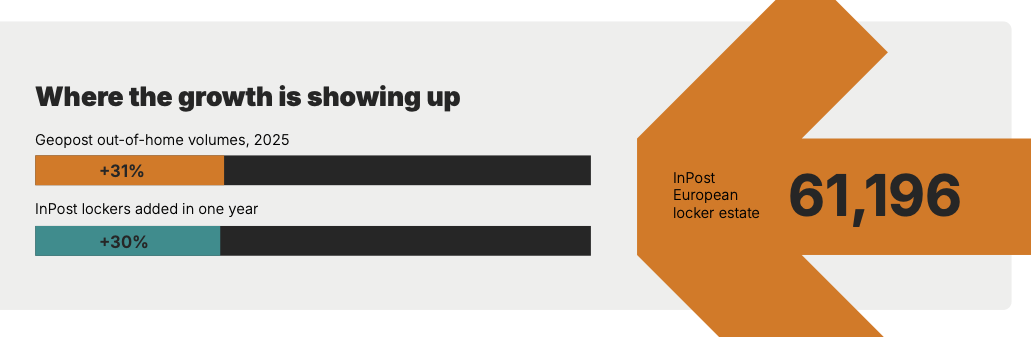
The volume behind out-of-home is now large enough to reshape the network. Geopost's out-of-home volumes grew 31% in 2025, across a pan-European network of more than 150,000 pickup points, including over 50,000 lockers. InPost ended 2025 with 61,196 lockers across Europe, having added 14,200 in a year, and handled 1.4 billion parcels, up 25%.
Competitors have also started pooling networks: DPD Germany and GLS, direct rivals, agreed to share out-of-home infrastructure in Germany, targeting 20,000 contact points within three years. Rivals share a network when it has become shared infrastructure rather than a point of difference, in the same way carriers already share sortation capacity or airlines share ground handling.
Then the structure behind the networks shifted
The corporate structure of European last-mile delivery moved on several fronts at once, and the forms differ.
-
A consortium led by FedEx and Advent International agreed a recommended all-cash offer valuing InPost at €7.8 billion, around a 50% premium: a proposed acquisition with completion expected in the second half of 2026.
-
In the UK, DHL completed a merger with Evri.
-
PostNL moved the other way, separating its parcels business.
-
And Royal Mail is rebuilding the UK universal service under new regulatory targets, a service-level change rather than an ownership one.
Within nine months, several of the networks a European shipper relies on took on new owners, new structures, or new rules, and often new financial priorities with them.
In the acquisition and merger cases, ownership is passing to larger financial backers. A locker network owned by a founder-led company may be run differently from one owned by a global logistics group or a private-equity consortium, which often prioritize scale, cross-network integration, and returns on a fixed timeline. For shippers, that can mean faster investment and wider coverage; it can also mean pricing and priorities set by the new owner's model rather than the local market. Which way a given network goes is not yet clear.
€7.8bn
value placed on InPost in the consortium's all-cash offer
Consortium incl. FedEx and Advent; ~50% premium, completion expected H2 2026
61,196
InPost parcel lockers across Europe at the end of 2025
Up 14,200 machines in a year; 1.4 billion parcels, up 25%
20,000
out-of-home points DPD Germany and GLS plan to share
Direct competitors pooling a network, within three years
What a network change means for a shipper
Ownership is not an abstract concern for the company shipping the parcels. When a locker network or carrier is acquired, merged, or split, the things a shipper depends on can move with it: rate cards, data access and API stability, locker and PUDO availability, and service priorities on specific lanes. A network being run for a new owner's return may reprice, deprecate an integration, or reallocate capacity in ways that were not on the table under the previous owner. None of that is certain, but all of it is now possible on networks that were stable for years.
The protection is less about predicting which way each network goes and more about not depending on any single one. A multi-carrier setup, where volume can move between networks without a new integration project each time, keeps an ownership change from becoming a single point of failure. It is also why carrier and locker agreements are worth rereading this year: where ownership has changed, the terms and the data access behind them may have changed too, and continuity is worth confirming rather than assuming.
Watch our webinar on demand - Multi-carrier control: When delivery changes can't wait
Data is the exposure that is easiest to miss after an ownership change. Out-of-home delivery depends on live feeds a retailer rarely sees directly: which lockers exist and where, which have space right now, and the tracking events that tell a customer their parcel is ready to collect. Those feeds run through the network's APIs, and a new owner rationalizing systems could change, delay, or deprecate them. If that happened, a delivery menu that showed real-time locker availability could start showing stale data, and the promise could degrade before anyone noticed. Confirm that the event and availability feeds still behave the same after a change, alongside the rate card check.
Optionality is only useful if switching is fast. A carrier already present in the platform's library can often be activated in days of configuration, where a fresh integration is typically a matter of months, by which time the disruption may have passed. The value of a plan B is the speed of activating it, which is why pre-integrating alternative carriers and networks, before a change forces the issue, tends to be worth more than reacting after one.
Postal service levels are changing too
The postal networks are changing as well. Royal Mail is rebuilding the UK universal service under new reliability targets after delivering well below the old one, and is under a fresh Ofcom investigation. PostNL is moving Dutch standard mail to two-day delivery and splitting its parcels arm.
For shippers, the practical effect is that a service level that was dependable becomes a moving target: the same postal product may carry a different speed, price, or reliability than it did a year ago. Building current service levels into the promise shown at checkout, rather than the ones from memory, avoids promising a speed the network no longer guarantees.
Cities are not interchangeable delivery zones
City policy kept tightening regardless of the ownership churn. Europe's low-emission zones have grown from 228 in 2019 toward a projected 507, and since January 2025, 18 Dutch cities have operated zero-emission zones for freight under a single national framework. These are access rules: which vehicles may enter which areas, and when. A delivery promise that works nationally can still fail inside a dense urban district with its own congestion, access windows, and out-of-home habits.
London, Paris, Berlin, and Amsterdam are better handled as separate operating environments, each with its own option set, cut-offs, and carrier mix, and with city access rules encoded into routing rather than held as local knowledge. Amazon's more than €10 billion European investment this year, adding fulfillment capacity and 25,000 jobs, is a reminder that speed and density competition in these cities is still rising.
The futuristic end of the last mile stayed marginal, as predicted: Starship and Uber Eats began commercial pavement-robot deliveries in Leeds in December, still a small share of volume.
The differences, seen from a local (and practical) perspective: the vehicle allowed in one city's low-emission zone may be charged or barred in another, access windows differ, and out-of-home is dense enough to lead with in some markets and too thin in others. Building those rules, which vehicle, which zone, which hours, which options, into routing and the checkout menu is what makes a promise hold inside a city rather than only on the national average.
What to check before peak
Two pieces of work matter more than usual this year.
-
First, reread the carrier and locker agreements that consolidation has touched, and confirm what has changed in rate cards, data access, and capacity commitments rather than assuming continuity.
-
Second, plan the top cities as distinct operating environments, with option sets, cut-offs, and carrier mixes set per city, and city access rules built into routing.
There is a concentration effect on both sides. Out-of-home is efficient because it concentrates parcels into fewer collection points, and the networks running it are concentrating into fewer owners. Use that efficiency, and pair it with enough carrier and network optionality that a single owner's pricing or capacity decision cannot strand your volume.
For the full mid-year check-in across all ten trends, midyear delivery trends research report. A multi-carrier, multi-network out-of-home strategy depends on broad carrier coverage and maintained connections, which is what nShift's carrier network and carrier connectivity provide.
More from the mid-year check-in:
- Ecommerce delivery options in 2026: choice, conversion, and returns
- Supply chain resilience in 2026: when trade policy became the disruption
- Fleet electrification in 2026: what it means for shippers who buy delivery
Ten trends. One mid-year evidence check.
Get the full 2026 delivery logistics mid-year check-in, with the data and recommendations behind all ten trends.
Get the report