
The seventh of ten deep-dives in our 2026 delivery trends mid-year check-in: vans delivered on electrification, trucks slipped, and the pressure changed source.
Our 2026 trends report argued that decarbonizing European road freight would be a fleet, depot, and data problem rather than a brand statement, and that the economics would tip first in urban and fixed regional patterns.
What we said in early 2026:
Decarbonization of European road freight is driven by law. EU CO2 standards for heavy-duty vehicles require 45% lower emissions from 2030, 65% from 2035, and 90%
from 2040, and the zero-emission truck fleet would need to grow from roughly 13,500 vehicles at the end of 2024 to around 400,000 by 2030. We expected the economics to tip first in urban and fixed regional patterns.
Halfway through the year the fleet data supports that, with one clear split: electric vans are scaling, electric trucks are not, and for shippers the levers to act on it are commercial ones, tenders, Scope 3 reporting and city-access rules, working alongside the manufacturer regulations.
For a retailer or brand that buys delivery rather than running trucks, the question is not which vehicle to buy, but which carriers run low-emission services where it matters and what evidence they can provide.
What fleet electrification means when you do not own the fleet
Fleet electrification is the shift from diesel vans and trucks to battery-electric ones, along with the depot charging, route planning, and energy contracts that make them work. For a fleet operator it is a capital and infrastructure decision. For a shipper who buys carrier services, it is a procurement and data decision: which carriers offer electric or low-emission services on the lanes you use, whether those services are reliable enough to promise on, and whether the carrier can hand back emissions data you can stand behind. The shipper does not choose the vehicle, but it chooses the carriers and services it promises on, and it answers for any green claim it makes.
The transition is running at two speeds
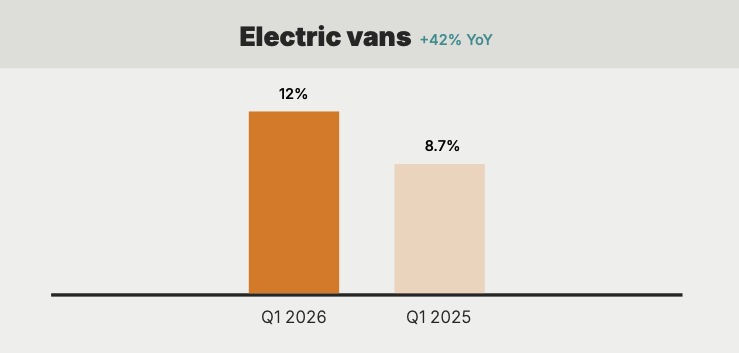
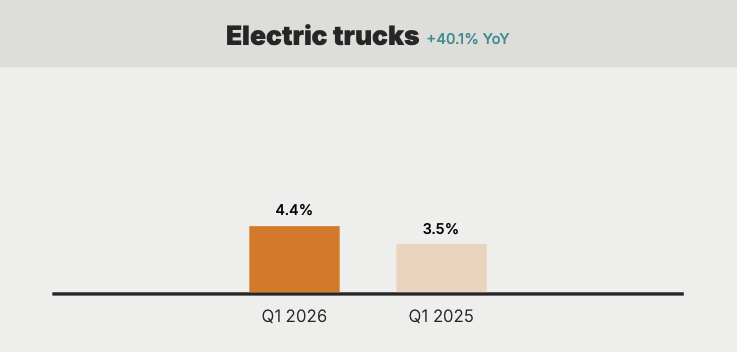
The registration data shows two different transitions inside one trend. In the first quarter of 2026, electrically chargeable vans, the vehicles parcel networks buy in volume, grew 42% year over year and reached 12% of EU registrations, up from 8.7% a year earlier. Electric trucks grew at a similar rate, 40.1%, but from a far smaller base, so they still hold only 4.4% of the market, with diesel at 92.4% of new registrations. ACEA's own assessment is that progress remains too slow, with uptake constrained by insufficient enabling conditions.
The split is not surprising once you look at where each vehicle runs. Vans do predictable urban and regional routes, return to a depot each night where they can charge, and need less range, so the economics tip first. Trucks cover long distances, depend on charging that barely exists along the corridors, and carry a much higher price premium, so the switch is slower even where the will is there. At 4.4% of registrations against diesel's 92.4%, the truck transition is early, whatever the growth rate.
12%
electric vans' share of new EU registrations in Q1 2026
Up from 8.7% a year earlier (ACEA)
4.4%
electric trucks' share, with diesel still at 92.4%
Q1 2026 (ACEA). Trucks grew fast but from a tiny base.
90%
CO2 cut required from new heavy-duty vehicles by 2040
EU standards: 45% from 2030, 65% from 2035, 90% from 2040
Why vans move faster: the cost case
Part of the reason vans are ahead of trucks is total cost of ownership rather than sticker price. An electric van costs more to buy, and whether lower running and maintenance costs offset that over its life depends on the route, the depot, and the operator, so the case holds on some urban patterns and not on long-haul, where the purchase premium is larger, the charging is sparse, and duty cycles are harder to serve on current range.
For a shipper, that is a question to put to carriers rather than an assumption to make: on which lanes does electric already pay for them, without a sustainability commitment subsidizing it.
Charging is moving from pilot to rollout, slowly
The constraint that holds trucks back is finally attracting bankable investment. Milence operates 34 heavy-duty charging hubs across eight countries, with 16 more in development and around 90 expected by the end of 2028. That is real movement, and it is still years behind what the 2030 truck math would require.
For a shipper, the practical read is that long-haul electric road freight will stay patchy and lane-specific for a while, so a low-emission long-haul service is available on some corridors and not others.
The van question: is the depot electrified?
Vans face a different constraint from the corridor charging that limits trucks: depot power. Electrifying a delivery depot means enough grid capacity to charge a fleet overnight, the charging hardware to do it, and an energy contract that keeps the cost predictable, and arranging enough grid capacity can itself take time.
For a shipper, this matters indirectly: a carrier's ability to offer electric urban delivery on your lanes depends on whether its local depot is electrified, which varies city by city. That is worth asking about directly rather than reading off a carrier's national commitment.
The levers a shipper can pull now
This year, the regulatory pressure on manufacturers eased. In March, the Council adopted a targeted flexibility letting truck makers bank CO2 credits earned between 2025 and 2029 against their 2030 targets. This did not remove the targets: the EU's 2024 heavy-duty CO2 standards still require manufacturers to cut new-vehicle emissions by 45% from 2030, 65% from 2035, and 90% from 2040. It eased the near-term deadline pressure on manufacturers, which changes who drives the transition in the meantime. The manufacturer regulations still set the long-run direction.
For a shipper, though, the immediate levers are commercial: tender criteria that score carbon, Scope 3 commitments that need real data, city-access rules that favor cleaner vehicles, and, where price and service are equal, some customers who prefer a lower-emission option. These act now, alongside the vehicle regulations, rather than waiting on the 2030 deadlines.
Scope 3 is, for many retailers, the most concrete of those commercial drivers. Most of a retailer's transport carbon sits in Scope 3, the emissions it does not produce directly but is accountable for through its supply chain. A retailer that has committed to a Scope 3 target needs delivery emissions it can report and defend, and those figures come from its carriers. A carrier running electric vehicles on a lane only lowers the reported number if the calculation reflects that cleaner service, through carrier evidence or emission factors specific to it rather than a fleet default; capturing the shipment alone does not do it. That turns a carrier's green fleet from a marketing point into a reporting dependency for the shipper.
For a shipper, electrification is a data problem before it is a fleet problem
A low-emission delivery promise is only credible when the vehicle, the route, the charging, the carrier service, and the emissions data all line up, and a shipper controls almost none of those directly. What a shipper can control is what it asks for and what it verifies. That makes electrification, from where a retailer sits, largely a data question: knowing which lanes are served by low-emission vehicles today, which is carrier evidence, and having emissions figures at the shipment level, calculated by a transparent method, that it can report and defend.
That data is harder to assemble than it sounds, because it has to come from many carriers in different formats and be turned into one comparable set of figures. Closing that gap means calculating emissions consistently at the shipment level across every carrier, using a documented, standards-aligned methodology, and centralizing the result so the numbers are comparable and defensible.
That calculation, across multi-carrier shipment data, is what nShift's Emissions Tracker does. It produces a consistent CO2e figure per shipment from a transparent method; on its own it does not certify that a given parcel travelled in an electric vehicle, which is separate, carrier-level evidence. Without figures like these, a retailer either overstates its green credentials, a growing legal and reputational risk, or understates them and loses the commercial benefit of the low-emission services it already pays for. We go deeper on the reporting side in our piece on closing the emissions reporting gap.
Two questions to put to every strategic carrier
Tender season is where a shipper's electrification strategy is executed. Ask carriers two things and keep them distinct:
-
Where do they run low-emission services today, lane by lane and with what reliability, since a carrier-wide sustainability claim is not the same as a clean vehicle on your route; this is the evidence behind any lane-specific green option you offer.
-
What shipment-level data can they provide to feed a documented emissions calculation, so the CO2e you report is consistent across carriers. The first supports what you can claim about a lane; the second supports what you can report about your footprint.
Put both into tender scoring alongside price and service, rather than treating sustainability as a separate box. That rewards the carriers investing in the transition and gives the shipper a documented basis for the low-emission options it promotes, which matters as green claims come under more scrutiny.
Promote low-emission options only where they hold up
The temptation, once electrification is a selling point, is to badge as many delivery options as possible as green. The more durable approach is to offer a lower-emission option only where the carrier genuinely provides that service on the lane and the emissions calculation behind the claim holds up. Naming a delivery "electric" is a promise, and it should be made only where the carrier guarantees an electric service at order level; where it cannot, a broader "lower-emission" description backed by a documented method is the safer claim. A green badge that cannot be substantiated when a customer or regulator asks does more damage than not offering it.
Where this leaves a shipper before peak
The mid-year picture on electrification is a two-speed one: vans and cities are moving, long-haul trucks and their charging are behind, and the manufacturer rules now allow more near-term flexibility than they did.
For a shipper, that argues for treating electrification as a procurement-and-data exercise this year rather than a headline: use tenders to find and reward the genuinely low-emission lanes, and calculate emissions at the shipment level so the claims are defensible.
The manufacturer regulations still set the direction, and tenders, Scope 3 reporting and city rules are the levers a shipper can pull now. The practical standard to hold: promote a lower-emission delivery option only where the carrier service on that lane, the evidence for it, and the emissions methodology behind the claim all support it.
For the full mid-year check-in across all ten trends, read the report. To turn multi-carrier shipment data into auditable emissions reporting, nShift's Emissions Tracker is built for that job.
More from the mid-year check-in:
- Supply chain compliance in 2026: one data backbone, not ten projects
- Out-of-home delivery in 2026: the networks behind it are being reshaped
- Supply chain resilience in 2026: when trade policy became the disruption
Ten trends. One mid-year evidence check.
Get the full 2026 delivery logistics mid-year check-in, with the data and recommendations behind all ten trends.
Get the report