The ninth of ten deep-dives in our 2026 delivery trends mid-year check-in: the half-year's rules moved in different directions and rewarded the same thing - the evidence backbone.
Our 2026 trends report called regulation the underlying force shaping the other trends, and predicted a steadily tightening ratchet: carbon pricing on road fuels, digital freight documentation, tougher vehicle CO2 standards, and expanding city-access rules, all hard-wiring low-carbon, data-rich operations into European logistics.
What we said in early 2026:
Regulation is the invisible hand behind the trends: ETS2 carbon pricing on road fuels, eFTI digital freight documentation from July 2027, tightening heavy-duty CO2 standards, and expanding urban access rules would hard-wire lowcarbon, data-rich operations into European logistics.
Halfway through the year, where do things stand?
The substance held, but the detail was redrawn. The ratchet did not tighten evenly - it loosened at the EU climate level while tightening almost everywhere else, and the deadlines both moved and multiplied. Underneath the churn, one thing stayed constant: nearly every new rule rewards the same capability - structured, auditable data on every order and shipment.
What supply chain compliance means in delivery
In a delivery and logistics context, supply chain compliance is the work of meeting the legal and regulatory requirements attached to moving goods: customs and duty rules, product and packaging rules, emissions reporting, consumer-rights obligations, data and AI transparency, and the documentation each of these demands.

In 2026, the notable feature is how many rules arrived at once, and how much of what they ask for is the same underlying thing: accurate, structured, auditable records across each order and its journey.
The 2026 rules moved in two directions at once
The first half of 2026 pulled compliance in opposite directions.
At the EU climate level, the pressure eased.
ETS2 carbon pricing on road fuels was postponed by a year, to 2028.
The CSRD sustainability-reporting rules were rolled back through the first Omnibus package, raising the reporting threshold to companies with more than 1,000 employees and €450 million turnover and taking listed SMEs out of scope.
Truck makers gained flexibility to bank CO2 credits against their 2030 targets.
For logistics operators, the carbon-cost timeline slipped and the population of companies under mandatory emissions disclosure shrank. Neither change reverses the direction of travel; both move the dates. A business modelling multi-year transport costs still has to account for carbon, now against a 2028 ETS2 start with auctioning from 2027 rather than something sooner, and a company that fell out of CSRD scope this year can fall back in as thresholds, ownership, or listing status change.
Planning to the letter of the current deadline, rather than to the direction, is how the next revision turns into a scramble.
Almost everywhere else, the rules tightened.
From 1 July 2026, a temporary €3 customs duty applies to goods under €150 entering the EU from non-EU sellers registered for IOSS, covering 93% of e-commerce flows. The duty is assessed on each different item in a consignment according to its tariff heading. VAT remains separate. The proposed handling fee is not part of this temporary measure and remains under discussion.
The Commission fined the marketplace Temu €200 million in May under the Digital Services Act, its largest such penalty so far.
The EU AI Act's transparency obligations apply from August, requiring that people be told when they are dealing with an AI system, which reaches delivery chatbots and automated notifications.
And since 19 June, distance sellers must offer a clearly visible withdrawal function.
We cover the customs change in the €3 parcel era and the packaging rules in what PPWR asks of sellers; this blog draws the pattern across all of them.
What every one of these rules asks for is the same thing
Read individually, these look like unrelated problems for different teams:
-
customs for trade, the DSA for legal
-
AI transparency for product
-
emissions for sustainability
-
withdrawal rights for customer service
But read together, they converge on one requirement:
-
A €3 customs charge needs accurate customs values and commodity codes on each parcel.
-
Emissions reporting needs a calculated CO2e figure per shipment.
-
eFTI, the EU's electronic freight information framework, which stays on schedule for full application in July 2027, needs structured freight documentation.
-
A service-level dispute with a carrier needs the event history of the shipments in question.
-
AI transparency needs a record of where automated systems touched the customer.
Different obligations, one evidence chain: linked, auditable records from the order and item through shipment and carrier events to the customer interaction.

Rule-by-rule projects accumulate complexity
The instinct is to run each rule as its own project: a customs workstream, an emissions workstream, a consumer-rights workstream, each building its own data flow and its own report.
That works for one or two rules. It scales badly, because the rules keep arriving, the data they need overlaps heavily, and every new project rebuilds a slightly different version of the same shipment record.
Over a few years, an organization that handles compliance rule by rule tends to end up with several disconnected sources of shipment truth, none of which quite agree, which becomes its own risk when an auditor or a regulator asks a question that crosses two of them.
The alternative is one order-and-shipment evidence backbone
The more durable approach is to treat the order and shipment record as the shared asset and make every requirement, regulatory or commercial, a consumer of it.
That means one connected layer holding the data each rule draws on, with common identifiers for orders, items, shipments, lanes, carriers, services, emissions values, documents, and events.
The common identifiers are what make it one backbone rather than a warehouse of copies: when a carrier, a lane, or an emissions value means the same thing everywhere it appears, a customs report and an emissions report describe the same shipment the same way, and the two reconcile without anyone matching records by hand. When the next rule arrives, the relevant records are already there to be queried and shaped into whatever form it asks for.
Read our guide about holding the shipment truth at record level: Evidence-Grade Delivery, the new architecture of B2B logistics
That is also the logic behind nShift Data Fabric and the wider delivery platform. Data Fabric brings together delivery data from checkout, ERP, WMS and carrier APIs, then normalizes carrier feeds and delivery events. It provides the delivery-data layer of the backbone. Product, packaging and customer-interaction records still need to come from the systems that own them, linked through common identifiers rather than recreated in a separate compliance stack.
Different rules need different records
The backbone only works if it is wider than the shipping label. Across the 2026 rules, four kinds of record carry the weight, with most requirements drawing on more than one.
-
Order and item data: the declared value, commodity code, seller of record, and destination of each item. This is what the July customs charge runs on, and what a marketplace-accountability question under the Digital Services Act reaches for.
-
Shipment and carrier data: the service chosen, the labels and documents raised, the scan events and handovers along the way, and the calculated emissions for the movement. This answers carrier service-level questions and emissions reporting alike.
-
Product and packaging data: the materials and packaging attributes an item carries, which is what packaging and product rules such as PPWR and ESPR are built around, and which the order record rarely holds on its own.
-
Customer and decision records: the withdrawal requests a customer makes, the notices they receive, the points where an automated system or AI touched the interaction, and the disclosure shown. Consumer-rights and AI-transparency obligations live here.
Held separately, these four sit in four systems with separate owners and definitions of the same shipment. But regarded as one evidence backbone, they describe a single order and its journey once, so that whoever asks, a regulator, an auditor, or a customer, is answered from the same source of truth.
The same records answer a regulator and a customer
The difference is easiest to spot when you look request by request.
The July customs charge needs an accurate customs value and commodity code on each item; because the charge attaches before the goods clear, that data has to exist at the point the basket is priced, not after despatch.
With the value and classification already on the order record, showing a landed price that includes the duty at checkout is a lookup, and that matters commercially, because a charge that surfaces clearly at checkout costs far fewer sales than one that ambushes the customer at the door.
An emissions question, whether from a retailer's tender or a future ETS2 cost model, needs a calculated CO2e figure per shipment; if that figure is produced when the shipment is booked, reporting it later is a filter instead of a full, complex survey.
Not every request that reaches this data is a regulation: when a retailer challenges a carrier over missed delivery windows, or an operator has to defend its own service levels, that is a commercial evidence request, and it draws on exactly the same records.
It is live right now. Ofcom's reformed universal-service targets took effect in April, Royal Mail reported around 75.7% of first-class mail arriving next day against a former 93% target and is under fresh investigation, and PostNL moved Dutch standard mail to a two-day service.
As reliability targets shift and carriers are measured against them, the party that can produce clean, timestamped event data for the affected shipments is the one who can hold the conversation on facts rather than impressions. Whether the request comes from a regulator, an auditor, or a commercial partner, the data already exists in the work of getting the parcel delivered; the backbone is what keeps it from being scattered across systems that do not reconcile.
A backbone needs a single owner
Data alone does not make this work; someone has to be responsible for it.
In many organizations, shipment data quality is nobody's single job: customs owns part of it, the warehouse another, customer service a third, and sustainability a fourth, which is how the same shipment ends up described differently in four systems. Naming one owner for the quality of the order and shipment record, its accuracy, completeness, and consistency, is a small organizational change that tends to do more for compliance than most individual rule projects.
In practice, the role owns a concrete list: the required fields on every order and shipment, the mapping of each carrier's scan events to a common set of statuses, the customs and packaging attributes each item must carry, the retention periods for records a dispute or audit might reach for, the completeness checks that catch a missing commodity code or emissions value before it becomes a gap, and sign-off on the API changes and reports that expose this data to other systems.
It is also the person who can answer quickly when a regulator or a commercial partner asks something the business has not been asked before.
Signals to watch in the second half
A few dates shape the rest of the year:
-
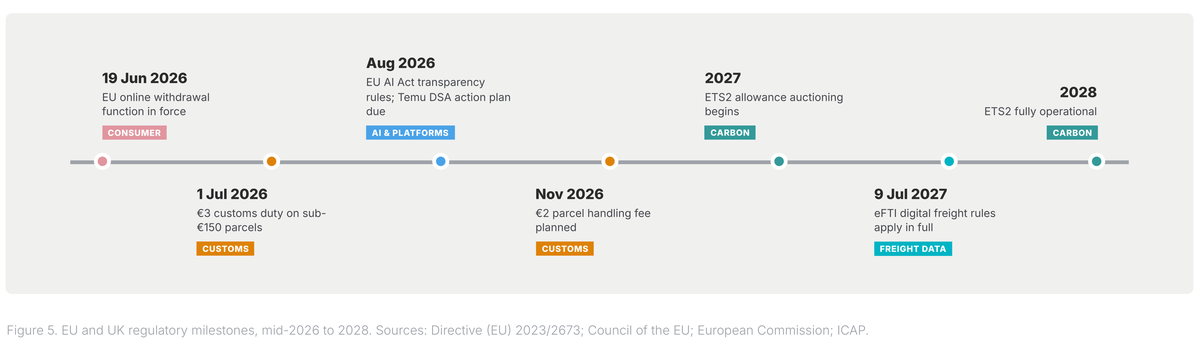
The customs change is live from 1 July, so the question is whether the duty surfaces clearly at checkout or arrives as a surprise on the doorstep; a handling fee has been proposed on top but remains under discussion.
-
August brings a cluster: the AI Act transparency obligations begin applying, and Temu's DSA action plan is due. ETS2 is now set for 2028, but allowance auctioning starts in 2027, so transport-cost models can begin reflecting road-fuel carbon exposure without waiting for the price.
-
eFTI preparation should be visible now. The framework's remaining implementing specifications are due by December 2026, ahead of full application on 9 July 2027, so what needs to be settled this year is: who owns the freight data, which data sets are in scope, how long records are retained, and whether the integration to exchange them through a certified platform is ready.
An organization that answers those questions in 2026 meets the 2027 deadline as a modernization rather than a scramble.
1 July 2026
EU temporary €3 customs duty on goods under €150 begins
On goods from non-EU IOSS sellers, assessed per item by tariff heading. A handling fee remains under discussion.
August 2026
AI Act transparency obligations apply; Temu DSA plan due
The month the tightening clusters.
July 2027
eFTI structured freight data reaches full application
Structure freight data this year to meet it as a modernization, not a scramble.
What to do before peak and budget season
The pattern under all of this is operational, not legal. Within a single half-year, customs, marketplace, AI, consumer-rights, and carbon rules all converged on the same question: can the business show clean, structured order and shipment data the moment someone asks to see it?
Answering the next request, whether it comes from a regulator, an auditor, or a commercial partner, should be a report over data you already hold, not a project to go and collect it.
For the full mid-year check-in across all ten trends, read our report. The same connected data layer that runs checkout, carrier execution, tracking, and returns - namely the nShift platform - is what makes customs, emissions, and service-level obligations answerable from one place.
More from the mid-year check-in:
- Supply chain resilience in 2026: when trade policy became the disruption
- Logistics APIs in 2026: why integration decides how fast you can launch
- Fleet electrification in 2026: what it means for shippers who buy delivery
- Ecommerce delivery options in 2026: choice, conversion, and returns
Ten trends. One mid-year evidence check.
Get the full 2026 delivery logistics mid-year check-in, with the data and recommendations behind all ten trends.
Get the report