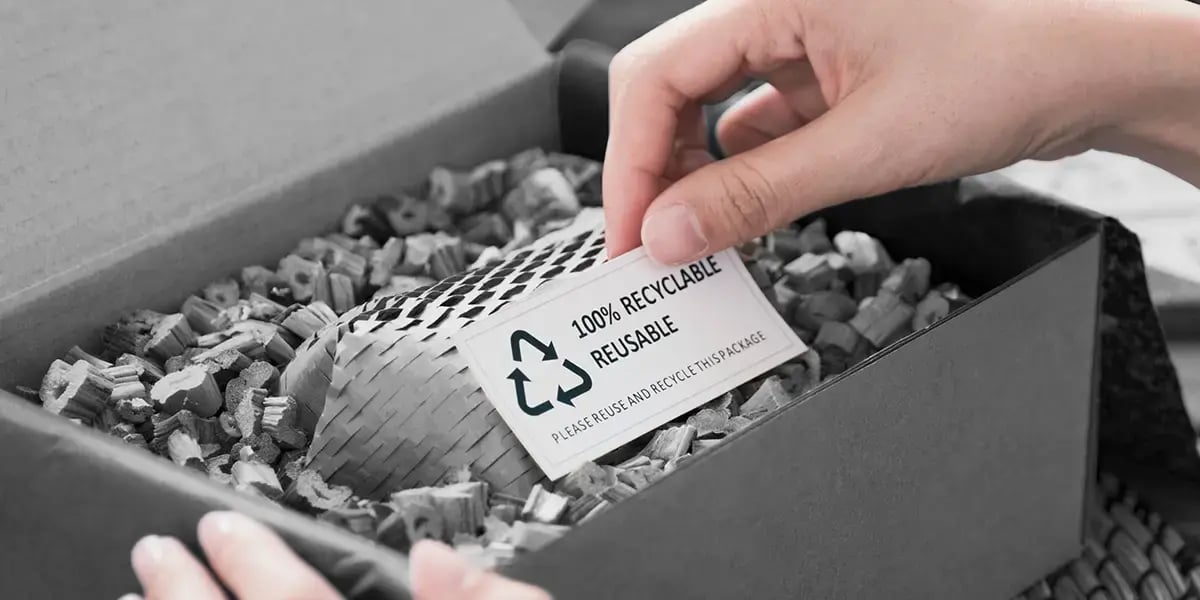
PPWR is the EU's Packaging and Packaging Waste Regulation. It applies from 12 August 2026 and covers every business that places packaging on the EU market, which means the box, the void fill, and the label on every parcel you ship. It sets rules for how packaging is designed, sized, marked, and recovered, and it gives ecommerce teams a reason to take control of packaging data they have rarely measured before.
For most online retailers, the change is concrete: the way you pack an order is now part of how you stay compliant, manage cost, and report on your environmental impact. Treat that as an operational upgrade and you come out of it with smaller parcels, cleaner data, and lower shipping bills.
What does PPWR stand for?
PPWR stands for the Packaging and Packaging Waste Regulation, formally Regulation (EU) 2025/40. It replaces the older Packaging and Packaging Waste Directive and, because it is a regulation rather than a directive, it applies directly across all EU member states without each country writing its own version. That single-standard design is the point: one set of rules covers every market you sell into.
The regulation entered into force on 11 February 2025 and applies from 12 August 2026, after an eighteen-month transition. It reaches manufacturers, importers, distributors, brand owners, and online sellers. If your goods arrive at a customer's door in a box, a mailer, or a pallet wrap, that packaging is in scope, regardless of where your business is based.
You will see PPWR discussed alongside terms like extended producer responsibility, recyclability grades, and void space. Those are the mechanisms inside the regulation, and the sections below explain the ones that change daily operations for an ecommerce team.
When PPWR applies, and the dates that matter
We already said the application date is 12 August 2026, but PPWR rolls out in stages. The general obligations and the duty to minimize packaging start in 2026. The specific numeric caps and material rules phase in through to 2030 and beyond, which gives operations teams a runway to prepare instead of a single deadline to scramble against.
| Date | What takes effect | What to prepare now |
| 11 February 2025 | PPWR enters into force, transition period begins | Map your current packaging sizes and materials |
| 12 August 2026 | General application, packaging minimization duty, extended producer responsibility obligations | Right-size boxes, stand up EPR data and reporting |
| 12 August 2028 | Harmonized material-composition labeling on packaging | Confirm material and label data with suppliers |
| 2029 | Mandatory labels for reusable packaging, including QR codes | Plan reusable formats and how you recover them |
| 1 January 2030 | 50% empty-space cap, minimum recycled content for plastic, recyclability grades A to C, reuse targets for transport and ecommerce packaging | Lock in materials and returns-based recovery |
In practice, 2026 is when the duty to right-size and document your packaging begins, and 2030 is when the hard thresholds bite. Planning against both dates now is far cheaper than redesigning packaging twice.
PPWR applies now, and the 2030 caps are closer than most packaging redesigns.
The PPWR readiness playbook scores your operation against the rules and turns each gap into dated work for 2026 and 2030.
Get the playbookWhat PPWR changes for ecommerce packaging
This is the operational core that lands directly on the people who choose boxes, fillers, and labels.
Packaging minimization and the empty-space cap
PPWR requires you to minimize packaging weight and volume, and it introduces a maximum empty-space ratio of 50% for grouped, transport, and ecommerce packaging.
The duty to minimize applies from 12 August 2026, while the numeric 50% cap is set to take effect from 2030, once the European Commission confirms the calculation method. The ratio measures the gap between the volume of the box and the volume of what is inside it.
One detail trips teams up early: filler does not save you. Air pillows, bubble wrap, foam, and paper shred all count as empty space, not as a way to fill it. The only way to meet the ratio is to use a box that fits the contents.
For retailers running a handful of fixed box sizes, that usually means adding sizes to the range, or moving to right-sizing equipment that builds the carton to the order.
Recyclability by design
From 2030, packaging will need to meet recyclability performance grades, and only packaging graded A to C will be allowed on the market. Lower grades phase out over the following years. Designing for recyclability now protects you from reworking materials later.
Minimum recycled content
Plastic packaging will carry minimum recycled-content thresholds from 2030. If your mailers or protective packaging are plastic, the recycled share becomes a spec you have to track and prove.
Labeling and material marking
From 2028, packaging needs harmonized labeling that shows material composition so customers and sorting systems can separate it correctly. Reusable packaging gains its own labeling, including QR codes, from 2029.
Reuse targets
Transport and ecommerce packaging carries reuse targets from 2030. For online retailers, that connects packaging strategy to the returns flow, because reusable packaging only works if you can recover it.
Extended producer responsibility
You are responsible for the cost of collecting and treating the packaging you put on the market, and you register and report against that obligation. Clean packaging data is what makes the reporting manageable.
Why this lands on ecommerce and delivery teams specifically
Packaging rules used to sit with a sustainability or compliance lead. PPWR pulls them into the daily work of delivery and ecommerce operations, because the obligations attach to the parcel itself.
Keep the records and EPR evidence the rules now require
Extended producer responsibility runs on data. You need to know the materials, weights, and volumes of the packaging you ship, you pay fees based on what you place on the market, and you keep the evidence to report it. The reporting unit is tonnes of packaging by material type, split across paper, plastic, and other categories. Teams that already capture shipment-level data have a head start, because the same records that support carrier billing and emissions reporting feed packaging compliance. Teams that track packaging in a supplier spreadsheet tend to discover the gap late, usually when the first report is due.
Verify producer EPR data if you operate a marketplace
If you run an online marketplace, PPWR expects you to collect and check producer registration and EPR information before sellers list, and to make a genuine effort to confirm it is complete and reliable. That turns seller onboarding into a data-quality task, and it rewards platforms that can validate information at scale.
Cut shipping cost by right-sizing boxes and void fill
The empty-space rule and the cost of carriage point the same way. A box sized to its contents weighs less, costs less to ship, and uses less filler. Right-sizing is one of the few compliance moves that pays for itself, because dimensional weight pricing already penalizes oversized parcels. Most carriers charge on whichever is greater, actual weight or volumetric weight, so a half-empty box is paying to ship air. Trimming a carton by a few centimeters on each side can move a parcel into a lower price band and cut filler at the same time. Compliance and margin improve together here, which is rare in regulatory work.
Hold your cross-border reach with one EU-wide standard
Because PPWR applies directly across the EU, a single packaging approach travels across every market you serve. You design and document once, then sell into all member states on the same basis, which keeps cross-border expansion simple rather than country by country.
How to get your packaging ready for PPWR
Readiness is mostly about visibility: you cannot minimize, grade, or report on packaging you have never measured.
A practical path looks like this:
-
Start with an audit of what you actually ship: the box and mailer sizes in use, the materials, the fillers, and the labels.
-
Map each against the PPWR requirements and flag the obvious gaps, such as oversized cartons or plastic packaging with no recycled content.
-
Bring packaging into the same data layer as your shipment and carrier records, so weights, dimensions, and materials live in one place rather than in a supplier spreadsheet.
-
Then set a right-sizing plan, because reducing box count and void fill delivers compliance progress and cost savings at the same time. Finally, connect packaging to your returns design, since the 2030 reuse targets depend on getting packaging back into circulation.
Consider a mid-sized apparel retailer shipping across several EU markets from one warehouse. It runs three carton sizes and fills the gaps with paper void fill. An audit shows that most single-item orders go out in the medium box, half-empty, which inflates both the void ratio and the volumetric weight the carrier charges for. Adding two smaller box sizes and routing each order to the right one cuts filler, lowers the average parcel cost, and brings the void ratio down well before the cap applies. The same shipment data that proved the problem now feeds the EPR report. That is the pattern PPWR rewards: measure first, then design the parcel down.
None of this requires waiting for the final implementing acts - the audit, the data, and the right-sizing work are useful on their own terms, and they put you ahead of the 2030 thresholds.
How nShift fits the new packaging-and-delivery picture
PPWR is a packaging regulation, and nShift is not a packaging-compliance tool. What nShift gives you is the delivery infrastructure that makes the packaging changes measurable and manageable, so compliance falls out of a well-run operation rather than a separate project.
The mechanism is the data: the nShift platform captures shipment-level detail across your carrier network, and nShift Data Fabric brings that delivery data into one place.
When packaging weights and dimensions sit alongside carrier and shipment records, a change like dropping to a smaller box or switching to lighter material shows up as a measurable shift in cost and carbon, not a guess.
That same data drives emissions reporting. nShift Emissions Tracker provides shipment-level emissions data, with methodology certified by the Smart Freight Centre against ISO 14083 and the GLEC Framework, so the claims you make to customers and regulators are demonstrable. On the recovery side, nShift Returns gives you the routing and visibility to bring packaging back, which is what the 2030 reuse targets will require.
The throughline is control: right-size the parcel, measure the result, report it with confidence, and recover what you can. The delivery setup that does this well is the same one that keeps you ready for each PPWR milestone.
Where the EU packaging rules are heading
PPWR is the near edge of a longer shift toward packaging that is lighter, recyclable, and accounted for. The recyclability bar tightens after 2030, moving toward only the highest grades later in the decade, and the data expectations around packaging keep rising in step with emissions reporting and digital product information.
PPWR also sits alongside other EU rules reshaping post-purchase operations. From 19 July 2026, the EU ban on destroying unsold goods closes off destruction as a default for unsold apparel and footwear, putting the same pressure on returns and recovery that PPWR puts on packaging.
The direction favors retailers who treat packaging as standing infrastructure rather than a one-time fix. Measure it, design it down, and connect it to delivery and returns, and each new requirement becomes an adjustment rather than an overhaul.
Want to get your delivery and packaging data ready for PPWR? Talk to nShift about building the visibility behind it.
Score your operation. Then plan one redesign, not two.
A ten-point self-assessment across packaging data, right-sizing, materials, EPR reporting, and reuse, with dated worklists for 2026 and 2030.
Download the playbookFrequently asked questions about PPWR
When does PPWR come into force?
Does PPWR apply to ecommerce packaging?
What is the 50% empty space rule under PPWR?
Who does PPWR apply to?
What is the difference between PPWR and the old packaging directive?

About the author
Thomas Bailey
Thomas Bailey was Product Innovation Lead at nShift. The role focused on making new features and platform improvements deliver real value to customers. With a background in product, tech and go-to-market strategy, Thomas wrote about checkout, returns and delivery experience from a practical angle. The articles reflect nShift's thinking when they were published.