The problem
Delivery costs more than you think, and most of it is preventable
Shipping appears on the P&L. The damage poor delivery does to conversion, retention, and operational overhead usually does not. Four cost drivers account for most of the gap.
Cart abandonment
48% of online shoppers abandon their cart when extra costs (shipping, taxes, fees) are too high. Another 24% leave because delivery is too slow. For a retailer with 500,000 monthly sessions and a 2.5% conversion rate, a single-percentage-point lift means 5,000 extra orders per month.
WISMO and service cost
The average inbound call to a European contact center costs GBP 5.58. WISMO inquiries make up 30-40% of post-purchase support volume. For a retailer handling 5,000 monthly orders, that can mean 100+ avoidable calls a month, each tying up agent time that could go toward revenue.
Return processing
Processing a return costs 21% of the order's value on average. In European e-commerce, return rates run 20-25%, with fashion hitting 26-30%. Better delivery information prevents some of those returns, and an exchange on the rest keeps the margin in the business.
Failed deliveries
A failed first delivery attempt costs roughly EUR 14 per parcel once you add re-delivery, storage, and customer service. European warehouse labor runs EUR 34.90/hr (EU average) to EUR 55.10/hr (Nordics) and is climbing 4.1% year-on-year. Every manual touch in that workflow runs at those labor rates.
Delivery speed now outweighs loyalty-program membership when people decide where to shop, and they will switch to get it; 52% of consumers have stopped buying from a brand after a bad experience. Almost none of it appears on the shipping line of the P&L, which is why it so often goes unmanaged.
Lever one
Delivery options at checkout lift conversion and order value
Most checkout abandonment has nothing to do with product price. It happens because the delivery options are too few, too expensive, or too slow. When customers can pick the carrier, speed, and collection point that suits them, conversion goes up and baskets get bigger.
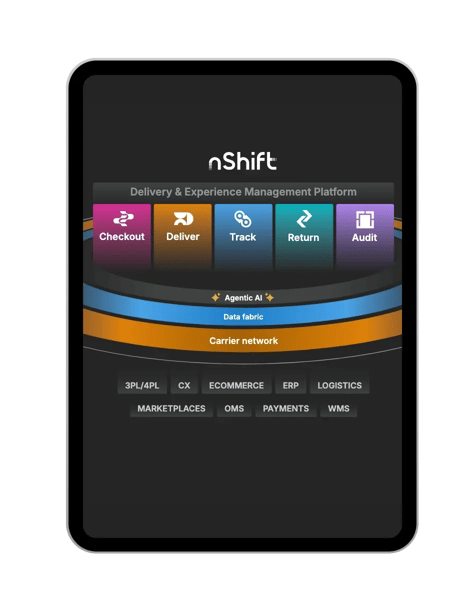
nShift Checkout connects to 1,000+ carriers and shows the right delivery options (home delivery, PUDO points, time slots, express) at the moment of purchase. Options update live based on the shopper's location, basket weight, and carrier availability. The retailer controls what appears and how it is priced.
20%
checkout conversion increase. 70% of Nordic customers chose the new PUDO option.
28%
higher average order value
4%
conversion lift, plus 28% higher average order value
We're seeing a clear increase in customer satisfaction and conversion with a 4% increase in conversion and a 28% increase in order value. For those of us who already have a good conversion rate, these are great numbers.
Fredric Boson, CEO
Topformula and Scandinavian Luxury Group independently reported the same 28% rise in average order value, which points to delivery choice shaping basket size directly. Conversion gains were broader, from 4% to 25%, with abandonment down as much as 20%, and the spread reflects how much room each retailer had to begin with.
Lever two
Multi-carrier automation cuts shipping costs and gives warehouse hours back
Manual carrier selection, label printing, and booking are the biggest hidden tax on fulfillment. Every minute a warehouse worker spends choosing a carrier or printing a label is a minute they are not picking, packing, or shipping the next order. Without automation, most businesses default to one or two carriers and overpay.
nShift's Deliver suite (nShift Ship, nShift Delivery, and Transsmart) automates carrier selection, label printing, booking, and documentation across 1,000+ carriers from a single integration point. Business rules decide which carrier handles each shipment based on destination, weight, speed, and cost, and the platform rate-shops each parcel automatically for the cheapest compliant option.
90%
less time per shipment, saving 35 printing hours per day
We are saving 35 printing hours per day and doing more orders in the same time, with less people, less stress, reducing energy and reducing plastic waste.
Edwin Schildkamp, Project Manager
<6 months
ROI payback on initial project costs
The payback from the initial project costs was less than six months. And with approximately 20-30% of our parcel volume now via the new letterbox service, we have seen substantial savings that wouldn't have been possible without nShift.
James Henry, Head of Multichannel Operations
Scale references
Platform-wide delivery numbers
Proshop: 30,000 orders per day with zero downtime
Elgiganten: 5 million parcels a year through the platform
Wittusen & Jensen: saved the equivalent of an entire annual salary automating 400,000 parcels per year
Imerco: 14% annual shipment growth and 240% peak increase supported without platform changes
Across ten customers, time per shipment fell by 75% to 95% and warehouse efficiency rose by 15% to 40%. The labor that frees up runs to FTE months or full annual salaries, and the same automation leaves room to enter new markets or absorb peak volume without adding staff. Multi-carrier rate shopping takes another 10-15% off shipping costs platform-wide, though the operational labor savings are often the larger of the two.
Lever three
Branded tracking cuts support costs and drives repeat purchases
After a customer clicks "buy," the delivery experience decides whether they come back. Most retailers hand that experience to carrier tracking pages they do not control and cannot brand. The result: a flood of "where is my order?" calls to support, and a missed chance to sell again while the customer is still watching the parcel.
nShift Track gives retailers branded tracking portals and proactive delivery notifications (email, SMS) under their own branding. Customers see real-time shipment status without calling support. The same tracking page also carries branded content, product recommendations, and feedback prompts alongside the delivery updates.
27%
reduction in customer service calls
The advantage of having full control over the shipment experience is that customers do not feel abandoned after pressing the 'Buy' button. They feel like they have closer contact with us because statuses are sent the entire time, they can follow their order and ultimately leave feedback when the product has been delivered.
Pär Svärdson, Managing Director
5×
average email marketing click-through rate
nShift has significantly improved our post-purchase experience which has reduced calls to our customer service team, improved our brand perception and boosted our bottom line.
Haroun Saleemi, Head of E-commerce
Proactive delivery communication cuts the load on support teams, and the branded tracking page and delivery emails drive repeat purchases. Across the platform, WISMO calls fall by about 50%, with individual results between 27% and 90% depending on starting point and implementation depth.
Lever four
Returns recover margin when you handle them well
Most businesses treat returns as a cost to absorb. Processing one return costs 21% of the order's value on average, and European e-commerce return rates run 20-25%. Handled well, returns change that math. An in-store return puts the customer back in the store, an exchange keeps the original revenue, and automated workflows cut the cost of processing each one.
nShift Returns digitizes the process: customers start a return through a branded portal, choose a return method (mail-back, in-store, PUDO), and get a pre-paid label or QR code. The retailer controls which options appear, can offer exchanges before refunds, and routes returns to the cheapest destination.
30%
repeat return customers (platform-wide)
15%
increase in in-store returns, creating direct repurchase opportunities for store teams
Hunkemoller's 15% shift to in-store returns captures both a cost saving (no return shipping, no warehouse receiving) and a revenue opportunity (the customer is back in the store). Combine the channel shift with processing automation and the gains compound. A full refund loses 21% of order value to processing on top of the reversed revenue; an exchange costs only the processing and keeps the sale. Steer returns toward exchanges instead of refunds and you keep the order value you would otherwise hand back.
Risk reduction
The cost of downtime is never zero
Every number so far assumes the platform stays up. The moment it doesn't, the losses outrun the gains: a peak-season outage freezes the warehouse, floods the support queue, and sends customers to whoever can still deliver. Any honest financial case has to price that in.
When shipping goes down
For a retailer processing 500 orders per hour at EUR 85 average order value, a four-hour shipping outage means EUR 170,000 in delayed or lost revenue. Add customer service escalation, carrier SLA penalties, and the reputational fallout from late deliveries, and the real cost multiplies.
65M
parcels processed, Black Friday month 2025
25/sec
peak throughput
300%
order surge handled with zero downtime
It's critical that we have a stable system that can handle that amount of pressure. It's about reliability, and it's about flexibility. With nShift, there is zero downtime. This makes it a no-brainer.
Ronnie Stormfeldt, Head of Logistics
Consistent delivery accuracy across time-sensitive transport schedules
It is very important to us that our transports go exactly according to schedule. That places a high demand on our systems to always be stable, which nShift's always have been. That is something we truly appreciate.
Tord Tillman, Process Specialist
Reliability proves itself in the losses that never happen: the revenue and customers you keep when demand spikes, when a carrier rewrites its API overnight, when a peak week leans hard on the infrastructure. A shipping system built in-house would have to weather Proshop's 300% surge and Stockmann's 30x spike to make the same claim. The platform pushed 65 million parcels through last Black Friday without breaking stride.
Build vs. buy
The hidden cost of doing it yourself
Delivery management looks simple from the outside: print a label, book a carrier, dispatch the parcel. Some businesses take that as a cue to build their own integrations, wiring up the carriers through their own APIs or ERP.
It works at first. Then the carriers change their formats, every new market needs another connection, and the maintenance never lets up, until the developers who should be building the product are keeping the plumbing alive instead.
We came up against so many bugs when we tried connecting all the systems together. That's why we ultimately chose to put our solution to one side and implement the all-in-one solution offered by nShift and Walley instead.
Fredric Boson, CEO Topformula
Before using nShift, we had direct links to our carriers, which were APIs. But creating and enhancing those links was time-consuming. With nShift, it's easy. We don't have to spend any time coding ourselves.
Ronnie Stormfeldt, Head of Logistics Proshop
Before, we coded our own labels for the different carrier products in our WMS system, which was time-consuming due to continuous updates from the carriers. Today, nShift does all this, so we instead are able to focus on what we do best.
Peter Slatcher, Logistics Manager Prime Cargo
Consolidation economics
What consolidation actually saves
I believe nShift to be highly cost-effective. Much more cost-effective than if we had created our own custom solution.
Teemu Kangas, Ecommerce Specialist Happy Angler
Thanks to nShift's SaaS solution, there is no limit to how much we can grow and the changes we can make ourselves without the support of expensive and time-consuming development.
Petri Ventelä, Head of Logistics Gina Tricot
450+
integrations maintained by the platform
1/5
of revenue invested in R&D
In-house means owning every carrier API, every label-format update, every new-market integration, and every compliance change yourself, while your developers could be building features that bring in revenue instead.
Option value
New markets, carriers, and products become configuration changes
The numbers so far measure the first deployment. The real value, though, arrives six months on: a new market, another carrier, a product you switch on over a weekend. On a platform, handling each of those takes a configuration change. Without one, each becomes a fresh integration project, with its own timeline, budget, and risk of slipping.
153%
international shipment growth
What makes nShift an ideal partner is that, as we grow, nShift will grow with us. Whether it's localizing logos on delivery options, creating access to relevant carriers in new geographies or setting up new rules around delivery times, nShift gives us the agility to fulfil our ambitions.
Yasser Shabbir Sveder, Head of E-Commerce
Through nShift we integrated with multiple carriers very quickly which saved a huge amount of time and effort. It also enabled us to acquire new customers and start new projects fast, helping business growth a lot.
Jia Mo, International Logistics Europe JD Logistics
Every new storefront adds complexity, but nShift makes that complexity invisible. We can launch quickly, scale quickly and still deliver the same high standard to customers.
Emil Henriksson, CEO Sweden Buyers Club
With nShift's huge carrier network, it is as easy as flicking a light switch.
Cedric Poupon, Logistics IT Project Manager Somfy
Skip the integration project, the vendor evaluation, and the development sprint, and what you save is both cost and time to revenue. For a retailer opening a new European market, six weeks of carrier integration versus a same-day switch-on can be the difference between missing the seasonal peak and owning it. And because every new market, carrier, and product lands on infrastructure that is already there, each one costs less and moves faster than the last.
Composite model
What does this look like for a single business?
Product-by-product ROI tells you where to start. The numbers change when all four levers run together and the gains compound.
Conservative scenario
Example: a European retailer with 500,000 monthly sessions
Assumptions: 500,000 monthly sessions, 2.5% conversion, EUR 85 AOV, 12,500 monthly orders, 150,000 annual shipments, 20% return rate, 40% gross margin.
| Lever | Mechanism | Annual value | Type |
|---|---|---|---|
| Checkout | 4% conversion lift + 5% abandonment reduction | ~EUR 1.86M | Incremental revenue |
| Ship | 10% shipping cost reduction on 150k shipments | ~EUR 75k | Cost saving |
| Ship | 500 warehouse hours saved annually | ~EUR 17.5k | Labor saving |
| Track | 30% WISMO reduction on 3,000 annual calls | ~EUR 4.5k | Direct saving |
| Track | 2% return rate reduction (600 returns retained) | ~EUR 20.4k | Margin retained |
| Returns | 5% in-store shift + labor saved + support calls avoided | ~EUR 56k | Combined saving |
| Conservative annual total | ~EUR 2.03M (EUR 1.86M revenue + EUR 173k savings) | ||
| Moderate annual total | ~EUR 6M+ (Checkout contribution roughly triples; operational savings roughly double) | ||
EUR 155k
revenue lost per month of delay (Checkout alone)
Harvey Nichols reported full payback from initial project costs in under six months. They are the only customer with an explicit payback statement, but the broader evidence points the same way: measurable results in weeks to months, not years. DTK saves 35 printing hours per day. Wittusen & Jensen saved the equivalent of an entire annual salary. Bauhaus went live in 48 hours. None of the 30+ customer stories in this report describe a multi-year implementation with delayed returns.
The conservative annual Checkout value in this model is EUR 1.86M. That is EUR 155,000 for every month you wait. The operational savings alone (Ship, Track, Returns combined at EUR 173,000/year) add another EUR 14,400 per month. Revenue and margin lost to delay cannot be recovered after the fact.
The conservative scenario uses cautious assumptions across every lever. No business starts with all four products at once, and results vary by baseline maturity. The model shows the ceiling for a fully integrated deployment; no business hits it on day one. Most nShift customers start with one or two products and expand as they prove value.
Implementation
Live in days, value in months
A delivery management platform justifies itself quickly when the integration is fast and the first carrier goes live within weeks. nShift's implementation model is built for speed: dedicated project manager, technical consultants, and a PMI-based project process.
48 hrs
from kickoff to go-live, scaling to 750,000 annual orders
During the pilot phase, nShift surpassed expectations while the implementation proved to be simple and fast. nShift's speed and scalability has given us the confidence to expand the partnership.
Håkan Asp, Logistics Development Manager
3× faster
implementation than quoted alternatives
nShift was able to offer implementation in a third of the time quoted compared to its competitors. The number of carrier integrations they could offer was much higher as well.
James Henry, Head of Multichannel Operations
Speed indicators
How fast customers go live
Bauhaus: live in 48 hours, 200,000 pilot orders, scaling to 750,000
Sweden Buyers Club: all carriers configured within 48 hours for peak readiness
RevolutionRace: "Our priority was to get up and running quickly with as little hassle as possible. And that is exactly the outcome we got."
Mobile Climate Control: measurable financial benefits visible after the first months of operation
Proshop: 30,000 orders per day shipped with zero downtime
Imerco: 14% annual shipment growth and 240% peak increase supported without platform changes
Emissions
Carbon reporting built into the workflow you already run
The EU sustainability reporting landscape has narrowed, but transport emissions data still matters. Companies in scope need value-chain evidence, and many suppliers will still be asked for shipment-level data by customers, investors, or procurement teams. For businesses already managing shipments through a delivery platform, that data is easier to capture inside the workflow they already run.
nShift Emissions Tracker is SFC-certified against ISO 14083 and the GLEC Framework (certified March 2026). It calculates the carbon footprint for every shipment processed through the platform, using carrier-specific data where available and standardized emission factors where not.
Companies that already track emissions through their delivery management platform absorb the compliance cost into existing workflows instead of building a parallel reporting stack. The incremental effort is lower when emissions data runs on the same shipment data that powers label generation and carrier selection.
For businesses where sustainability is a customer-facing value (D2C brands, Nordic retailers, companies selling into ESG-conscious supply chains), visible emissions data at checkout can also lift conversion, letting shoppers choose lower-emission delivery options.
KPI framework
A measurement checklist by product area
ROI reporting works when the metrics are specific, the cadence is regular, and someone captured the baseline before go-live. It gives operations and e-commerce teams a place to begin, so delivery ROI is tracked from week one rather than reconstructed later.
Checkout
| Metric | Cadence | Baseline source |
|---|---|---|
| Checkout conversion rate | Weekly | Google Analytics or shop platform |
| Cart abandonment rate | Weekly | Google Analytics or shop platform |
| Average order value | Weekly | Order management system |
| Delivery option selection mix | Monthly | nShift Checkout dashboard |
Ship
| Metric | Cadence | Baseline source |
|---|---|---|
| Shipping cost per parcel | Monthly | Finance / carrier invoices |
| Time per shipment (label to dispatch) | Monthly | Warehouse management system |
| Carrier mix and rate shopping savings | Monthly | nShift Ship dashboard |
| Warehouse hours allocated to shipping | Quarterly | Operations / HR |
Track
| Metric | Cadence | Baseline source |
|---|---|---|
| WISMO call volume | Monthly | CRM / ticketing system |
| Tracking page engagement (opens, clicks) | Monthly | nShift Track dashboard |
| Post-purchase email CTR | Monthly | nShift Track dashboard |
| Delivery-related NPS or CSAT | Quarterly | Customer survey |
Returns
| Metric | Cadence | Baseline source |
|---|---|---|
| Return rate (%) | Monthly | Returns platform or OMS |
| Exchange-to-refund ratio | Monthly | nShift Returns dashboard |
| In-store return share (%) | Monthly | POS / returns data |
| Processing time per return | Quarterly | Warehouse operations |
Emissions
| Metric | Cadence | Baseline source |
|---|---|---|
| CO2e per shipment | Monthly | nShift Emissions Tracker |
| % of shipments with carrier-specific data | Quarterly | nShift Emissions Tracker |
| Low-emission delivery option selection rate | Monthly | Checkout + Emissions Tracker |