The third of ten deep-dives in our 2026 delivery trends mid-year check-in: the standards race we expected in freight documents broke out at checkout instead.
Our 2026 trends report argued that logistics was shifting from bespoke, point-to-point integrations to API-driven ecosystems, and that a company's ability to join and switch partners would depend more on its APIs than its assets.
What we said in early 2026:
Custom point-to-point integrations are giving way to shared platforms and standardized APIs. Regulation such as eFTI and industry standards like DCSA’s API models and electronic bills of lading push freight data into structured, machine-readable formats. In 2026, the most attractive partners are those that are easy to plug into, from carrier connectivity to documentation and tracking.
Six months on, that has held, and it has moved fastest in an unexpected place. A retailer can sign a marketplace deal and still wait weeks to ship, because one carrier the contract requires is not integrated yet. The commercial agreement is ready; the integration is what holds up the first order.
What an API ecosystem in logistics means
A logistics API ecosystem is the set of documented connections that let a retailer or brand plug delivery capability, carriers, checkout options, tracking, returns, and customs data, into their own systems and their partners' systems through standard interfaces rather than one-off custom builds. In practice it decides how fast you can add a carrier, launch in a market, or expose a delivery promise to a marketplace or an AI assistant. The stronger the ecosystem, the closer "add this carrier" gets to configuration instead of a project.
Why partners now pick you for your APIs
The old competitive question in logistics was about assets: fleet, warehouse space, network reach. The 2026 question is increasingly about connection; when a marketplace, a retailer, or a carrier evaluates whether to work with you, they are asking, in effect, how quickly and cleanly you can plug into what they already run.
For a retailer, that shows in how fast you can add the carriers a new channel requires, and how much of the delivery menu you can stand up in a new market without a build.
For a carrier or logistics provider, the same force runs in reverse: providers with well-documented APIs and reliable event streams are easier to add to a shipper's multi-carrier setup, and in our experience that ease is increasingly a factor in tenders. A carrier that is slow or costly to integrate can lose volume it would otherwise win on rate.
An asset advantage still counts, but it can be offset by a connection that is hard to work with, because a buyer tends to route volume to whoever they can onboard before the season starts. That makes the quality of your APIs part of your commercial offer, read by the people deciding whether to send you business.
Two integration fronts moved in 2026, at very different speeds
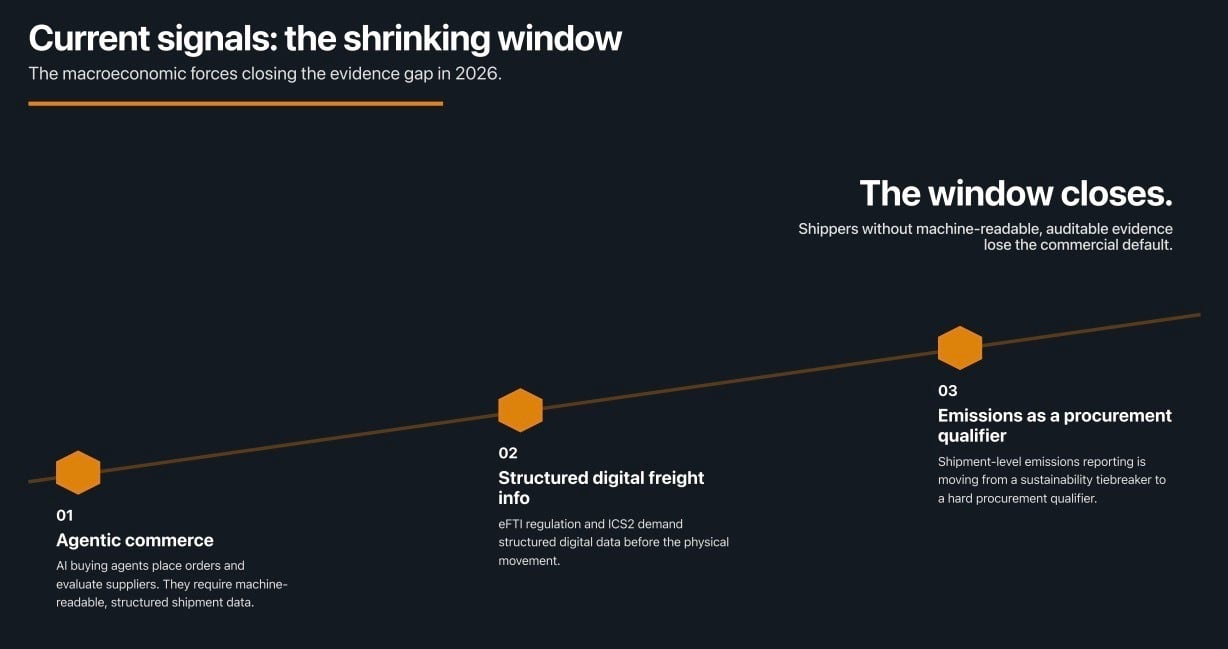
The freight-data side moved on schedule, as regulation intended. The EU's eFTI framework is in its build year, with certified platforms and authorities preparing through 2026 and full application from 9 July 2027, when authorities across the EU must accept electronic freight information through certified platforms. The Commission estimates savings of up to €1 billion a year for the sector.
Alongside it, DCSA member carriers hold to their pledge of 50% electronic bills of lading within five years and 100% by 2030. This side is predictable and moves to a public timetable.
The commerce side moved the other way. Between April 2025 and January 2026, five competing agentic commerce protocols launched: OpenAI's Agentic Commerce Protocol, Google's AP2 with more than 60 partners, Visa's Trusted Agent Protocol, Mastercard Agent Pay, and then a Universal Commerce Protocol backed by Google, Shopify, and a coalition of major retailers and payment networks.
The standards contest we predicted for freight documents is happening first over how machines read offers, prices, and delivery terms. We cover that shift in our agentic commerce guide.
As for logistics specifically - the commerce stack is being rebuilt around interoperable protocols, and delivery data is part of what those protocols carry.
5 protocols
competing agentic commerce standards launched in nine months
April 2025 to January 2026, incl. OpenAI ACP, Google AP2, UCP
€1bn
estimated annual EU savings from electronic freight information
European Commission estimate for the eFTI framework
9 July 2027
eFTI applies in full; authorities must accept e-freight data
2026 is the build year for platforms and authorities
The two fronts call for different plans
Because it's public and dated, the freight-data timeline is the straightforward one to plan for: structure your shipment and documentation data through 2026 so that joining a certified eFTI platform in 2027 is a connection rather than a scramble.
The commerce-protocol side cannot be planned that way: five protocols launched in nine months, payment networks and platforms are backing different combinations, and merchants are being advised to expect a multi-protocol world rather than a single winner. Committing an integration strategy to one protocol is a real risk.
The more defensible approach: keep the delivery data structured and exposed cleanly enough that supporting a new protocol is a mapping exercise rather than a rebuild. The work that makes carrier onboarding repeatable makes protocol support repeatable too, because both depend on the same thing: clean, well-modeled data behind a documented interface.
Getting the freight-data side ready
A shipper can prepare for the freight-data change on a known timetable: eFTI is less about new paperwork than about making the freight and transport information regulations already require, such as consignment and dangerous-goods details, structured and exchangeable through a certified platform, so that authorities across the EU accept it electronically from July 2027. Preparing early is a choice about when to do the work, not whether: getting the shipment and documentation data into a consistent, machine-readable shape during 2026 means connecting to a certified platform later can be a configuration step rather than a last-minute one. The same structured data may also support other uses, such as reducing manual freight paperwork, though how much depends on an organization's current systems.
Read more about evidence-grade delivery here.
Integration debt is commercial delay
For logistics leaders, the cost of fragmented integration now appears as commercial delay: slower market launches, a thinner set of delivery options at checkout, harder carrier switching, and weaker performance in everything downstream that depends on clean connections, from visibility and emissions reporting to AI and whether an agent can read your delivery terms at all.
Superdry's logistics team addressed the operational version of this: some of its third-party sites contractually require specific carriers, so a carrier missing from the platform has to be added fast, not next quarter. One connection into a large carrier library can turn that from an integration project into a configuration change, which is the difference between capturing a channel and missing its launch window.
The reasonable objection? Of course you can build each integration when a deal needs it, and at low volume that holds. But it will stop holding when deals arrive faster than engineering can connect them, and when every new marketplace expects you to already speak its protocol. At that point, the backlog itself starts to lose deals.
The new test: can a machine read your delivery?
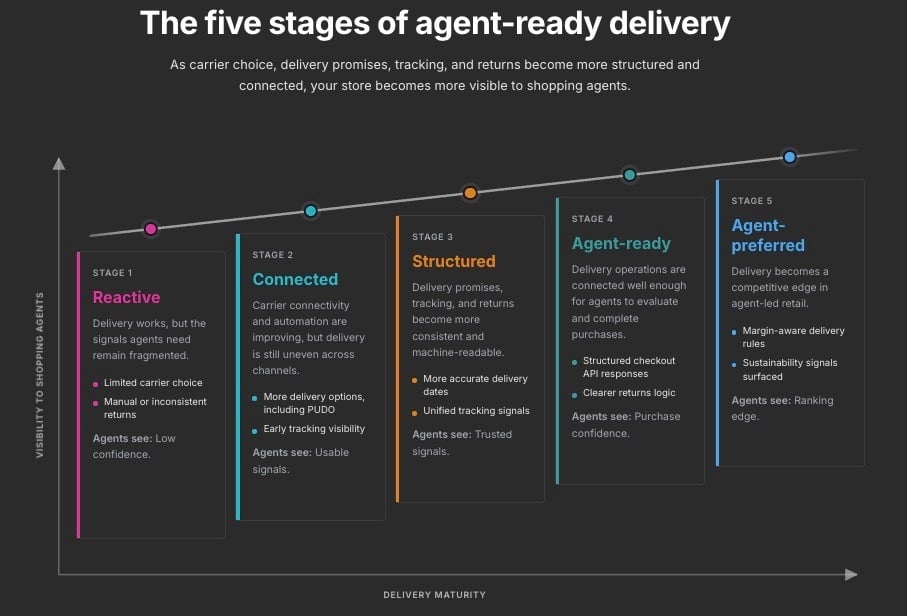
APIs are now how logistics systems connect, and in 2026 they also became how AI assistants read a retailer's delivery options. When an assistant compares options for a shopper, it reads structured delivery data, options, dates, fees, and returns terms, through an interface. A delivery proposition a machine cannot parse is harder for it to present accurately, which points to a growing reason to expose delivery data in a structured, machine-readable form. For retailers, integration used to be mostly a back-office concern; it increasingly affects whether an assistant can present their delivery options at all.
Read more about agentic commerce here.
It is worth checking what a machine can read from your checkout: whether the structured data includes the delivery date, the fee, and the returns terms, or only the price. An assistant can only weigh a delivery proposition it can read, so one exposed as a price alone is one it cannot fully evaluate. Returns terms belong in that structured data too, as part of the offer rather than a footnote.
What agent-readable delivery requires
Making delivery legible to a machine is concrete work, not a setting to switch on. Where a channel or protocol supports it, the aim is to expose each option as structured data an agent can compare: a named service, a specific promised date or window rather than a vague "standard delivery", a total price that includes known surcharges and, for cross-border, an estimated duty where available, and the returns method and refund terms attached to the order.
Not every protocol supports every field, so the practical goal is to model this data cleanly once and expose as much of it as each channel allows. The common gap today is that a checkout shows all of this to a human through layout and fine print, yet exposes only a price to a machine.
What a strong integration model looks like
A strong integration model has a few recognizable traits, worth checking for before you buy anything that sits on top:
Onboarding a new carrier is a configuration step rather than a fresh build, because the connection already exists in a maintained library. When a carrier deprecates an old API version, changes a required field on its shipping label, or updates its tracking event codes, a maintained-library model is designed to handle that change once, centrally, rather than leaving each shipper to fix a broken integration in the middle of peak. Delivery data arriving in one consistent shape across carriers means the systems downstream, checkout, tracking, returns, and emissions reporting, do not each need their own translation layer, and the same delivery information can be exposed outward, to a marketplace, a checkout, or an AI assistant, without a bespoke build for every channel.
Repeatability is what separates these models in practice: whether the tenth carrier, market, or marketplace can be added the same way as the first, or whether each one restarts the project. With a repeatable model, engineering time goes to things customers notice; without one, it goes to rebuilding the same connections.
Measure integration debt in commercial terms
Integration is often tracked as an engineering backlog, which conceals its obvious commercial cost. Two metrics bring it into view:
-
First, how many weeks pass from signing a new carrier or marketplace to the first live shipment.
-
Second, how many bespoke, one-off connections you retire each quarter against how many you add. If that second number keeps climbing, integration debt is building faster than it is being paid down, and each new launch starts from a slower position.
When the weeks from a signed carrier contract to a live shipment are spent building and testing a bespoke connection, a market launch can slip an entire peak because a required carrier is not ready in time. Where the connection already exists in a maintained carrier library, that onboarding is a configuration change rather than a build, which can be the difference between launching on the date the commercial team committed to and launching when engineering can reach it. The size of that gap is worth measuring in your own environment rather than assuming a figure.
A repeatable integration model, one connection to a large carrier library plus documented APIs for the rest, turns carrier onboarding and market launches from projects into configuration. That is the model nShift Go and our carrier connectivity are built on. The same approach applies upward: exposing delivery options, promises, and returns terms through APIs that assistants and agents can read, so that what a retailer offers is visible to the systems now comparing it.
What it means before peak
Before peak, the useful step is to measure integration the way the commercial team already experiences it: the weeks from signing a carrier to the first live shipment, and whether that figure is rising or falling as new carriers are added. Where it is rising, the slowest connections are the ones to move into a repeatable model first, before a launch depends on them.
A commercial team commits to a go-live date for a new market or channel, and a required carrier cannot be live by then because its integration is still being built; closing the gap between those two dates is most of what an API strategy is for.
For the full mid-year check-in across all ten trends, read the full report. For the demand side of this shift, how AI assistants are changing discovery and what agent-readable delivery requires, see our agentic commerce guide.
More from the mid-year check-in:
- AI shopping in 2026: the agentic inversion and what it does to your delivery promise
- Ecommerce delivery options in 2026: choice, conversion, and returns
- Supply chain compliance in 2026: one data backbone, not ten projects
Ten trends in one mid-year evidence check.
Get the full 2026 delivery logistics mid-year check-in, with the data and recommendations behind all ten trends.
Get the report