The fourth of ten deep-dives in our 2026 delivery trends mid-year check-in: the delivery menu became a conversion lever, and returns moved first.
Our 2026 trends report called delivery choice a baseline expectation and warned that missing the option a shopper wants costs the sale.
What we said in early 2026:
Delivery choice is now a baseline expectation, out-of-home infrastructure is mature and still expanding, and, as we framed it then, miss the delivery or returns option a shopper wants, and you lose the sale. Omnichannel and out-of-home become the operational default in 2026, promise accuracy becomes the primary experience metric, and returns shift out-of-home even faster than deliveries.
The mid-2026 consumer data puts numbers on it. DHL's 2026 E-Commerce Trends Report, drawing on 29,000 shoppers across 29 countries, found that 67% of online shoppers have abandoned a cart because of the delivery offering, and about seven in ten will leave if the delivery or returns options they want are missing at checkout. The options on the page are now part of whether the order completes.
What ecommerce delivery options are
Ecommerce delivery options are the choices a shopper sees at checkout for how and when an order arrives: home delivery at different speeds, click and collect, pickup points and lockers (out-of-home), nominated-day or timed delivery, and the returns methods offered alongside them. In 2026 the useful question has shifted from how many options to offer toward which ones a given market, basket, and postcode reward, and which the network can reliably keep.
The 2026 data: choice, trust, and out-of-home
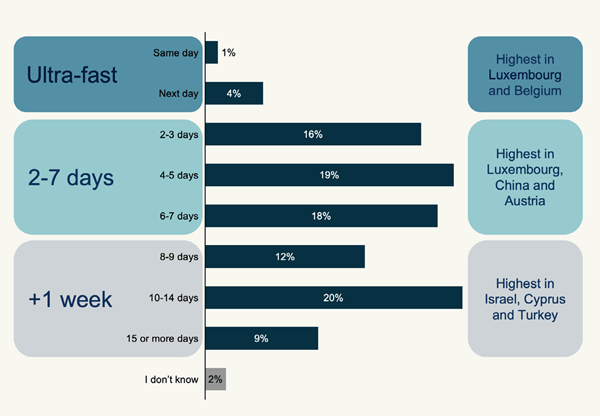
The DHL research goes past cart abandonment. Seven in ten shoppers said that trust in the delivery partner, and being able to choose it, matters when they decide where to buy. Almost three in ten now send deliveries to an out-of-home point, four in ten hold a delivery-and-returns subscription, and more than six in ten returns already happen out of home. The International Post Corporation's survey of nearly 31,000 shoppers across 37 countries adds a speed marker: the share of cross-border parcels taking 15 days or longer fell from 29% in 2020 to 7% in 2025. Expectations have reset, and for a large minority of shoppers out-of-home has moved from a convenience to a default.
The four in ten shoppers holding a delivery-and-returns subscription are a signal in their own right: a segment now treats predictable delivery and easy returns as something worth paying for up front, which rewards retailers whose options are consistent enough to build a subscription around.
67%
of online shoppers have abandoned a cart over the delivery offering
DHL 2026 E-Commerce Trends Report, 29,000 shoppers
6 in 10
returns now happen out of home, ahead of deliveries
DHL 2026 E-Commerce Trends Report
20%
conversion increase after Flying Tiger rebuilt its delivery choices
Flying Tiger Copenhagen, with nShift Checkout and better PUDO options
Returns are now part of the buying decision
One DHL finding reframes returns as a pre-purchase factor rather than an after-sales cost. About seven in ten shoppers said they will abandon if the returns options they want are missing at checkout, which means the return method is read before the order is placed, not after it arrives. A visible, low-friction return path, an out-of-home drop-off with a clear refund window, is part of what convinces a hesitant shopper to commit, especially in high-return categories like apparel. A retailer that buries returns terms deep in a policy page loses that reassurance at the point the shopper is deciding whether to buy.
Trust and the choice of carrier
The same seven in ten shoppers told DHL that trust in the delivery partner, and the ability to choose it, affects where they buy. This moves the carrier from a back-end decision the retailer makes invisibly to something the shopper weighs. In a market where one carrier has a poor local reputation, offering an alternative and naming it at checkout can be the difference between a completed order and an abandoned one. The same logic extends to returns: a shopper who trusts the return carrier and route has one less reason to hesitate over a product they might send back. Carrier choice, once an operations decision, is now part of what the shopper sees and judges.
The delivery menu is a merchandising decision
When choice matters, the instinct is to add options. The more useful move, in our experience, is the opposite: a smaller set tuned to each market rather than one national template. A locker option belongs high on the page where locker habits are established and lower where they are not. A two-day promise should not appear in a postcode where the carrier is running three days late. Deciding which options show, by market, postcode, basket, and product type, using conversion and failed-delivery data, is closer to a merchandising decision than a settings screen filled in once.
Flying Tiger Copenhagen rebuilt its delivery choices around better PUDO options with nShift Checkout and recorded a 20% increase in conversions. The gain came from matching the options to where and how its customers collect, rather than from offering more of them.
Placing out-of-home in the menu
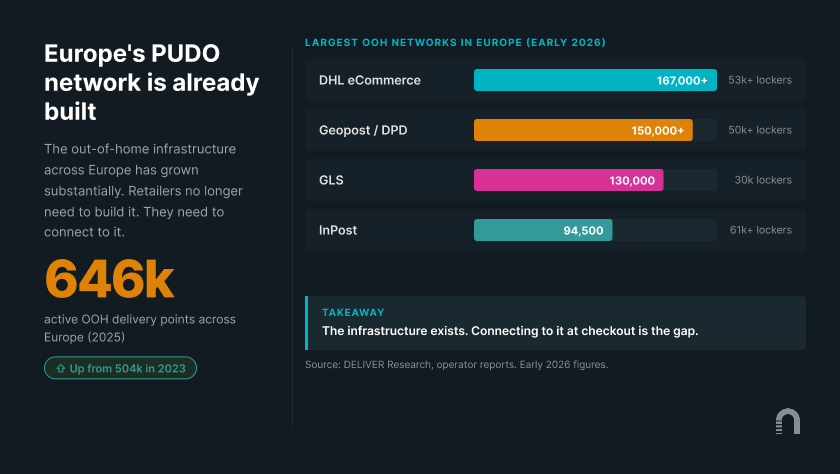
Out-of-home is where menu tuning shows the clearest payoff, because locker and pickup-point behavior varies significantly by market. Where collection is habitual, showing a pickup point or locker high in the menu, or setting it as the default for smaller parcels, is worth testing: it can lift conversion and lower failed-delivery cost at once. Where collection is not habitual, the same option pushed to the top can add friction instead. The tuning? Which out-of-home points are close enough to the shopper to matter, whether they have capacity at peak, and whether the same points can take returns as well as deliveries. Those are per-market decisions, which a single national setting for out-of-home cannot capture.
Credible choice depends on what the checkout can see
A retailer can only present an option it can keep. Showing a locker option means the checkout can see local out-of-home locations and their capacity. Showing a two-day promise means it can see carrier services, cut-off times, and current performance on that lane. The visible menu depends on a chain of coordination behind it: carrier services, capacity, cut-offs, cost rules, and returns flows, all resolved in time to make the promise good. Where part of that chain is missing, the safer move is to suppress the option before the shopper selects it, rather than break the promise after they have.
Done well, this means the checkout can use live lane performance: if a carrier's on-time rate on a route drops below what the promised date assumes, the two-day option can be pulled for that postcode until performance recovers, so the shopper sees a date the network can hit. A date the network keeps tends to protect repeat purchase better than a faster date it misses.
This is also why landed cost belongs on the page. When a cross-border shopper sees a delivery fee that later grows with duties or handling on the doorstep, the problem moves from an abandoned cart to a refused parcel and a return. Surfacing the real cost at checkout, especially ahead of the EU's small-parcel customs changes, keeps the promise honest before the order is placed.
What the data should tell you
Tuning the menu well needs a few numbers per option:
-
Conversion by option shows which choices shoppers pick and which sit unused.
-
Failed-delivery rate by option and postcode shows where a promise is breaking, and where a home-delivery default should give way to a pickup point.
-
Return rate and cost by method show whether an out-of-home return is cheaper and cleaner than a home collection for your volumes, which is worth confirming rather than assuming.
These numbers are often held in separate systems, which is one reason the menu stays a fixed list: no single view shows which options legitimately earn their place and which cost more than they return. Those signals, brought together, can transform menu design from a one-off setup into something adjusted each season.
Returns moved out-of-home first, and the law caught up
The demand side moved fastest on returns. More than six in ten returns now happen out of home, and returns have become a planned peak event in their own right: Royal Mail prepared for roughly half a million items returned on a single day in early January, and rolled out lockers, parcel shops, and parcel postboxes for the wave.
Regulation has now moved in the same direction. Since 19 June 2026, EU consumer rules require online sellers to offer a clearly visible withdrawal function, making a distance purchase as easy to cancel as it was to place. The rule itself is specific: it concerns the visible right to withdraw, not how the physical return is run. It arrives alongside a consumer shift the DHL data already shows, toward out-of-home returns. A clear refund timeline and proof at drop-off are not demands the data measures, but they are sound returns practice in the same direction. Retailers that already treat returns as part of the delivery promise have less to change, for the rule and for that shift, than those that treat returns as an afterthought.
Get the EU Withdrawal playbook here.
What to tune before peak
In one word: selection. Use conversion and failed-delivery data to decide which options appear by market, postcode, basket, and product type, and give out-of-home real placement where locker habits are established rather than leaving it below home delivery everywhere. Meet the withdrawal-function rule with a clearly visible way to cancel, offer an out-of-home return option, which shoppers increasingly use, and add a stated refund timeline and proof at drop-off as sound returns practice. Keep landed cost honest at checkout so the fee a cross-border shopper sees is the fee they pay.
A shopper abandons over a missing option, and abandons again over a broken promise. The work before peak is per-market and per-carrier: keep the options the local carriers can support at the promised speed right now, and hold back the ones they cannot until their performance allows. Those are decisions made lane by lane, not set once at a national level.
For the full mid-year check-in across all ten trends, read the report. nShift Checkout is where the delivery menu is built and tuned by market, and nShift Returns handles the out-of-home return options and returns routing behind that experience.
More from the mid-year check-in:
- AI shopping in 2026: the agentic inversion and what it does to your delivery promise
- Out-of-home delivery in 2026: the networks behind it are being reshaped
- Logistics APIs in 2026: why integration decides how fast you can launch
Ten trends. One mid-year evidence check.
Get the full 2026 delivery logistics mid-year check-in, with the data and recommendations behind all ten trends.
Get the report