
In short: From 19 June 2026, traders selling online to EU consumers must provide a clear, easy-to-access digital withdrawal function: a distinctly labelled way for a customer to submit a withdrawal declaration through the same interface they bought through, with a confirmation step and an acknowledgement of receipt. It comes from Directive (EU) 2023/2673, which amends the Consumer Rights Directive.
A customer buys a pair of shoes, a speaker, a lamp, or a new jacket online. The order is confirmed. The warehouse may already be preparing it. The carrier process may be close to starting.
Then the customer changes their mind.
That part is not new; what changed in June 2026 is that the customer must be able to withdraw online through a clear digital function, and the retailer must be able to handle that request without confusing it with a normal return, a complaint, a cancellation request, or a customer-service case.
The phrase “withdrawal button” makes the change sound small, but the visible button is only the entry point. The harder question is what happens after the customer clicks it.
Since 19 June 2026, ecommerce businesses selling to EU consumers have had to provide a clear digital withdrawal function for qualifying online B2C contracts concluded through an online interface. The requirement comes from Directive (EU) 2023/2673, which amends the Consumer Rights Directive.
For retailers, the deadline is more than a legal date. It is a test of post-purchase infrastructure.
What changed in June 2026?
The new rule is the online withdrawal function itself.
Since 19 June 2026, traders selling to EU consumers through an online interface, such as a webshop, app, hosted checkout, customer account page, or other online contracting interface, must offer that interface as a way for the consumer to submit a withdrawal declaration.
The function has to be clearly visible, easy to access, and continuously available during the statutory withdrawal period. It must also be distinctly labeled, using wording such as “Withdraw from the contract here” or a clear local-language equivalent, subject to legal approval in each market.
The flow has to include a confirmation step. The first action should open the withdrawal function. A second, separately labeled action should confirm the withdrawal. The consumer should not withdraw by accident because of one mistaken click.
After the consumer confirms the withdrawal, the trader must send an acknowledgement of receipt on a durable medium. That acknowledgement should record what the consumer submitted, together with the date and time of submission. In practical terms, this will often be handled by email or by another receipt format that the consumer can store and reproduce unchanged.
Retailers should make sure this acknowledgement is configured and legally reviewed for each market. It should not depend on whether a return label has been generated, a warehouse task has been created, or a refund workflow has already started.
If the customer can enter into the contract online, they must also be able to withdraw from it online in a clear and accessible way.
A compliant withdrawal function is more than a button.
Our playbook shows how to build the operation behind it: separating the flows, getting the refund clock right, sending the acknowledgement, and routing the returns that follow.
Get the playbookWhat does not change?
The underlying right of withdrawal is not new.
Consumers already have a statutory withdrawal right for many online B2C purchases under the Consumer Rights Directive. For goods, the withdrawal period generally runs from when the consumer, or a third party other than the carrier, receives the goods. For services, it generally starts on the day the contract is concluded.
Digital content and digital services have more specific rules around consent, performance, and loss of the right, so consumer-facing wording for those categories should be checked against current guidance.
What changed on 19 June 2026 is not the existence or length of the withdrawal right. What changed is how easily the consumer must be able to exercise that right online.
The withdrawal function is a delivery mechanism for an existing consumer right. It is not a new return policy.
What the EU right of withdrawal already requires
The EU right of withdrawal gives consumers 14 days from the day their goods arrive to cancel a distance purchase without giving a reason. The trader then has 14 days from receiving the consumer's withdrawal notice to issue a refund. Both clocks come from the Consumer Rights Directive, which has applied across the EU since 13 June 2014, and the new withdrawal function builds on them.
The right comes with several duties for the trader. Before the sale, the trader has to tell the consumer about the right, how long it lasts and who pays for return shipping. If that disclosure is missing, the trader pays for the return. The trader must issue the refund using the same payment method the consumer used, unless the consumer agrees to a different method. The refund must also include the standard outbound delivery charge. If the consumer chose a faster delivery option, the trader does not have to refund the additional cost. The right does not apply to personalized and made-to-order goods, sealed hygiene goods after they have been opened, or some digital content. State these exclusions clearly at checkout.
For more on when the two 14-day clocks start, how split shipments are counted, which purchases are excluded and how the rules vary by country, see our post on distance selling regulations and the 14-day right of withdrawal.
Why withdrawal is not the same as a normal return
Most ecommerce teams already have a returns process. That is useful, but it can also create confusion.
A withdrawal is a statutory consumer right. A commercial return policy is something the retailer designs and controls. They may share warehouses, carriers, labels, refund processes, and customer communication, but they should not be governed by the same consumer-facing logic.
A withdrawal flow should not force the consumer through the same screens as a discretionary return. It should not require the consumer to choose a fault category, upload a photo, write a complaint description, or wait for retailer approval before the withdrawal is accepted.
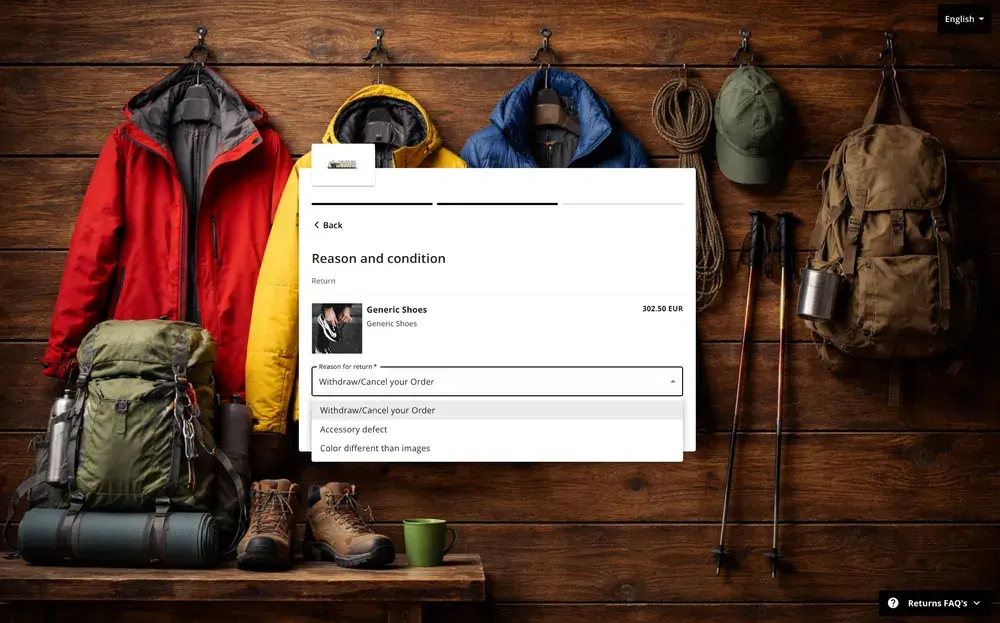
Those mechanisms may still be useful for ordinary returns, claims, damaged goods, wrong items, fraud control, and analytics. They should not be lifted into the statutory withdrawal flow without careful review.
This does not mean every retailer needs a completely separate technology stack. The law may describe a button. The operational challenge is deciding what kind of journey that button starts.
What has to work behind the button
Eligibility has to be calculated correctly at item level. Some goods may be inside the right of withdrawal and some may be outside it. Personalized goods, certain perishable goods, opened sealed hygiene goods, some dated bookings, and certain digital-content scenarios may be excluded, but the specific list and how it applies should be confirmed with legal counsel for each market.
Item-level state also has to be reliable. A single order can contain items that are withdrawn, returned under the commercial policy, claimed as damaged, already refunded, still in transit, never collected, or outside the withdrawal window. Without line-item state, the system cannot show the consumer only the actions still available. It also becomes harder for the back office to prevent duplicate refunds, conflicting carrier labels, or inconsistent customer messages.
The withdrawal window depends on a trustworthy delivery or collection timestamp. If the retailer cannot rely on the event data that starts or ends the withdrawal period, eligibility decisions and audit trails become weaker.
Uncollected parcels need careful handling. If the consumer withdraws before collection or delivery, the retailer should have a clear process for intercepting, returning, or resolving the shipment. Do not assume the consumer must collect the parcel before the withdrawal can be recognized. That point should be validated by local legal counsel.
Refund timing also needs precision. The trader must generally reimburse without undue delay and no later than 14 days from the day the trader is informed of the consumer’s decision to withdraw. For goods, the trader may be able to withhold reimbursement until it has received the goods back or the consumer has supplied proof of return, unless the trader has offered to collect the goods. How this applies in specific cases should be checked against national implementation rules and the facts of the transaction.
Outbound delivery cost requires the same care. Standard outbound delivery cost generally has to be reimbursed when the consumer withdraws from the full order. Extra costs for a more expensive delivery option, such as express delivery chosen by the consumer, generally do not have to be reimbursed beyond the least expensive standard delivery option offered by the trader.
Return shipping can generally be charged to the consumer only if the consumer was informed before purchase that they must bear that cost. If the trader did not inform the consumer, the trader may have to bear the return cost.
The customer, support team, warehouse, finance team, and carrier process all need a consistent view of what has happened. Without that visibility, complaints multiply, duplicate work increases, and the audit trail becomes harder to defend.
Where nShift fits
The market is already debating where this new function belongs. Is it an order cancellation? A return? A separate legal flow? A customer-service process?
“There is a lot of confusion in the market because withdrawal sits between order cancellation, returns, and customer service. Retailers need a practical way to connect that customer action to the systems already handling returns, refunds, carrier processes, and customer communication,”
Jyo Saikia, Product Specialist Director at nShift
In practice, it touches all of them. That is why the infrastructure matters.
For retailers already managing returns and post-purchase journeys through nShift, the withdrawal function does not need to become a disconnected process sitting outside the operational flow.
“The legal responsibility sits with the retailer, and software alone should not be presented as a guarantee of compliance. What nShift can do is help retailers put a practical operational mechanism in place, so the withdrawal request can be handled consistently across the post-purchase journey,”
Christian Wettergren, Data Protection Officer at nShift
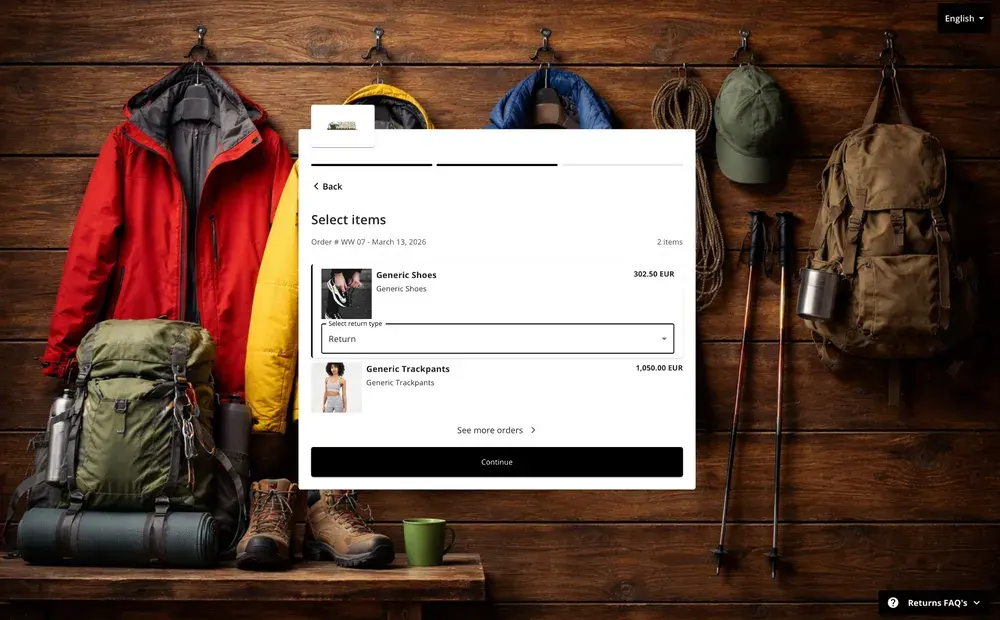
nShift can support retailers with a configurable approach inside the post-purchase journey. Depending on the retailer’s setup, the customer-facing entry point may sit on the retailer’s own website, order page, account area, or other online interface. Withdrawal can then be presented as a clearly separated option inside the returns flow, rather than being grouped with ordinary discretionary return reasons such as wrong size, damaged item, wrong color, or changed preference.
“The important thing is to make the withdrawal option clear for consumers and manageable for retailers. Our approach is to support a dedicated withdrawal option within the post-purchase flow, with rules that help retailers control when it appears, how it is handled, and how the customer is informed,”
Frida Wikingsson, Product Manager at nShift
Software does not replace legal review. Retailers still need to decide where the withdrawal function appears, how it is labeled, which products and contracts are in scope, how local market rules apply, and what their legal counsel approves.
Once the customer clicks, the request has to become an operational event. A configured nShift Returns flow can help retailers manage that bridge. It can support rules that make the withdrawal option available during the relevant withdrawal period, adjust the available options once that period has passed, and apply logic for areas such as original shipping cost where the retailer’s legal and commercial rules require it. It can also support customer communication by triggering an acknowledgement that the request has been registered as a return or withdrawal.
Many retailers do not need another isolated front-end tool; they need a clear customer path that connects the withdrawal request with the teams and systems responsible for returns, refunds, carrier flows, and customer service.
See the withdrawal function working inside nShift Returns
Book a 30-minute demo to see how a configured nShift Returns flow handles a withdrawal request alongside refunds, carrier processes, and the rest of the post-purchase journey.
What retailers should do now
Retailers should start by mapping every online interface where an EU consumer can conclude a contract. That may include the webshop, mobile site, native app, hosted checkout, sub-brands, owned marketplaces, customer account pages, and order-status pages.
They should then identify which contracts, product categories, and customer journeys are in scope of the statutory withdrawal right. Exclusions should be reviewed with legal counsel and checked across the markets where the business sells.
The withdrawal journey should be separated from ordinary return logic. A shared operational stack is fine. The consumer-facing flow is what has to differ: it should not treat statutory withdrawal like a complaint, claim, or discretionary return request.
The confirmation step should be designed properly. The proof-of-receipt message should capture the content of the withdrawal declaration, the date, and the time of submission. Refund and return-shipping rules should be aligned with the retailer’s legal position and with the configuration in the post-purchase platform.
Terms, pre-purchase information, and privacy documentation may also need updating, since the new function may create new processing, communication, or evidence requirements.
Retailers should also test the edge cases before the deadline. Partial withdrawal, duplicate withdrawal attempts, uncollected parcels, failed acknowledgement delivery, already-returned items, items outside the withdrawal window, personalized items, and mixed baskets are the scenarios where compliance gaps tend to show up.
Five questions decide whether a retailer is ready
-
Can the retailer separate withdrawal from normal returns?
-
Can it connect withdrawal events to carrier and warehouse flows?
-
Can customer service see what happened, when it happened, and what still needs to happen?
-
Can refund teams see whether the goods have been returned, whether proof has been supplied, or whether reimbursement can be withheld?
-
Can the customer receive a clear acknowledgement without waiting for the rest of the operational workflow to complete?
Penalties, enforcement culture, and consumer-authority practice vary by Member State. Retailers selling across the EU should validate local implementation rules and cross-border enforcement exposure.
The safer approach is to treat 19 June 2026 as an operational readiness deadline, not only as a legal date.
The bottom line
The withdrawal function is a customer-facing expression of whether the retailer can connect legal rights, order data, item status, carrier events, refund rules, and customer communication in one coherent post-purchase journey.
Retailers that treat the deadline as a front-end project may find the gaps later, when customers start using the function at scale. Retailers that treat it as an operations, data, and post-purchase infrastructure project will be in a stronger position.
The customer only sees the button. The retailer has to manage everything that happens after it is clicked.
Turn the requirement into an operation you can prove.
The EU right of withdrawal playbook walks through the legal baseline, the five-step build, and a readiness checklist you can act on.
Get the playbookLegal note
This blog is intended for general information for ecommerce, operations, and product audiences. It is not legal advice. EU consumer law is implemented at Member State level, and specific obligations, refund treatment, exclusions, labeling, wording, and enforcement may vary by jurisdiction. Retailers should obtain advice from qualified counsel in each market where they sell to EU consumers.