
The EU distance selling regulations give consumers a 14-day right to withdraw from most online purchases, and since 19 June 2026 retailers have had to make that option clear and easy to use. It looks like a single cancel button, so I recently sat down with four people who’ve been deep in the detail for months to talk through what actually sits behind it.
Between them they cover the compliance, product and commercial angles: Christian Wettergren, our Chief Compliance Officer; Frida Wikingsson, Associate Product Manager; Jyo Saikia, our Product Specialist Director; and Vanja Eriksson, an ecommerce strategy advisor fresh off a study of how big fashion retailers handle the moment after checkout. We meant to give it twenty minutes. We gave it an hour, covering everything that change actually triggers, and I came away convinced the button is the least interesting part of it.
If you sell into the EU, none of this is brand new. Consumers have always been able to change their mind on a distance purchase and get their money back. What changed in 2026 is how visible and usable the distance selling regulations now require that right to be. No more parking it at the bottom of an FAQ or behind a login. It has to be there, clear, and simple to act on. For the specifics of what landed on the 19 June deadline, we wrote those up in the EU withdrawal function. This is the wider conversation: what you have to offer, when the clocks run, what’s exempt, how the rules shift by country, and what has to work behind the scenes so it builds buyer confidence instead of adding cost.
What are the distance selling regulations?
The distance selling regulations are the consumer protection rules that apply whenever someone buys without meeting the seller in person: online, by phone or by mail order. In the EU, these rules are set out in the Consumer Rights Directive (2011/83/EU), which every member state has applied to contracts concluded since 13 June 2014. The same directive establishes the right of withdrawal discussed in this post.
The directive sets out what online retailers must do when they handle delivery and returns. Before the sale, the retailer must tell the consumer who the seller is, the full price, the delivery cost, that they have a right of withdrawal, and who pays for return shipping. From the day the goods arrive, the consumer has 14 days to withdraw without giving a reason. Once the consumer tells the retailer they are withdrawing, the retailer has 14 days to issue a refund. And unless another date was agreed at checkout, the goods have to be delivered within 30 days of the order.
As Christian Wettergren, our Chief Compliance Officer, explains below, the June 2026 change (Directive 2023/2673) strengthened a right shoppers already had. It adds a visible withdrawal function to the storefront, while the underlying rights from 2014 stay the same.
Do the distance selling regulations still apply in the UK?
The UK’s Distance Selling Regulations 2000 were replaced on 13 June 2014 by the Consumer Contracts (Information, Cancellation and Additional Charges) Regulations 2013, so the old name now points to the 2013 rules. People still use it because the main requirements are the same: a 14-day cancellation period that ends 14 days after the customer receives the goods, a 14-day refund deadline, and the duty to tell customers about their cancellation right and any return shipping cost before the sale. In the UK this is usually called the cooling-off period.
The main difference between the EU and UK rules is the 2026 withdrawal function. The function is EU law, and it applies to sales to consumers in the EU, including sales a UK retailer makes into the EU. A retailer serving both markets therefore needs a storefront that includes the withdrawal function, which the cross-border section below covers in more detail.
Key takeaways in one glance
-
The right of withdrawal isn’t new. What’s new is that it has to be visible before purchase and easy to exercise, not hidden away.
-
Withdrawal, pre-shipping cancellation and a normal return are three different flows. Your systems need to tell them apart the moment a customer acts.
-
Two 14-day clocks run in sequence: the window to withdraw, then the window to refund. Split shipments are counted per parcel.
-
Personalized and made-to-order goods are generally exempt, so the exclusion has to be clear at the point of sale.
-
Country rules differ, and the safe move is to build one flow tuned to the strictest market you sell in.
-
Customers don’t have to say why they withdrew, so the returns feedback loop you rely on needs a new way to stay useful.
Watch the full discussion
Christian, Frida, Jyo, Vanja and I go through all of this in about forty minutes, including the cross-border grey areas and the operational traps.
What the right of withdrawal actually asks you to offer
The point Christian kept coming back to is that the law tightens up a right you already had rather than inventing a new one. The legislator’s aim is simple: a consumer should be able to withdraw from a contract as easily as they entered it. Get that intention right and the fiddly implementation details carry far less risk.
“If you fulfil the intention of the law, a few pixels off won’t kill you. If you don’t fulfil the intention, that’s where you have a problem.”
In practice, three things have to be true on your storefront.
-
The option to withdraw is clearly visible, not gated behind an account login.
-
The customer is told about it before they buy, including any return fee and how refunds work.
-
When they do withdraw, they get an immediate confirmation that the request has landed.
Jyo made the commercial case for leaning into this rather than tucking it away. A shopper reads your policies before they commit, and seeing that changing their mind will be painless is part of what gives them the confidence to buy in the first place.
“It comes into play even before checkout. You’re building that confidence before they’ve pressed the buy button.”
That’s why the option belongs on your checkout experience and product pages, not only inside the returns portal.
Withdrawal, cancellation and a normal return aren’t the same thing
This was the distinction the team was keenest to draw, because customers experience all three as “sending something back” and retailers often build for one flow when they need three.
-
A pre-shipping cancellation happens before the parcel leaves the warehouse, so the order can be stopped with nothing in transit.
-
A statutory withdrawal happens inside the 14-day window: the customer is using a legal right, doesn’t have to give a reason, and the goods come back on the terms the law sets.
-
A normal return runs after that window closes, on whatever commercial terms you choose to offer.
“Within fourteen days it’s a withdrawal. Whatever passes fourteen days is a normal return.”
The practical consequence is that your systems have to know which one is in play the moment a customer acts, because the eligibility checks, the refund rules and the data you capture all differ. A retailer already running a proper returns portal starts from a much stronger position here than one still handling requests by email and manual labels.
The two 14-day clocks: when the withdrawal window starts, and when you refund
Frida walked us through the timing, and this is the part a deadline announcement rarely spells out.
The withdrawal window, sometimes called the cooling-off period, generally starts the day after the consumer receives the goods, not the day they order. Once they withdraw and send the items back, you then have 14 days to refund them. Two clocks, running one after the other.
Split shipments change the sum. If one order arrives as separate parcels, say a sofa that ships weeks after the cushion that came with it, the window is worked out per delivery, not from the first parcel that shows up. So your flow has to track receipt at the shipment level rather than the order level.
Refunds have their own rules. When someone withdraws from a whole order, the original outbound shipping cost is refundable along with the price of the goods. You can still charge a return fee, but only if you told the customer about it before they bought. nShift Returns handles this directly: a shipping-refund setting returns the original shipping cost when a full order comes back, and refunds and credit notes can trigger automatically in your ERP or ecommerce platform instead of being keyed in by hand.
What’s exempt from the right of withdrawal (and why big items feel it most)
Not every purchase carries a right of withdrawal, and being straight about the exceptions is part of a fair, compliant flow.
Personalized and made-to-order goods are the usual case. A sofa in a chosen fabric, an item made to a customer’s spec, anything produced for their individual use, generally falls outside the right of withdrawal. Left unstated, that exclusion runs straight into a customer who assumes the standard 14-day right covers everything, so it has to be clear at the point of purchase rather than discovered later. Retailers of bulky and custom items feel this most, because those goods are already harder and more expensive to move, and a return that should never have been accepted is a costly one to unwind. Clear exemption messaging up front protects both the customer relationship and the operation behind it.
Cross-border rules: one rulebook, tuned to the strictest market
The directive is EU-wide, but member states apply it with local differences, and that shapes how a cross-border retailer should set policy. This is an operational read from the discussion rather than legal advice, so check the specifics for each market you sell in.
Some countries enforce more firmly than others, and a few are phasing the change in against existing national rules rather than flipping a switch. Because a consumer can complain in their own country, Vanja’s advice was to build to the strictest interpretation you face and apply it everywhere, rather than run a different flow per market.
“The recommendation is to comply to the harsher interpretation, not the general EU idea of it all.”
The reach is broad too. Any retailer whose shipments touch Europe is in scope, whether they sell from inside the EU, the UK or the US. Running one policy set to the toughest requirement is simpler to operate and safer than a patchwork, and nShift Returns supports it with market configuration and automated routing, so a single setup applies the right rules per market without a separate build for each one.
What actually happens when someone hits the button
We stayed here a good while, because a compliant button and a healthy operation can part ways fast. Pressing withdraw triggers a chain of checks:
-
Which order it relates to, and which items are eligible.
-
Whether the window is still open.
-
Whether the parcel has already shipped.
-
How the refund should be handled across payments and the warehouse.
The customer sees none of it, and all of it has to resolve fast.
“The button is really the entry point to a whole journey. There’s a set of ifs and thens being triggered behind it.”
Wire that button straight through to a manual returns desk, and a rise in requests piles onto whatever pressure already exists. Orchestrate the flow instead, and the same volume barely adds cost. Christian’s warning was against reflexive automation, though: a withdrawal where the retailer made the error and one where the customer simply changed their mind can look identical to a system, and a blunt automated response in the wrong moment loses the customer anyway. Keep the clear-cut cases automated, route the ambiguous ones to a person, and give that person the order and shipment context so they can act quickly.
Vanja brought the customer psychology to this from her fashion study. Across the retailers she looked at, shoppers were forgiving when they were kept informed and unforgiving when they were met with silence after something went wrong. A withdrawal flow that confirms, updates and resolves cleanly protects the relationship. Peak periods raise the stakes, since seasonal sales already produce a returns spike and a visible withdrawal option sits on top of it, so the retailers modelling their peak volume now are the ones who won’t be surprised by it later.
The returns reason data you stop getting
There’s a consequence that’s easy to miss until it’s gone. A customer using the right of withdrawal doesn’t have to tell you why.
“You don’t need to give a reason. You can just say, because I don’t feel like it.”
For retailers who lean on return reasons as a feedback loop, that’s a gap opening up. Reason data is how you spot that a product photo oversells a colour, or that a size runs small, and fix the source of avoidable returns. If more send-backs arrive as reasonless withdrawals, that signal thins out. The workable answer, which the team landed on, is to invite a reason voluntarily inside the flow and keep withdrawal data joined up with the rest of your returns picture. nShift Returns supports configurable and category-specific reasons, and its returns analytics highlight the products driving the most send-backs, so voluntary reason capture still feeds real decisions.
How we built the flow in nShift Returns
None of this has to turn into a cost centre. Run well, a compliant flow is the same self-service experience customers already expect from good returns, widened to cover withdrawal.
With nShift Returns, a customer validates their order through a logged-in account or a secure order lookup, picks the specific items they want to withdraw from, confirms, and gets immediate confirmation that the request has registered.
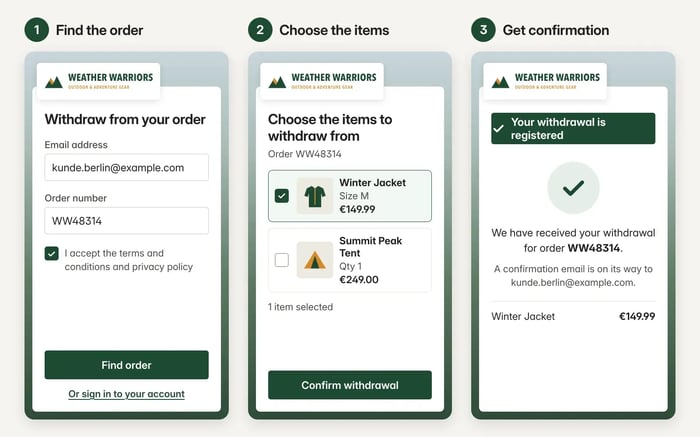
A shopper's withdrawal in three steps: find the order, choose the items, get confirmation.
“The moment they confirm, an email goes out saying we’ve received the withdrawal. The customer knows it’s done.”
Behind that, shipments booked through nShift flow into Returns automatically, so eligibility and shipment status are already known. Refunds and credit notes trigger in your connected ERP or ecommerce system, the shipping-refund and return-fee rules apply by configuration, and market routing keeps the right policy in place per country. Your operations team gets a single view of orders and returns to work the cases that need a human. Presented this way, the requirement gives the customer reassurance and keeps the back office calm, which is what we were building toward. For the full operational detail, including the refund and evidence steps, there’s a withdrawal operations playbook you can download.
If you only do one thing from this session
Stop thinking of the withdrawal button as the deliverable. Treat it as the front door to a flow that has to check eligibility, respect two refund clocks, honour local rules and keep the customer informed, and build that flow as part of your delivery and returns setup rather than a legal box. Do that, and the change you were told to comply with becomes part of what wins you the sale in the first place.
Watch the full discussion, see how nShift Returns runs a compliant self-service withdrawal flow, or talk to us about your setup.
Turn the requirement into an operation you can prove.
The EU right of withdrawal playbook walks through the legal baseline, the five-step build, and a readiness checklist you can act on.
Get the playbookLegal note
This blog is intended for general information for ecommerce, operations, and product audiences. It is not legal advice. EU consumer law is implemented at Member State level, and specific obligations, refund treatment, exclusions, labeling, wording, and enforcement may vary by jurisdiction. Retailers should obtain advice from qualified counsel in each market where they sell to EU consumers.