The first of ten deep-dives in our 2026 delivery trends mid-year check-in. The verdict, six months after our initial forecast: AI moved into live logistics decisions, and the constraint moved to people. Read our perspective on this 2026 delivery trend below.
Our 2026 trends report put AI and autonomous decision-making first among the ten trends we nominated. What we said at the beginning of the year was:
AI in logistics is moving from hype to targeted deployments that deliver measurable gains.
Early autonomous supply chain initiatives have already achieved around 27% shorter order lead times and 25% higher labor productivity for adopters, even though overall maturity remains low. The winners in 2026 will focus on a small set of scaled use cases, clean data, and human-in-the-loop designs instead of spectacular but fragile experiments.
Halfway through the year, the data shows a clear split:
AI is genuinely in use across logistics operations, while most organizations are struggling to staff, govern, and absorb it as fast as the technology moves.
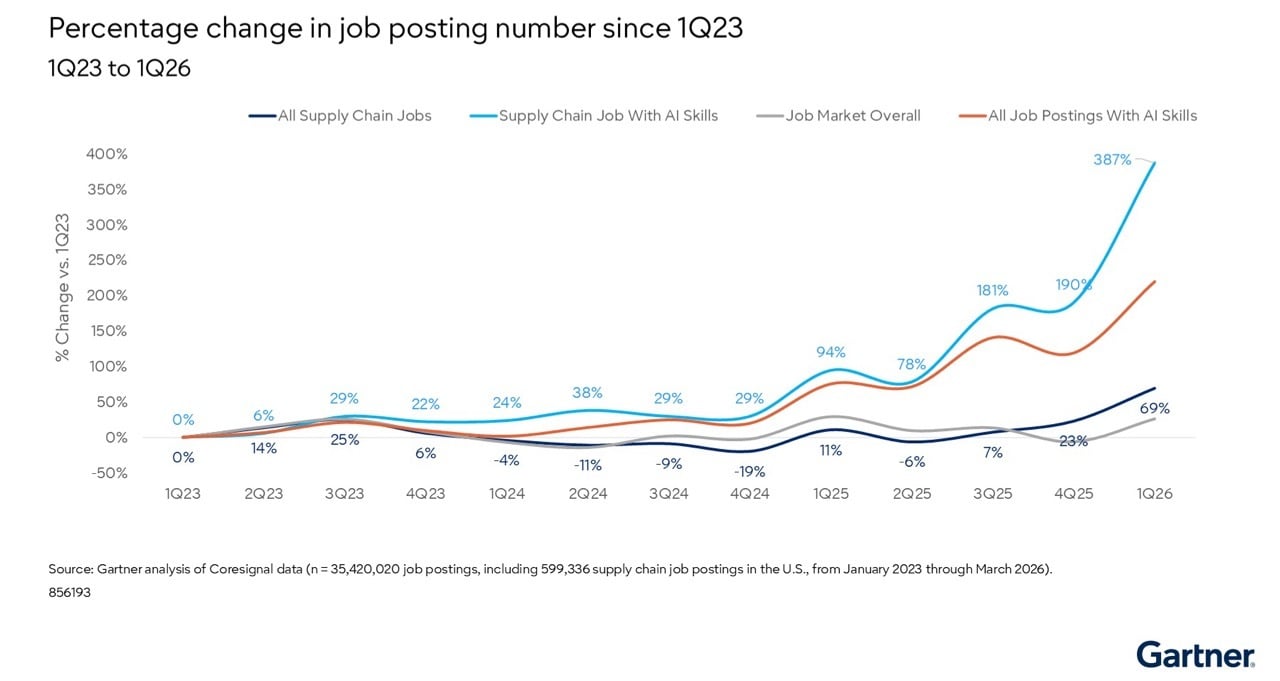
The strongest signal is in hiring. Gartner analyzed more than 35 million job postings and found demand for supply chain roles requiring AI skills up 387% between early 2023 and early 2026, most of it at mid-senior and director level. These are experienced people expected to arrive fluent in both supply chain and AI, and there are not enough of them to go round. Gartner's own read is that the gap cannot be closed by hiring alone.
What AI in logistics covers
AI in logistics means machine learning and increasingly autonomous decision-making applied to delivery: demand forecasting, carrier and route selection, ETA prediction, delay detection, exception handling, and customer communication. In 2026 it is widely used, though usually in narrow applications rather than wholesale redesign. The constraint is data quality, integration, and skills, rather than access to models.
The shortage of AI-and-logistics skills
The people the hiring market wants combine deep supply chain knowledge with real AI fluency, and every operator, carrier, and retailer is now bidding for the same small pool.
A second finding makes the squeeze worse. By February, 55% of supply chain leaders expected agentic AI to reduce entry-level hiring, and 51% expected overall workforce reductions. Reducing entry-level roles while competing for senior AI-and-supply-chain specialists removes the main place those specialists come from. Gartner's guidance to expand entry-level talent and upskill internally follows from that: a business that stops developing its own people has no answer to a talent market it cannot out-hire.
The operational consequence is about how scarce expertise gets used. Every AI initiative competes for the time of a small group of people who understand both the operation and the model. An initiative that occupies one of them for months to produce a report no planner acts on is expensive, whatever the software costs. That argues for pointing scarce expertise at decisions the business already measures, rather than at exploratory projects.
Much of the value in these senior roles is knowing when the model is wrong: when a forecast is thrown by a one-off promotion, when a routing recommendation ignores a customs constraint the model never saw, when an ETA reads as confident but rests on a carrier feed that went stale overnight. Catching those cases takes someone who understands the operation as well as the model, which is why demand sits at mid-senior and director level rather than in graduate hiring. The value of an AI system is capped by the judgment available to supervise it.
387%
rise in demand for supply chain roles requiring AI skills
Q1 2023 to Q1 2026, across 35 million job postings (Gartner)
17%
pursue a transformational AI redesign; 83% apply it incrementally
Gartner survey of senior supply chain leaders, May 2026
55%
expect agentic AI to reduce entry-level hiring needs
Gartner survey, February 2026 (51% expect overall reductions)
Adoption is broad, but incremental
In Gartner's May 2026 survey, 17% of supply chain organizations were pursuing an immediate transformational redesign around AI; 83% were applying it to specific use cases or scaling gradually. The barriers they named were technology integration and talent, with data quality beneath both. Gartner separately expects 70% of large organizations to adopt AI-based supply chain forecasting by 2030, a multi-year rollout still ahead rather than a capability already in place.
Incremental adoption is a reasonable response to those barriers. In practice, the applications that stick are narrow and close to operational cost: delay prediction on a lane the business runs daily, ETA quality on a carrier whose events it already receives, and inquiry handling for the questions customer service answers repeatedly. Each ties to a number the operation already tracks.
Underneath most of them is the same prerequisite: delivery events from different carriers, in different formats, reconciled into one consistent record a model can learn from. Quality here has specific dimensions: whether events arrive in time to act on, whether the same real-world event means the same thing across carriers, whether exceptions carry enough detail to separate a genuine problem from a formatting quirk, and whether handovers between carriers are visible at all. A model trained on data that fails those tests learns the noise with the signal, which is one reason adoption stays incremental.
Reconciling delivery events across carriers into a consistent record is the work nShift's Data Fabric does for delivery data.
Which applications are worth funding
-
For a retailer or brand, the use cases easiest to justify are the ones that move a metric the business already owns: delivery promise accuracy, avoidable WISMO contact, fulfillment routing, or protected margin.
-
For a carrier or logistics provider, the strongest cases are closer to the physical operation, in linehaul planning, sortation, ETA quality, and delay prediction.
In both, the common feature is proximity to a measurable operating cost.
And it's where executive attention is moving: Accenture's 2026 Pulse of Change research found that 75% of supply chain executives see AI as more beneficial for revenue growth than cost reduction, a change from the efficiency-first framing that shaped earlier waves of automation.
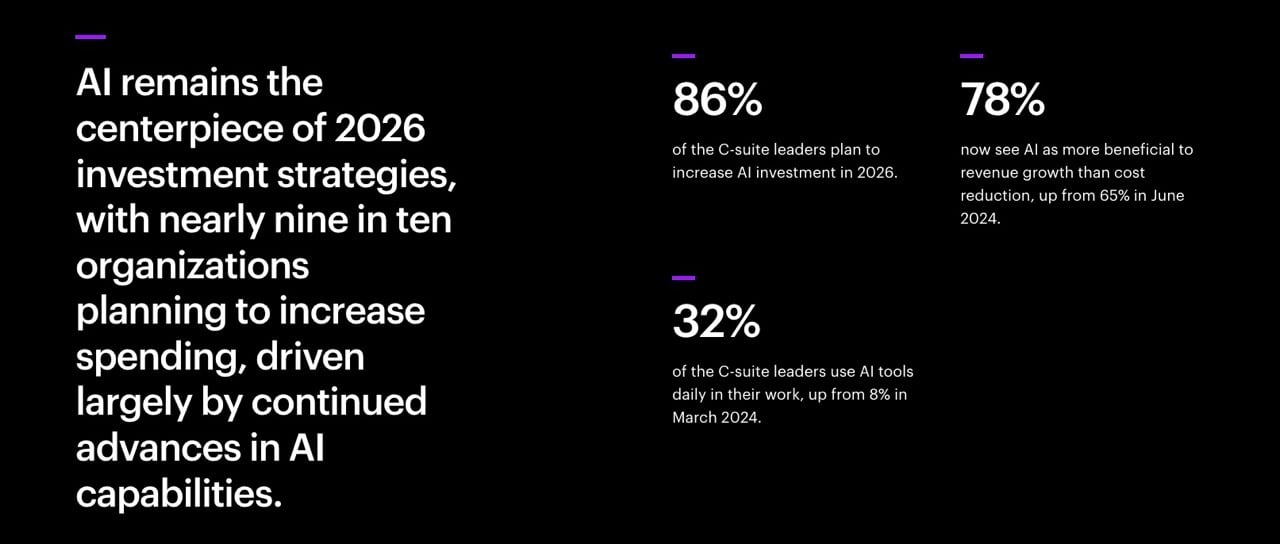
For delivery, this points the strongest use cases at the top line as much as the cost line: promise accuracy that protects conversion and repeat purchase, and routing that protects margin, rather than headcount reduction on its own.
Fulfillment routing is easy to overlook and can be among the highest-value of these: choosing which location ships an order based on stock, distance, carrier cut-offs, and cost at the moment the order is placed, rather than by a fixed rule. Getting that choice right protects both the delivery date and the margin on the order. A static rule handles it poorly, because it cannot weigh those factors together for each order.
Delay prediction estimates which parcels are at risk of missing their promised date, early enough for customer service to contact those customers before they ask. ETA quality tightens the delivery window shown to the customer and used in planning, which reduces both missed expectations and the buffer time built in to cover uncertainty. Inquiry handling uses AI to draft or resolve routine "where is my order" contacts, freeing agents for the exceptions that need judgment. Each replaces a specific, repeated manual effort with a faster version of the same decision.
A different piece of Accenture research on autonomous supply chains shows what the leading adopters achieve: early initiatives report 27% shorter order lead times and a 25% rise in labor productivity, with median autonomy maturity around 16 on a 0-to-100 scale. Those results come from advanced deployments, and most organizations are near the start of that scale. They are reachable, but slowly and only with mature data, which argues for funding specific decisions rather than a general transformation.
Knowing whether it is working
Because the aim is a measurable decision, the measurement has to be set up before the model goes live. That means a baseline: the share of orders where the promised date held last peak, and the WISMO contact rate per thousand orders, taken before any AI touches them. Without that baseline, an improvement is hard to separate from a slow week or an easier peak, and the program becomes hard to defend when budgets tighten. It also means attributing carefully: if promise accuracy rises the same quarter a major carrier improves its own performance, the model can end up credited for someone else's work. The discipline is ordinary analytics, applied before the pilot rather than as an afterthought.
Getting AI into the workflow
Adoption also turns on something discussed less than models or skills: whether the output reaches the person who can act on it, in the tool they already use. An accurate delay prediction that lands in a separate analytics portal, rather than in the customer-service queue or the transport planner's screen, is slow to act on and often reaches the customer too late to help.
For platform and technology leaders, the most valuable AI work sits below the visible assistant. A normalized event model lets the system reason over one consistent version of what happened across carriers. A permissions framework sets what the system may do on its own, such as suppressing a delivery promise at checkout, rebooking a carrier, or messaging a customer, and what needs a person to approve. Workflow integration puts the recommendation into the booking system, the notification flow, or the checkout rule where the decision gets made. An assistant with a capable model but none of these leaves recommendations that planners have to check by hand and act on slowly, if at all.
The most valuable AI work sits below the visible assistant.
Those permissions matter more as decisions become autonomous. A planner needs to know which choices the system makes alone, how to see why it made them, and how to override it when it is wrong. For customer-facing steps, the EU AI Act's transparency obligations from August 2026 add a specific requirement to tell people when they are dealing with an AI system, which applies to delivery chatbots and automated notifications. Setting those boundaries is part of the cost of putting AI into live operations, and skipping it is a common reason pilots stall before production.
What agentic AI means in delivery today
The workforce numbers refer to agentic AI, systems that take actions rather than only make recommendations. For a delivery team, the useful way to hold it is as a set of bounded, permissioned actions rather than a general operator. Sensible autonomous actions are narrow and reversible: sending a proactive delay message, rebooking a parcel to a different service within set rules, or suppressing a checkout option when a carrier feed says the promise is at risk, each with a clear rule behind it and a person able to override it. Keeping agentic AI scoped that way, rather than expecting it to run an operation end to end, is what keeps it useful and controllable while the technology matures.
Your delivery history is the starting data
Most delivery AI can start on data the business already holds. Bookings, carrier events, promises, and exceptions are a record of what was promised and what happened, which is enough to begin predicting delays or scoring risk without acquiring anything external. The realistic sequence is to get that history into usable shape first, then point a model at one decision it can already answer, rather than commissioning a model and finding afterward that the data underneath cannot support it.
Jurgen and I took this argument further on the podcast in September, including what the SaaS apocalypse debate leaves out for logistics software.
Where to focus in the second half
For teams deciding where to spend before peak, a few moves follow from the evidence. Tie any AI initiative to a metric already on someone's targets; delivery promise accuracy and WISMO contact rate are the easiest to read quickly, because they are measured continuously and at high frequency, so a change shows within a peak rather than a fiscal year. That makes a use case straightforward to justify and, if it does not work, straightforward to stop. Fund the data and integration work as part of that initiative, not as a separate program that has to justify itself. And develop AI capability internally, because the hiring market will not supply it at the pace the 387% demand curve implies.
 The practical path: pick the handful of delivery decisions AI can improve now, resource them properly, and protect the entry-level roles that produce the specialists the market cannot supply fast enough.
For the full mid-year check-in across all ten trends, read our 2026 Delivery trends midyear checkin report. For where teams are starting with delivery AI in practice, see our AI use cases across delivery operations.
More from the mid-year check-in:
- Supply chain control towers in 2026: from dashboard to decision system
- Warehouse robotics in 2026: where the delivery payback is
- AI shopping in 2026: the agentic inversion and what it does to your delivery promise
Ten trends. One mid-year evidence check.
Get the full 2026 delivery logistics mid-year check-in, with the data and recommendations behind all ten trends.
Get the report