The eighth of ten deep-dives in our 2026 delivery trends mid-year check-in: robotics scaled at the top of the market, and the payback still depends on what leaves the warehouse.
Our 2026 trends report argued that warehouse robotics would move from niche to central capability in the largest networks while most warehouses stayed manual or semi-manual, and that integration, not the hardware, would be the bottleneck.
What we said in early 2026:
Warehouse robotics and operational twins would move from niche to central lever in larger networks, while most warehouses stayed manual or semi-manual. Integration would be the bottleneck: automation only protects the delivery promise when warehouse events reach transport planning and customer communication.
Halfway through the year, both halves hold: the flagship operators scaled up fast, adoption across the rest of the market remains uneven, and for anyone whose goal is a kept delivery promise, the payback from this automation depends on something the robots do not do by themselves: connecting to what happens after the parcel leaves the shelf.
What warehouse robotics covers
Warehouse robotics is the use of automated machines to move, pick, sort, and store goods inside a fulfillment center.
In practice, it spans a few families:
-
autonomous mobile robots (AMRs) that carry totes and shelves to human pickers,
-
goods-to-person systems and cube-storage grids that bring stock to a station,
-
robotic arms that pick or palletize,
-
newer and rarer - humanoid robots that work in spaces built for people.
Most 2026 deployments are the first kinds, because they are proven and they slot into existing buildings. The common purpose is throughput: more picks per hour, fewer steps walked, and steadier performance when volume spikes.
The flagship operators scaled up
At its London event in June, Amazon unveiled a next-generation Proteus robot that takes natural-language instructions and plans its own routes, introduced Vulcan, described as its first robot with a sense of touch, and said STARK, a robotic tote-handling system piloted in Barcelona, would expand to 15 European sites by 2027, all inside a European investment of more than €10 billion.
These are announcements and pilots rather than broad deployment. It follows Amazon passing one million robots in operation in 2025 and, by 2024, DHL Supply Chain crossing more than 500 million robot-enabled picks with Locus Robotics. That is scale proof that the technology works for advanced operators; the question is who can operate it well.
Coordinating a large fleet is a software problem
As a fleet grows from dozens of robots to thousands, it's getting increasingly challenging to coordinate the whole fleet: which robot goes where, how they avoid each other, and how the work is sequenced so throughput holds through a peak. That coordination is increasingly an AI layer sitting over the hardware, and in our view the coordination software, more than any single better robot, is now the harder and more valuable part. For a business evaluating automation, this is a reason to weigh the software, and its ability to integrate with everything around it, as heavily as the robots themselves.
Humanoids crossed a threshold
Below the flagship headlines, a smaller milestone matters more than it looks: humanoid robots started doing measured, repeatable work in real operations. Agility Robotics' Digit has moved more than 100,000 totes in a commercial GXO Logistics operation, which is a step up from a demo. Even so, humanoids remain rare on real floors and are usually not the first system a warehouse reaches for; the nearer-term gains still come from the proven mobile and goods-to-person systems doing the everyday work.
The broader adoption picture is still uneven
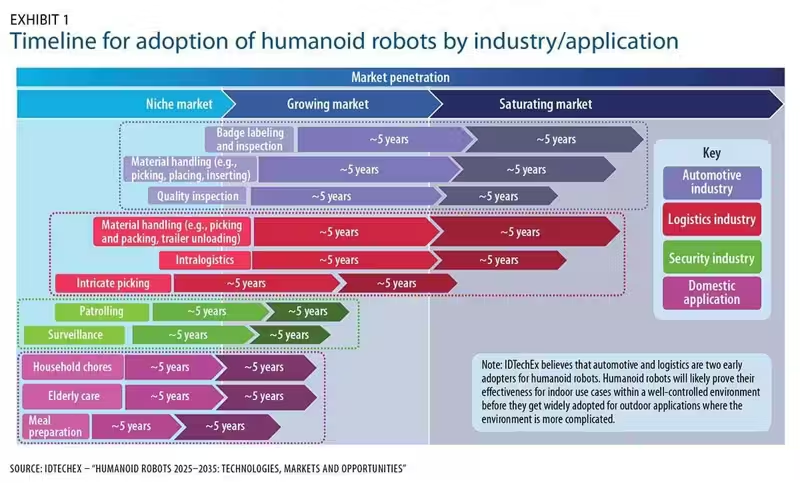
The flagship news does not change the broader picture, which remains uneven. A 2023 Interact Analysis forecast expected only around 26% of warehouse sites to have meaningful automation by 2027, and Gartner's prediction that half of new warehouses in developed markets will be designed as robot-centric facilities by 2030 is about future new builds, not the existing estate. A few advanced operators are compounding a lead while most sites remain far less automated. Businesses should ask themselves this year which single process to automate first, and how to judge whether it worked - rather than which humanoid to buy.
1 million
robots in operation at Amazon, passed in 2025
The flagship end of the market is scaling fast.
500 million
robot-enabled picks, DHL Supply Chain with Locus Robotics
Scaled robotics beyond Amazon's walls too.
~26%
of warehouse sites expected to have meaningful automation by 2027
A 2023 Interact Analysis forecast. Adoption beyond the flagships remains uneven.
The bottleneck is still integration, not hardware
Our original trends report's central claim was that integration, not robotics, would be the constraint, and mid-year that holds.
A robot that improves picking productivity does not, on its own, improve the customer's experience.
It does so only when warehouse events, a completed pick, a delay or an exception reach the booking, manifest, carrier-handover, and notification steps in time for the relevant cut-off. A faster pick that still misses the carrier cut-off produces the same outcome the customer feels either way: a late delivery. The gain inside the four walls is real, but it stops at the loading dock unless the information travels with the parcel.
In our experience, automation investment often underperforms its business case. The picking rate improves, the internal metrics look better, and the delivery promise does not move, because the warehouse and the transport and customer-service systems still exchange information slowly or in batches. The robot does its job; the coordination around it lags.
The second payback is connecting the warehouse outward
There are two paybacks from warehouse automation:
The first is throughput inside the building.
The second, which for a delivery business can be the more valuable, comes from wiring warehouse events outward, so that a completion, delay, or exception reaches the downstream steps in time to act on it. That wiring is delivery-management work rather than warehouse work, which is part of why it is easy to overlook.
We make the fuller version of this argument in our piece on why warehouse automation pays off when shipping is automated too.
Operational twins: the model that sits over the robots
The other half of this trend - operational twins -is the data model used to coordinate and test a robot-dense operation before changes are made. A twin depends on the same clean event stream that decides whether a control tower can act, which is why it becomes practical where the operation is already well instrumented.
Returns are the other place robotics reaches delivery
Robotics attention usually goes to outbound picking, but returns are another place where warehouse speed reaches the customer. A return that is scanned, graded, and put back into sellable stock quickly gets the item earning again and the refund out faster, which both the customer and the finance team feel.
For a delivery-led business, judging a robotics investment on returns speed, and not only outbound throughput, captures a payback that outbound-only metrics miss.
Peak is where automation earns or loses its case
Peak is the real test of a warehouse automation program, because it is when manual processes break and the delivery promise is hardest to keep. A system that lifts picks per hour in a normal week but stalls, jams, or falls back to manual under peak volume has not solved the problem it was bought for.
On the other hand, the stronger case can be argued for automation that holds its throughput and its cut-off times under peak volume, so the last order of the day still ships on time. Peak is also where the outbound connection matters most: a warehouse running smoothly but sending its status updates in overnight batches will still miss cut-offs and surprise customers on exactly the days that decide the season.
The useful way to judge an automation investment is by how it behaves in the worst week, not the average one.
Where to start, and how to judge it
For operators still deciding where to begin, these choices matter more than the choice of vendor:
-
Start automation where peaks and cut-offs break first, the process that fails under volume and costs you promises, rather than the one that demos best.
-
Judge the business case in delivery terms, not only picks per hour: later cut-offs that let customers order longer, faster returns processing, and steadier performance through peak are the outcomes that reach the customer, and they are what a delivery-led business is buying.
And plan the outward connection in from the start; in our experience, it is the part most often left until last, and the one that most affects whether the automation reaches the customer.
What to weigh before peak
The mid-year picture on warehouse robotics is a widening gap: flagship operators compounding an advantage, a large middle still at the start, and humanoids real but early. For a delivery business, the useful move this year is less about the robots and more about the wiring around them: automate the process that breaks first under peak, and judge it by the delivery outcomes customers feel. Where automation is connected to the rest of the delivery chain, it does more for the promise.
For the full mid-year check-in across all ten trends, read our 2026 trends midyear checkin report. The nShift platform and its WMS integrations connect warehouse operations to carriers, automating despatch from pick and pack through to shipping.
More from the mid-year check-in:
- Supply chain control towers in 2026: from dashboard to decision system
- AI in logistics in 2026: the skills gap is the real constraint
- Ecommerce delivery options in 2026: choice, conversion, and returns
Ten trends. One mid-year evidence check.
Get the full 2026 delivery logistics mid-year check-in, with the data and recommendations behind all ten trends.
Get the report