Every year, Black Friday puts Europe’s retail and logistics networks under extraordinary strain. But the real story of last year wasn’t about record volumes or late-night deals. It was about delivery certainty, and what happens when it fails.
Across the first two sessions of our Peak season performance series, experts Thomas Bailey, Ian Russell, Vanja Eriksson, and Jonathan Hales unpacked what millions of shipments (and tens of thousands of customer reviews) reveal about peak season pressure.
Their combined message was clear: More than discounts, Black Friday success is about operational control.
Session 1
From data to decisions: Tracking is the new peak
In the first live session, nShift’s Thomas Bailey and Ian Russell were joined by e-commerce expert Vanja Eriksson to examine how retailers and carriers performed through Black Friday 2024. Tom revealed exclusive nShift insights from millions of shipments and a deep-dive analysis of 80,000 customer reviews from the Black Friday period.
1. The new Black Friday: a shorter, sharper surge
Black Friday 2024 wasn’t a single event - it was a “pressure wave.” Volumes started rising two weeks before Black Week, peaked early, and fell twice as fast as in 2023.
There isn’t really a Black Friday anymore. It’s a pressure wave that starts early, hits hard, and drops fast.
The total order volume remained stable year-on-year, but was compressed into fewer days, leaving no room for error. Retailers who hadn’t shifted planning, stock, and delivery forward simply couldn’t keep up.
2. What actually goes wrong during Black Friday
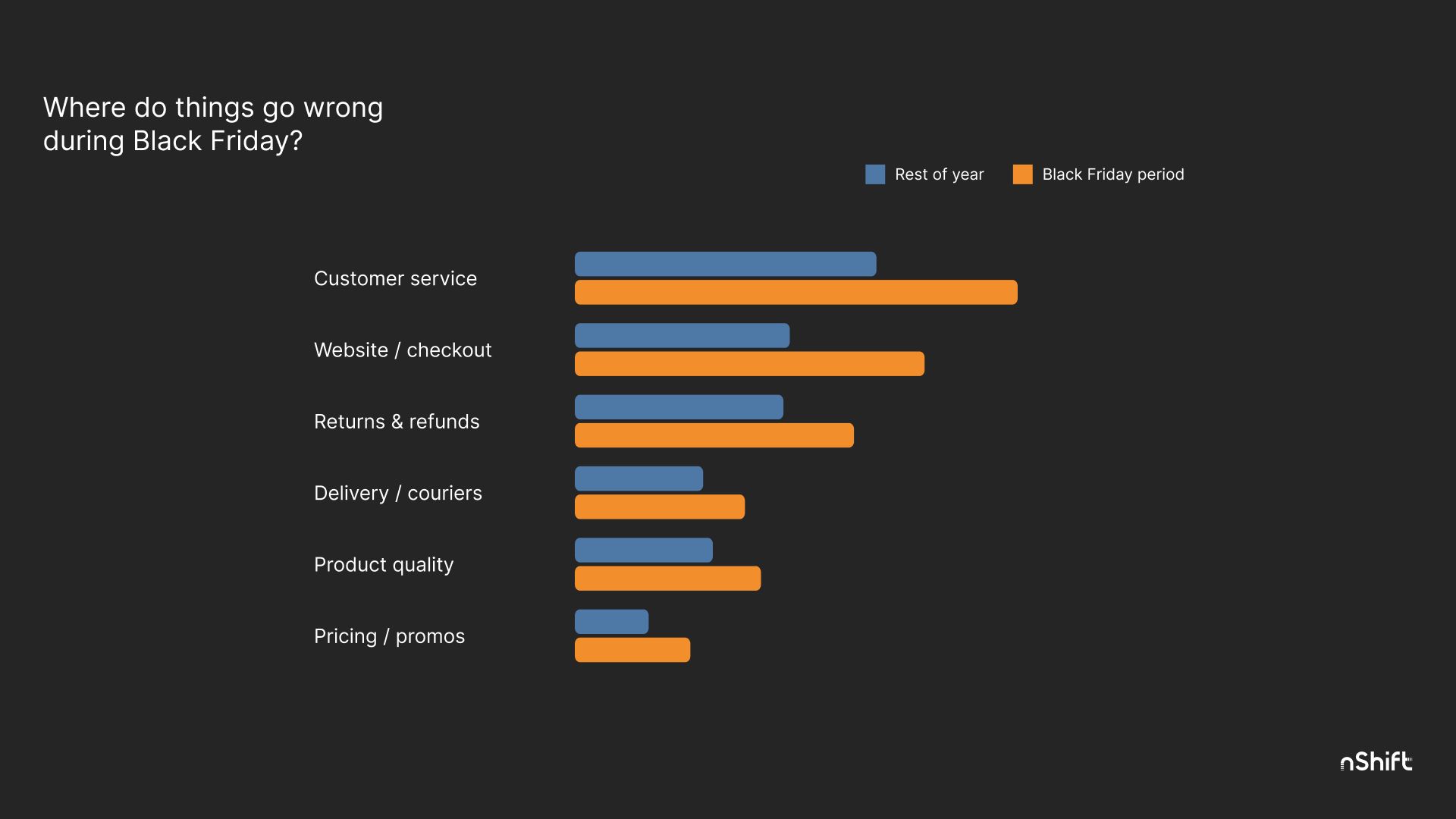
Our analysis of customer feedback revealed that “Customer Service” consistently ranks as the most common complaint during peak - but it’s rarely the real issue.
Customer service teams are the unsung heroes on the frontline. They’re often praised by name (as they put a face to a problem) but they’re rarely the cause of it.
Behind those complaints, the data told a different story:
- Late or failed deliveries: 6.17%
- Lost or untracked parcels: 4.83%
- Refunds unclear or delayed: 19.74%
- Returns confusion: 17.98%
- Checkout errors under pressure: 3.88%
- Missing post-purchase communication: 16.96%
In other words: operational, not interpersonal, failures.
Fixing customer service alone won’t make much difference. It’s the symptom, not the cause. The real solution is an ecosystem that works seamlessly, from checkout to tracking to returns.
Poll insight
During the live session, attendees were asked:
“What’s the biggest challenge you face during Black Friday?”
The clear majority chose Customer Service, echoing the data. But, as pointed out, it’s often a symptom, not the cause.
3. Data shows where stress hits hardest
Our shipment data confirmed what many in logistics already sense:
- Customer service demand rises by almost 50% during the Black Friday period.
- Website and checkout issues spike nearly as high, as traffic volumes overwhelm systems.
- Returns and refunds become the third major pain point, especially when refund timelines are unclear.
Customer service issues dominate Black Friday complaints, but behind them are operational weak points in checkout, refunds, and tracking.
The clear takeaway: tracking and post-purchase visibility aren’t back-office tools anymore; they’re frontline experience drivers.
When customers can’t see what’s happening, they assume the worst and start calling.
4. The solution: visibility, flexibility, and data
Our speakers emphasized three fundamentals for retailers heading into 2025:
- Visibility: real-time, branded tracking that keeps customers informed and reduces WISMO (“Where is my order?”) tickets.
- Flexibility: multiple carrier integrations to prevent caps and bottlenecks when one network overloads.
- Data: using delivery analytics to predict surges, reroute automatically, and build proactive communication.
Adding more carriers builds resilience. You need redundancy built into your network before the pressure hits.
5. Tracking as engagement, not admin
The first session ended with a powerful reframing: tracking is communication more than it is logistics.
Every status update is an opportunity. Instead of a generic carrier link, make it part of your brand: reinforce tone, provide value, and keep customers close.
Transactional updates now have 4–5x higher open rates than marketing emails, making them one of retail’s most effective engagement tools. Smart retailers are turning that tracking notification into a brand touchpoint.
Session 2
Delivering certainty at peak: Late cut-Offs, flexible fulfilment, and the psychology of trust
The second live session, led by Jonathan Hales (Commercial & Customer-Focused Expert), shifted focus from analysis to action. If session #1 revealed what breaks during peak, session #2 showed how to fix it.
1. The certainty effect: why clarity wins checkout
Our speaker introduced the idea of the “certainty effect”: the psychological bias that makes people choose a guaranteed outcome over an uncertain one.
Customers want to know exactly when their order will arrive. Unclear delivery promises feel risky. At peak, they’ll abandon checkout rather than take the chance.
nShift’s consumer surveys support this: half of shoppers will abandon checkout if their preferred delivery option isn’t visible or credible. Adding clarity, even if delivery is slower, drives higher conversion and lower post-purchase anxiety.
2. Late cut-offs and delivery flexibility drive real results
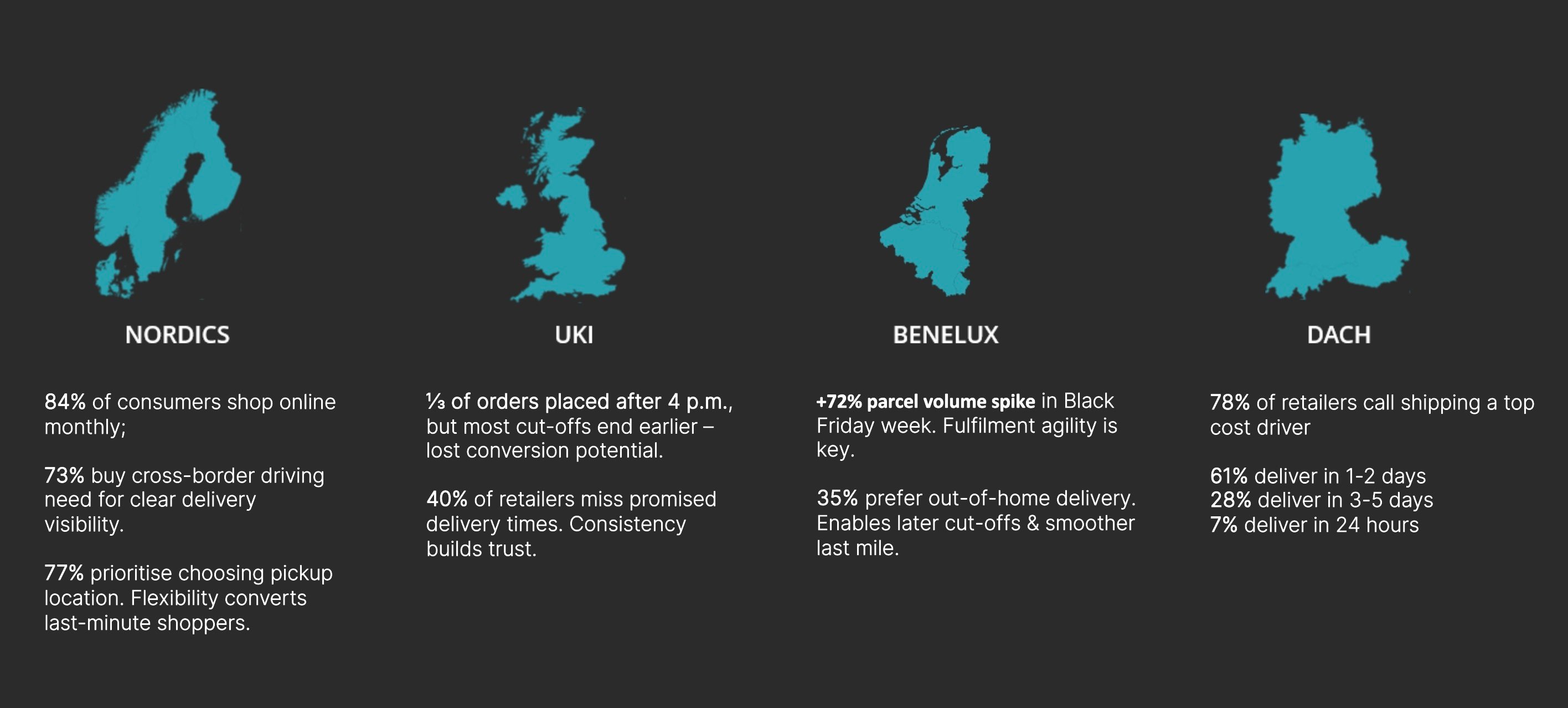
Retailers are missing out on millions in sales by not aligning order cut-offs with actual shopping behaviour. In the UK, for example, one-third of orders are placed between 4–9 PM, but 40% of retailers close their dispatch window before 4 PM.
Late cut-offs are one of the simplest, most profitable changes a retailer can make. It doesn’t require new tech - just better coordination with carriers.
Flexible fulfilment models, like ship-from-store or dynamic routing, also help maintain promises when networks strain. Retailers using 3–5 active carriers with automated allocation saw the fewest delays during peak 2024.
3. Returns as the second peak
Returns now represent roughly 10% of all shipments during and after Black Week - a figure that’s growing year-on-year. For many retailers, the “returns peak” in January now mirrors the outbound one in November.
A failed return experience is often the last impression a customer has of your brand. Get that wrong, and you lose them for good.
Retailers that offered transparent, self-service returns and refund tracking saw measurable improvements:
- Fewer customer support tickets
- Faster warehouse processing
- Higher re-purchase intent
Quiz and Flying Tiger Copenhagen, both nShift customers, demonstrated the impact:
- Quiz reduced warehouse handling time by digitising return tracking.
- Flying Tiger boosted checkout conversion by 20% by letting shoppers choose pickup points instead of assigning them automatically.
4. From survival to strategy
We closed session #2 with a challenge: stop treating peak season as something to “survive.” Retailers who integrate delivery, tracking, and returns data throughout the year can use peak as a growth accelerator, not a crisis to endure.
Delivery certainty is where the brand promise becomes real. That’s what keeps customers coming back, long after Black Friday is over.
Five lessons from the first two sessions
- Peak is shorter, so plan earlier. The surge starts two weeks out and ends faster than before.
- Customer service isn’t broken - the system is. The real failures happen in delivery, returns, and tracking.
- Certainty beats speed. Clear, reliable delivery info converts more than unrealistic promises.
- Flexibility wins. More carriers, later cut-offs, smarter fulfilment are small tweaks that deliver huge impact.
- Returns are your next sale. Fast, transparent returns protect both revenue and loyalty.
The bottom line
During the first two sessions of our live series, we revealed a simple truth: customers want more than a fast delivery - they want confidence. And that confidence is built from the first click to the last mile.
Tracking isn’t a backend process anymore. It’s the heartbeat of peak performance.
Our live series continues this week with expert-led sessions #3 and #4. Sign up once for access to all live sessions and recordings → Register here