
Your team can update a campaign in hours and change a price in minutes. But the delivery options shoppers see at checkout? Those still take a developer ticket, a sprint, and a release window to change.
That disconnect has a price. According to the DHL E-Commerce Trends Report 2025, 81% of shoppers will abandon a purchase if their preferred delivery method is not available at checkout. Even if the product is fine and so is the price, the delivery options just don't not fit the way they actually live or expect delivery to happen.
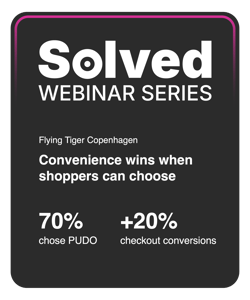
When Flying Tiger Copenhagen gave their customers the ability to choose their own pickup point at checkout, conversions rose 20%. The option had been available in their carrier network for months. Their checkout just hadn't caught up.
This is what I keep seeing across ecommerce teams in 2026: the delivery step is the last part of the checkout that the business cannot move at commercial speed.
It is also what my colleague Josh Barber and I are going to fix live on April 28 in the next episode of Solved, nShift's 30-minute webinar series. Three builds, one realistic retailer scenario, no slides-only theory. Save your seat here.
The delivery step is where control breaks down
Most checkout optimization happens around price, payment, and page design. These are areas where marketing, merchandising, and UX teams have direct access and can test changes whenever they want.
Delivery options sit in a different category. Rules are often hard-coded or buried inside platform configurations that require a developer to change. Adding a new carrier service, adjusting pricing for a specific market, or surfacing parcel lockers for a particular region means waiting.
The result is a delivery step that reflects what was technically possible three weeks/months ago rather than what the shopper expects today. And the gap between intent and execution grows during the moments that matter most: new market launches, seasonal peaks, flash promotions.
Every ecommerce manager I speak to knows exactly what delivery options they want to show. The frustrating part is how long it takes to make those changes live.
What shoppers actually choose when you let them
The instinct for many retailers is to focus on speed: faster delivery, faster shipping, next-day everything. But the data from real checkout behavior tells a more specific story.
When Flying Tiger Copenhagen introduced a map-based PUDO selector at checkout, 70% of their customers chose it. Speed had nothing to do with it. They wanted a locker on the commute or a pickup point near the grocery store, collected on their own schedule.
As Sander van Enschot, Head of Digital Operations at Flying Tiger Copenhagen, put it:
Improvements made in delivery choice at the checkout have been a key success factor in increasing conversion and improving the customer experience.
Swedish health and wellness brand Topformula saw something similar. After integrating checkout and payment into a single flow with full delivery choice, the company recorded a 28% increase in average order value and a 4% lift in conversion rate.
Fredric Boson, CEO of Topformula, described the effect:
We're also seeing effects in the form of customers contacting us and thanking us for the opportunity to choose what best suits them.
Rather than being redesigns or replatforms, these are configuration changes to the delivery step, made possible because the team had direct control over what appeared at checkout.
Speed-to-market as a conversion lever
The business case for better delivery choice is clear, but the operational question is just as important: how fast can you act on it?
-
You expand into a new market and discover that parcel lockers outperform home delivery 3-to-1 in that region.
-
Or you run a flash promotion and want to offer free next-day PUDO for high-margin items.
-
Or a carrier raises surcharges mid-peak and you need to adjust checkout pricing before the weekend.
 In a standard platform setup, each of those changes requires a developer ticket. With nShift Checkout, your commercial team handles them directly. Rules for which options appear, what they cost, and which estimated arrival times are shown can all be updated in minutes by the people closest to the commercial decision.
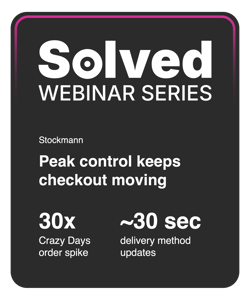
Finnish department store Stockmann runs one of the most intense peak events in Nordic ecommerce: Crazy Days, where order volumes spike roughly 30x in the first few minutes. During that window, delivery methods need to be right from the start.
As their logistics team put it:
Now, with nShift Checkout, we can manage the configuration ourselves: changing the order of carriers presented in our webshop or enabling/disabling carrier services within minutes, with all changes going live in our checkout.
In practice, their updates take around 30 seconds. The faster you can match what shoppers see at checkout to what they actually want, the fewer of them walk away at the last step.
AI that works from your actual configuration
Configuration speed solves one half of the problem. The other half is knowing what to change.
This is where operational AI starts to earn its place in delivery management: not as a forecasting dashboard or a trend report, but as an assistant that reads your actual checkout configuration and tells you what is missing.
nShift's AI Companion, now available in Checkout, analyzes the delivery options, pricing rules, and carrier services you have live. It surfaces gaps, like a high-density urban area with no out-of-home option, or a market where your delivery mix is underperforming. And it suggests specific changes, grounded in your real data, not a generic best-practice checklist.
The merchant still decides what goes live. Companion gives them a reason to decide differently, grounded in their own data rather than a generic playbook.
Testing instead of guessing
Once you have the speed to change delivery options and the intelligence to know what to try, the last piece is validation.
Most ecommerce teams still rely on gut feeling or aggregate analytics to decide whether a delivery configuration is working. Did conversion improve this month because of the delivery options or the new product photography? Usually impossible to say.
A/B testing applied directly to checkout delivery removes that ambiguity. You can isolate a single variable, like whether showing three delivery tiers converts better than two in the German market, and measure the result against live traffic without wiring up external tools or syncing data across systems.
What we are building live on April 28
I have been talking about the speed gap between business intent and checkout delivery. On April 28 at 12:00 BST / 13:00 CET, my colleague Josh Barber and I are going to close it live.
In 30 minutes, we will walk through three builds using a realistic retailer scenario:
- Configure delivery options in minutes. Rules for which options appear, PUDO with an interactive map, pricing, and estimated arrival times, all updated by the commercial team without a developer ticket.
- Run a live A/B test. We will set up an experiment that isolates which delivery configuration converts better, using real-time data.
- See AI Companion in action. A first look at how Companion reads a live checkout configuration and surfaces specific recommendations for what to change next.
Each build closes a gap that slows most ecommerce teams down today, from configuration bottlenecks to optimization guesswork.
Register for the webinar and receive the “Win at Checkout” guide, a practical playbook for converting browsers into buyers through delivery choice.
Who gets the most from this session
- Ecommerce and webshop managers who own conversion at checkout but depend on IT to change delivery options
- Conversion and UX leads looking for the next optimization lever after the obvious gains are exhausted
- Digital commerce directors responsible for multi-market checkout performance
- Operations and logistics managers who need to understand what delivery changes are possible and how quickly they go live
The delivery step is the part of your checkout your team cannot change fast enough. That is what we are going to fix. Save your spot and join us.