A delivery management system rarely fails in the sales demo.
It earns its keep later, when a carrier changes a label spec, rate cards shift, peak gets closer, customer service wants cleaner tracking data, and finance asks for cost per parcel without waiting for five exports.
That's the moment enterprise buyers should build the evaluation around.
The right shortlist looks past carrier counts and integration logos. It tests whether the delivery management platform can keep shipping, tracking, returns, cost data and operational change under control once the business starts moving at full speed.
Think of it as the month-three test: can the platform still perform when real change starts landing on the operation?
In short
An enterprise delivery management system helps large businesses book shipments across many carriers, automate delivery rules and labels, connect with ERP and WMS systems, track parcels after dispatch, manage returns, and report on cost, service and emissions data.

At enterprise scale, the best system is the one that keeps those moving parts tied to the same shipment record after go-live.
Update, July 2026: we have recorded a nine-minute walkthrough of the reference architecture that sits underneath these five tests, including the four failure modes that show up daily at enterprise volume. Jump to the video.
The month-three test for enterprise delivery software
Most delivery management evaluations begin with the part vendors are best prepared to show.
The interface looks clean, the carrier library looks deep, and the feature list looks complete. Everyone can see how the platform should work in a controlled environment.
Enterprise delivery does not stay controlled for long:
- a new country opens
- a carrier changes a service
- a warehouse adds a dispatch flow
- finance wants a new cost split
- customer service needs better tracking data
- sustainability asks for shipment-level emissions data
-
peak season adds volume, exceptions and pressure at the same time
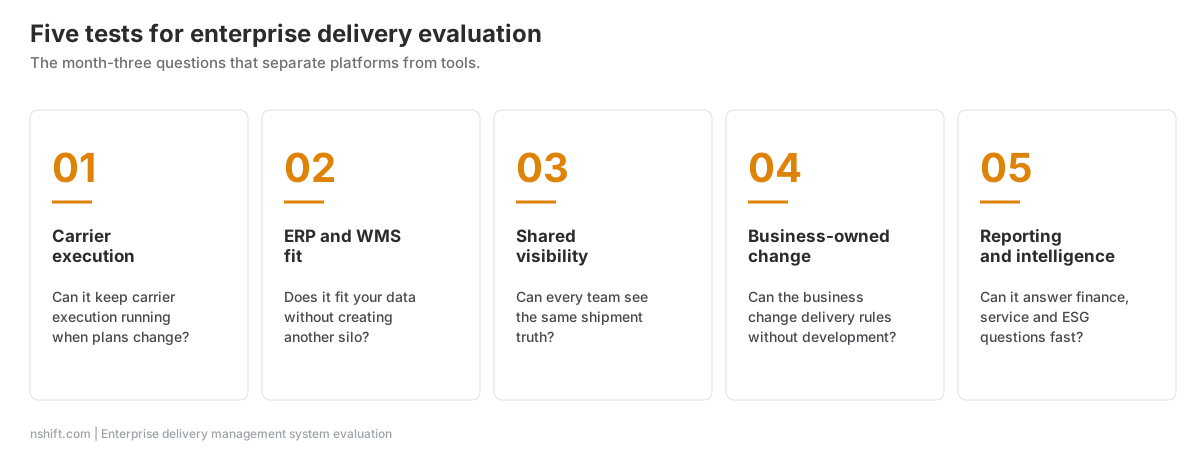
The main question is whether the operating model holds: can the platform still perform when the business starts changing around it? For enterprise teams, that means testing five things before the shortlist gets cut:
- Can the platform run the carriers and services you already use, plus the ones you plan to add?
- Can it sit inside your ERP, WMS and order flow without creating another silo?
- Can customer service, operations and shoppers work from the same shipment truth?
- Can the business make delivery changes without waiting for development?
- Can finance, operations and sustainability get the data they need without manual workarounds?
A strong evaluation turns those questions into working tests.
Test 1:
Can it keep carrier execution running when plans change?
Carrier coverage is the obvious starting point, and it's also the easiest part to overvalue.
A long carrier list only helps if those connections stay usable, current and operational under pressure. For enterprise shippers, the harder questions are about maintenance, speed and control.
Can a new carrier service go live quickly? Who updates label rules when a carrier changes the specification? How are rate cards kept current? What happens when one carrier needs to take overflow from another during peak? Can the business steer shipments by service, price, destination, capacity or delivery promise?
nShift connects to more than 1,000 carriers and supports more than 20,000 businesses worldwide, moving shipments at about 25 parcels per second. At that volume, carrier connectivity is an operating layer, not a static integration list.
A carrier change that quietly breaks a label template does not stay quiet for long. It shows up in the packing queue, the customer promise, the service desk and the end-of-day report.
So make the test practical. Ask the vendor:
- to show how a carrier service is added or changed
- who maintains carrier updates
- how service rules are configured
- what happens when a shipment fails validation
- how quickly volume can move to a different carrier or service when the plan changes
The difference between a delivery management platform and a shipping tool shows up in those details.
Take Berggård Amundsen, the Norwegian electronics wholesaler. It ships more than 1,200 parcels a day to installers, power plants and construction sites across Norway. Up to 80 carrier routes run from its main warehouse every day. Rolf Inge Danielsen, Logistics Director, describes the value of having that complexity in one place:
“We gather everything regarding shipments in one overall system: shipping methods, carriers, tracking, documentation and reports. The amount of shipping history we have serves as an informative basis when we need to assess new carriers.”
That's the enterprise test: the platform should execute today’s shipments and create the evidence for tomorrow’s carrier decisions.
Test 2:
Can it fit your ERP, WMS and order data without creating another silo?
A delivery management system has to work inside the systems the business already runs on:
- Orders sit in the ERP
- Picking and packing sit in the WMS
- Customer service works from the order record
- Finance needs shipment and cost data
- Ecommerce teams care about the delivery promise shown before purchase
If the delivery platform sits outside that flow, another team inherits the reconciliation work.
For enterprise buyers, integration is not just a technical checkpoint. It decides how fast the business can operate, how cleanly teams can work, and how much manual correction sits between order and delivery.
A good evaluation should test the real data flow:
- How does order data enter the delivery platform?
- How are delivery options, shipping rules and carrier services returned?
- How are tracking events pushed back to the systems teams already use?
- Can custom fields, cost centres, service codes and warehouse-specific rules be handled cleanly?
- How much work still depends on vendor engineering after go-live?
nShift Delivery integrates with WMS and ERP systems already running in enterprise operations.
Berggård Amundsen uses nShift Delivery with Astro at the main warehouse and Infor M3 across 25 service centres. That gives every location the same shipping method, carrier and tracking data from one system. Danielsen explains the operational effect:
“We don't waste time entering and finding data or tracking parcels in different systems. The integrations have improved our track and trace capability and allow all Berggård Amundsen employees to track all deliveries throughout the Group.”
The same point shows up at 3PL scale. Aditro Logistics runs nShift with Jeeves, Astro WMS and Ongoing WMS. Fredrik Krysén, Transport Director, puts the value plainly:
“The functionality, reliability and print speed gives us a solid delivery foundation, where we do not lose money on downtime or slow print of labels.”
Ask vendors to show the integration pattern for your ERP, WMS, OMS and ecommerce setup. Check published WMS integration partners. Then ask what your team can configure and what still needs a project.
Month three is when that difference becomes visible.
Test 3:
Can every team see the same shipment truth?
Once a parcel leaves the dock, the same shipment starts carrying different questions: customer service wants the latest status, operations wants the exception pattern, the shopper wants the ETA, finance may want the cost and sustainability may later need the shipment data for reporting.
If those answers live in different systems, teams lose time and customers lose confidence.
Enterprise visibility is a data problem before it is a tracking page problem. Different carriers send tracking updates in different formats, at different times, with different levels of detail. The platform has to turn those updates into one usable event stream.
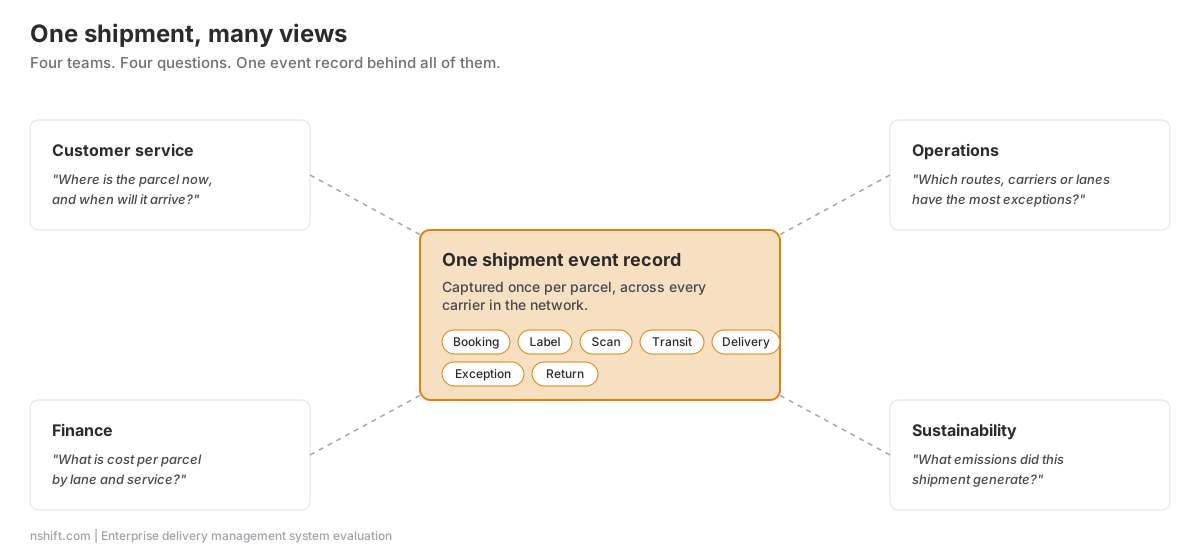
That event stream should support the shopper experience, the service desk, the operations dashboard and the reporting layer.
Proactive, branded post-purchase tracking can reduce WISMO calls by up to 50% by keeping shoppers informed and reducing routine “where is my order?” contacts.
The bigger point is control. WISMO is often a symptom of fragmented delivery data. If shoppers cannot see what is happening, they ask. If agents cannot see the same data, they escalate. If operations cannot see the exception pattern, the cause stays hidden.
Apotea, the Swedish pharmacy retailer, consolidated tracking across every carrier into one branded experience and recorded a 27% reduction in customer service calls. Pär Svärdson, Managing Director, explains the customer impact:
“The advantage of having full control over the shipment experience is that customers do not feel abandoned after pressing the ‘Buy’ button. They feel like they have closer contact with us because statuses are sent the entire time, they can follow their order and ultimately leave feedback when the product has been delivered. The fact that you get everything in one app and not just a bunch of emails ties together the experience very well."
In the evaluation, go beyond the tracking page and ask the vendor to show the same shipment from the shopper view, the customer service view and the operations view.
Then check the story. Does the status match? Does the ETA match? Are exceptions visible? Can notifications be triggered from the right events? Can the service team act without opening the carrier portal?
A branded tracking page helps, but a shared shipment record does more work.
Test 4:
Can the business change delivery rules without waiting on development?
Enterprise delivery operations change more often than vendor roadmaps allow.
A new carrier is added. A new country opens. Finance changes the cost allocation. A store chain shifts dispatch logic for a weekly product drop. Peak season needs temporary rules. A delivery option needs to be hidden for one region and promoted in another.
If every change needs a development ticket, delivery becomes the bottleneck.
Flexibility and governance belong in the same evaluation. The business needs control, but that control has to be safe. Teams should be able to change shipping rules, delivery options, label settings, pricing zones and carrier logic without adding risk to the operation.
Gina Tricot faced that kind of test. With more than 180 stores across the Nordics, weekly product drops, and ecommerce running alongside store replenishment, the team needed a delivery management system that could adapt quickly. Petri Ventelä, Head of Logistics, explained the selection criterion:
“When we were in the market for a new delivery management system, we set high requirements that it should be flexible and that we should be able to make the necessary changes ourselves. This was what we found in nShift Delivery.”
Self-serve configuration saves weeks when change is constant. A carrier update handled in a day beats a request that lands three sprints later.
During the evaluation, ask vendors to show configuration live. No slides. No promise of what the implementation team can do later. A working example.
Ask them to create or change:
- a shipping rule
- a delivery option
- a pricing zone
- a label setting
- a carrier service rule
- a user permission
Then ask who owns that configuration after go-live. The answer tells you how fast the business can move once the implementation team has left.
Test 5:
Can it answer finance, service and sustainability questions fast?
Every enterprise delivery operation should be able to answer four questions quickly: what shipped, with whom, at what cost, and at what service level.
If those answers take days of exports and manual matching, the platform is not giving the business enough control.
Reporting is where delivery management moves from execution to intelligence. It helps teams understand carrier performance, service quality, exception patterns, shipment cost and emissions data. It also supports better decisions in procurement, finance, operations and sustainability.
Shipment history carries much of that value. It gives teams the evidence they need for carrier negotiations, service reviews and network decisions. Berggård Amundsen uses nShift shipment history as the starting point for evaluating new carriers. The cleaner the record, the stronger the next carrier conversation.
Cost intelligence adds the commercial layer. Multi-carrier rate shopping sits in front of every booking and, applied by service rule and cost, can cut shipping expenses by an average of 10 to 15%.
For enterprise teams, volume totals are the easy report. The stronger test is whether the platform can show:
- cost per parcel by carrier, lane, service or zone
- service performance by carrier and region
- exception rates by route or delivery type
- carrier usage over time
- delivery promise accuracy
- emissions data ready for sustainability reporting
These are the questions that come up after the implementation has settled. They decide whether delivery can be managed as a business lever, rather than a cost line buried in carrier invoices.
Ask vendors to pull example reports during the evaluation. If every serious question needs a custom export, the month-three experience will be slow.
Demo-room scorecard for enterprise buyers
Use this scorecard in vendor conversations to make the platform prove how it works under real operating conditions:
| Test | Ask vendor to show | Weak answer |
| Carrier change | Add or update a carrier service, label rule or shipping method in a live environment. | “Our team would configure that after implementation.” |
| Carrier resilience | Shift volume from one carrier or service to another based on a practical rule. | “That would need a workaround.” |
| ERP/WMS fit | Map order, shipment and tracking data from your real system flow. | “We usually solve this through custom work.” |
| Shipment visibility | Show the same parcel from the shopper, service and operations view. | “The carrier portal has that information.” |
| Business configuration | Create a new shipping rule without developer support. | “You would raise a request with support.” |
| Reporting | Pull cost, service and exception data by lane, carrier and period. | “That would need a custom report.” |
| Governance | Show user roles, auditability, SSO and data access controls. | “Security can review this later.” |
| Post-purchase control | Show tracking notifications, branded tracking and exception handling from the same event data. | “Tracking is handled separately.” |
| Proof at scale | Share customer examples with similar volume, geography and carrier complexity. | “We have customers in that sector, but no comparable reference.” |
Download this scorecard (pdf)
A good vendor should welcome this kind of working session, as it creates a clearer evaluation for both sides.
It also helps the buying committee align around evidence:
- Supply chain sees operational fit
- IT sees system fit
- Finance sees cost control
- Customer service sees visibility
- Sustainability sees data readiness
- Procurement sees proof beyond the sales claim
Watch: the five-layer architecture behind the five tests
The five tests above are the buyer-side questions. This walkthrough covers the system-side anatomy they are testing: the five layers an enterprise delivery stack runs on, where each one gives way under real volume, and how the nShift product set maps onto them, including the layer that has no dedicated product.
The video’s checklist and the scorecard above are built for different moments. The scorecard tests what the platform does while it is in front of you. The video’s questions test what happens underneath once the demo environment is gone.
Put nShift through the same evaluation
The month-three test is the right way to evaluate nShift, too.
Bring the carrier mix you use today, the services you want to add, the ERP and WMS setup your team already runs on, and the reporting questions finance or sustainability will ask later. A useful demo should show how those pieces connect, not just how the interface looks.
nShift is built for enterprise delivery complexity from checkout to doorstep to returns. Carrier connectivity, multi-carrier booking, checkout choice, branded tracking and returns work from the same delivery management foundation, helping teams connect delivery operations with conversion, cost control, customer experience and resilience.
The proof shows up in customer operations:
-
Berggård Amundsen runs up to 80 routes a day from one warehouse and uses shipment history to assess new carriers.
-
Aditro Logistics relies on nShift across a multi-WMS 3PL setup.
-
Apotea reduced customer service calls after consolidating tracking across carriers.
-
Gina Tricot chose nShift Delivery for flexibility and the ability to make necessary changes internally.
Those examples point to the same enterprise pattern: broad carrier connectivity, clean integration with existing systems, and operational control that stays with the business.
A delivery management system should support the network, fit the business, and keep pace after go-live.
Request a demo and bring your month-three test case with you.
Keep reading: to put the system you choose to work, see what an enterprise delivery management program includes for the operating model, roles, KPIs, and risk controls that run it.