Returns evaluation pack

nShift Returns: The questions buyers ask, answered

Evaluating a returns platform? Start here. 
nShift Returns overview

What customer experience, operations, IT, security and procurement ask about nShift Returns

Every return reaches the returns desk as a cost, and the handling decides whether it stays one or becomes the next order. A buying committee asks the same questions in every evaluation: what the customer sees, what warning the warehouse gets, what the warehouse gets warned about, and what stands in the contract. Each answer below carries its evidence.
nShift Returns, what customer experience asks view

What customer experience asks

Customer experience owns whether the shopper comes back, so they start with what the return feels like.

What does a customer see when they start a return?

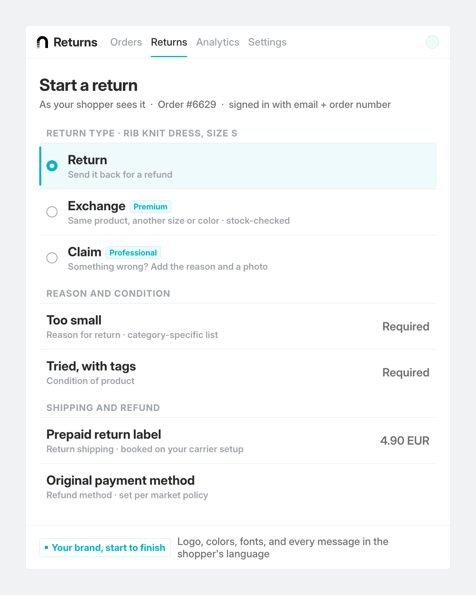
Your brand, start to finish. The consumer signs in with an email address and order number (or a secure email link), picks the item, chooses a return, an exchange, or a claim, gives the reason with an optional photo, then selects shipping and refund method. The flow runs under your logo, colors, and fonts, and every message arrives in the language the consumer selected.

Can a customer choose an exchange or a claim instead of a refund?

Yes. Return, Exchange, and Claim run as three outcomes of one flow. Exchanges cover the same product in a different color or size, checked against live stock so the flow only offers variants you can ship. Claims are available on the Professional plan and above; exchanges arrive with Premium.

Does it handle our markets and languages?

Yes, multi-market by design. A market groups the countries that share a currency and a return policy, carries multiple languages, and returns route automatically by destination country. Each market runs a single currency, so a setup selling in GBP and EUR is two markets.

What does a better returns experience change commercially?

Hunkemöller measured a 15% increase in in-store returns, rather than returns to the warehouse, across its seven markets. Quiz measured 5x its average email marketing click-through rate on branded returns communications and reports fewer calls to its customer service team. Platform-wide, the nShift ROI report measures 30% repeat return customers.

What operations asks

Operations takes over the moment a return is registered. What is coming, and how fast it clears the bench, is the whole section.

Can the warehouse see returns before they arrive?

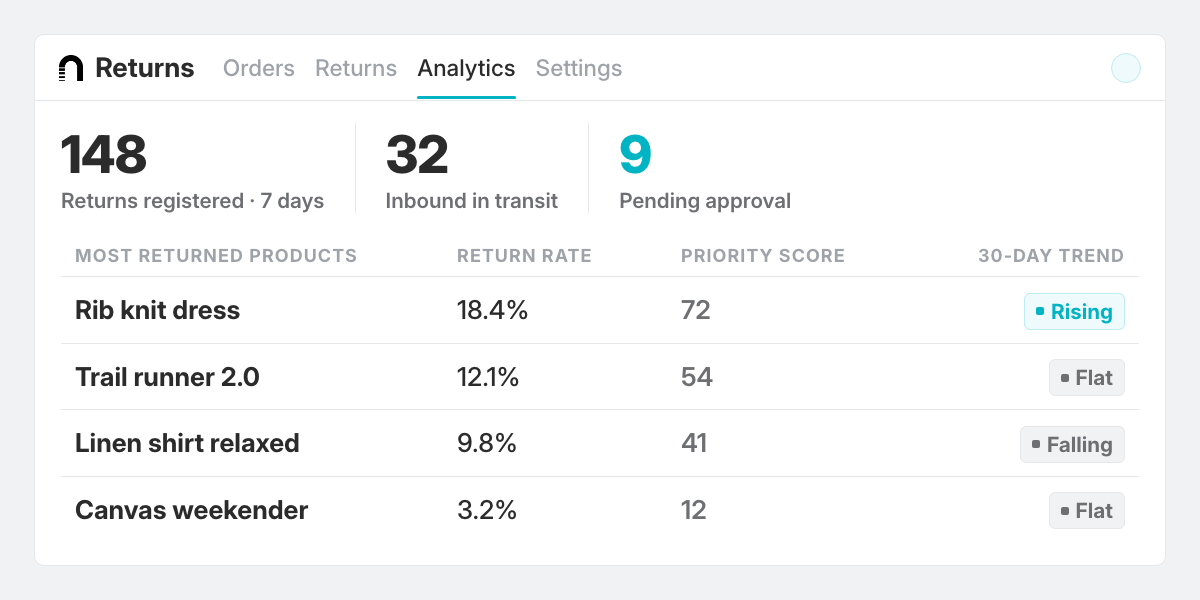
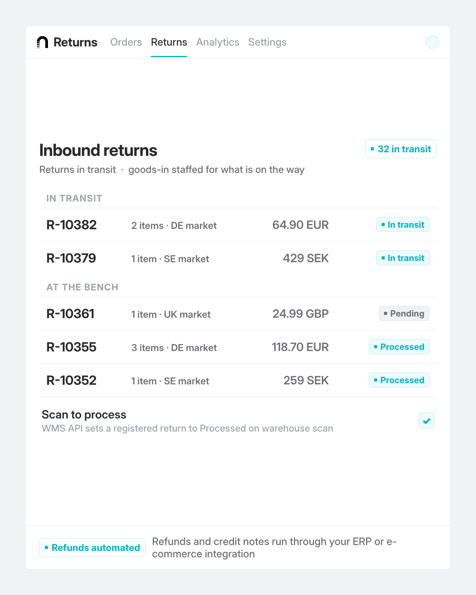
Yes. The Inbound view lists returns in transit, so goods-in is staffed for what is on the way rather than finding out at the dock.

How fast can a return be processed?

A warehouse scan can do it. The WMS API updates a registered return to Processed automatically on scan, provided the item counts match. Friluftsmagasinet, which runs its returns workflow on the nShift platform, registers a return in a few clicks and processes it in 2 to 3 minutes, down from 5.

Do refunds require manual work?

Not on the Professional and Premium plans, where automated refunds and credit notes run through your ERP or e-commerce integration. Partial refunds work by percentage or flat amount, and shipping-cost refunds are automated on full returns.

Can we hold risky returns for a human decision?
Yes. Approval flows run manual approval for claims only, for every return, or not at all, a fit for high-value items and international shipping. Per-customer return history is in the admin for whoever makes the call.
nShift Returns, what operations asks view
nShift Returns, what it asks view

What IT asks

IT meets this product twice: at go-live, and every time something changes. Here is what connects.

How do we integrate it?

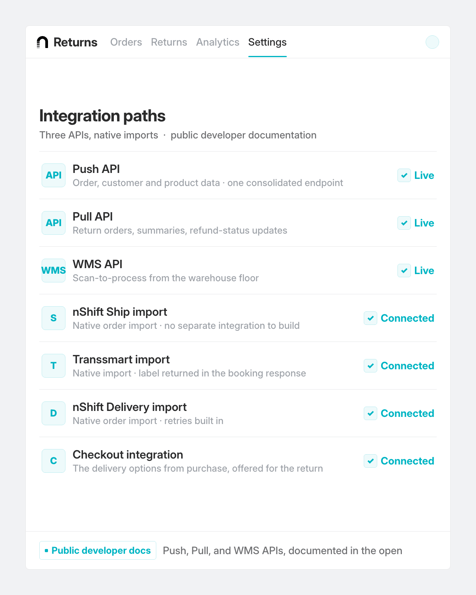
Three APIs plus native imports. A Push API takes order, customer, and product data through one consolidated endpoint; a Pull API serves return orders, summaries, and refund-status updates; a WMS API handles warehouse scans. Orders also import natively from nShift Ship, Transsmart, and Delivery with no separate integration to build. Developer documentation is public.

How does the return shipment get booked and labeled?

Through nShift Ship, Transsmart, or Delivery. Transsmart returns the label in the booking response, labels are downloadable from the admin, and tracking number and status are recorded per return. With the nShift Checkout integration, consumers get the same delivery options for the return as they had at purchase. Customs fields cover cross-border returns: HS code, origin, descriptions.

Can we embed the flow in our own site?

Yes, by iframe, restricted by a domain allowlist so only the domains you approve can serve it.

How do service accounts authenticate?

API access uses Basic Authentication with self-service credential users. Each password displays once at creation and cannot be recovered later, only replaced. Your own admins create and manage the credentials.

What security asks

Security signs off before go-live, starting with who can see what.

What certifications do you hold?

ISO 27001 certified, with an information security management system and the certificate available on request. Certification body: DNV. External penetration testing on our cloud systems within a risk-based security program.

How is our data handled?

Customer data is protected to GDPR obligations, hosted in AWS Europe, and encrypted in transit.

How do you keep one consumer from opening another's order?

Access is scoped to the order. The consumer authenticates with the order's email address and order number, or through a secure email link that only the registered email owner can open.

How is access controlled across teams, 3PLs, and brands?
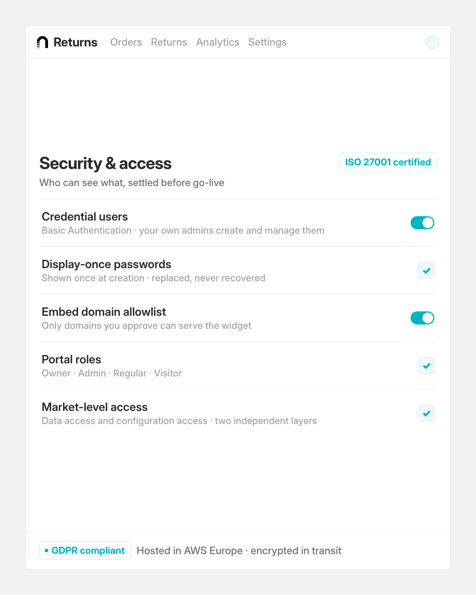
Four portal roles (Owner, Admin, Regular, Visitor), with market-level data access and configuration access as two independent layers. A 3PL can process one market's returns without any configuration rights, and a brand team can manage its own setup without seeing another market's data.
nShift Returns, what security asks view
nShift Returns, what procurement asks view

What procurement asks

Procurement wants the commitment in writing and the setup effort on the table.

Is reliability committed in writing, and can we verify it ourselves?

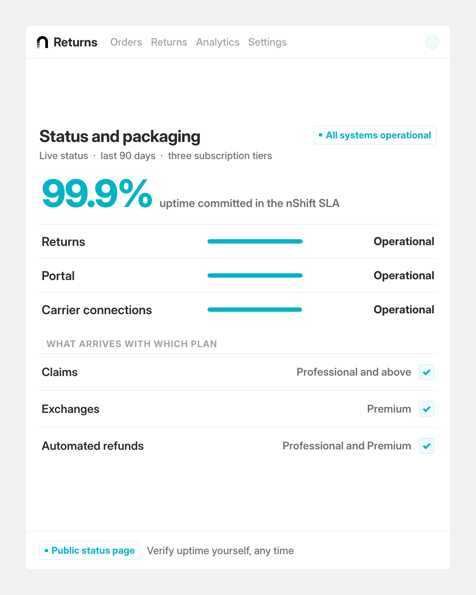
nShift commits to 99.9% uptime in its service level agreement, and you do not have to take that on trust: Returns is a named component on the public nShift status page, with live status and 90-day uptime history visible to anyone.

How is the product packaged?

Three subscription tiers: Essential, Professional, and Premium. Claims arrive with Professional, exchanges arrive with Premium, and automated refunds run on Professional and Premium. Pricing is tailored to volumes and handled per deal.

What does setup involve on our side?

Markets are set up with nShift Customer Service rather than self-service, and exchange activation requires a custom backend integration arranged the same way. Plan both as service steps in the implementation timeline. After go-live, return policies, per-language content, and shipping options are managed in the admin by your own team.

Can you provide references?

Yes. Published customer stories with nShift Returns include Hunkemöller and Quiz, and further references are matched by size, sector, and geography on request.

The full answer set for your RFP

The Returns RFP and Security Pack brings the security answers, the verified detail behind every claim on this page, and a ready-to-use response to the questions evaluation teams ask most.

Rather talk it through?

If your evaluation has a question this page does not cover, or you want the exchange flow, the warehouse scanning, and the integration path mapped to your own stack and markets, book a short demo. Bring the committee's open questions and we will work through them one by one.