
Cross-Border Commerce Europe's 8th TOP 500 B2C Cross-Border Retail Europe ranking landed in Brussels on April 23, 2026, and the headline practically wrote itself. IKEA holds the top spot, JYSK has climbed from fifth to second, H&M sits at third, while Lidl, last year's number two, has slipped to eighth. Zalando, the first online-born retailer on the list, is once again chasing the physical-store giants from behind.
On first read, it looks like a Nordic retail victory lap. Read again, and the ranking quietly tells you which capability now separates the league leaders from the chasing pack.
The deeper story sits below the names; the rules of cross-border ecommerce have changed beneath the retailers on this list. For a decade, “cross-border” mostly meant translating a website, accepting a few extra payment methods, and switching on international shipping. That test no longer sorts the league: the European market has moved into a slower, more demanding phase, and the retailers gaining ground are the ones treating international expansion as an operational discipline, with delivery infrastructure that holds up market by market.
A €108 billion market with shrinking room at the top
European cross-border B2C ecommerce reached €108 billion in 2025, excluding travel, which Cross-Border Commerce Europe puts at roughly 25% of the total European online market. The Top 500 generated €86 billion of that, up €17 billion or about 25% year over year. The top 10 retailers alone account for roughly 20% of total Top 500 cross-border sales, a level of concentration that suggests the easy wins at the top of the league table have already been claimed.
Cross-Border Commerce Europe describes the sector as evolving from rapid expansion into a more stable and mature phase, with leading retailers now prioritizing operational efficiency, margin improvement, logistics optimization, and customer retention over the land-grab posture that defined the 2010s.
That phrasing is doing a lot of work: it says, politely, that the market will no longer grow retailers out of operational fragility. The retailers gaining ground are the ones that have figured out how to make distance feel small.
The retailers winning digital cross-border have stores
Look at the top of the ranking. IKEA, JYSK, H&M, LEGO, MediaWorld, Pandora, Lidl, and Adidas are all store-based or brand-led multichannel operators. Many of them spent years building local operating models before ecommerce became the main growth story. Pure digital natives, Zalando being the obvious exception, trail behind.
The ranking alone does not prove that stores are the reason these brands win cross-border. That is interpretation, not data. But it does suggest something useful. Mature cross-border ecommerce increasingly rewards capabilities that sit below the website: local delivery options, returns paths, service rules, pickup networks, and exception handling. Those are the muscles a multichannel operator tends to have already built, in market, before going digital.
JYSK shows the pattern in motion. The retailer, now second in the cross-border ranking, has been an nShift customer for a while, since they began expanding into Central and Eastern Europe and needed local carriers that were not yet in the library. In JYSK's words:
“[nShift] accepted the challenge and as a result have become a key strategic partner since day one in our online journey, by allowing us to quickly onboard new carriers and expand into new markets.”
Adding the right local carrier in each new country, without rebuilding the integration stack, is what separates controlled expansion from a patchwork of one-off setups per market.
Cross-Border Commerce Europe's own data backs the intuition that the top of the market is now hard to disrupt. By the report's own description, the ranking “remains slightly unchanged compared to 2024, highlighting increasing market maturity and limited disruption at the top.” Stability at the top is a tell. It usually means the cost of competing has gone up.
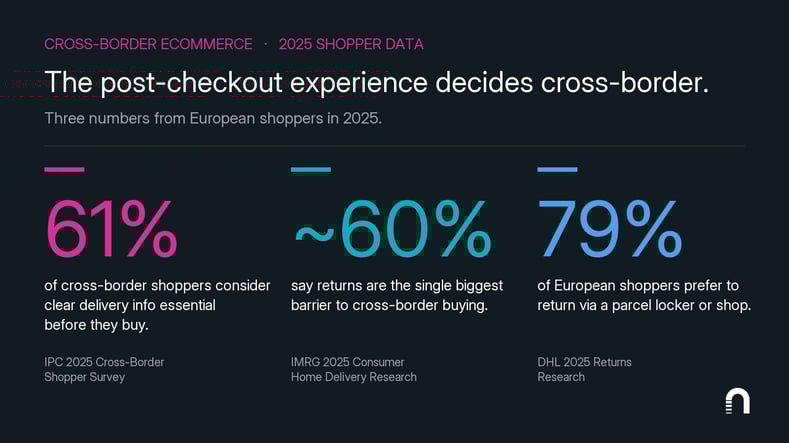
The post-checkout experience is where cross-border retail gets decided
If the storefront battle is largely settled (same translated copy, same global payment stack, same one-click flows), the post-checkout experience is where cross-border retail gets decided. And the data on what shoppers actually want is unforgiving.
The International Post Corporation's 2025 Cross-Border E-Commerce Shopper Survey, based on roughly 31,000 responses across 37 countries in September 2025, found that 61% of cross-border shoppers consider clear information on delivery charges before purchase essential to the decision to buy. Doorstep delivery is still the most common method at 44% of cross-border parcels, but parcel lockers have climbed to 13% and are growing fast. The proportion of cross-border parcels taking 15 days or longer has fallen from 29% in 2020 to 7% in 2025. Long international delivery times are becoming less normal, which raises the expectation bar for every retailer that ships across a border.
Out-of-home delivery is growing even faster. Geopost reports that 46% of regular European online shoppers now favor out-of-home delivery options, up 15 points since 2019, and that its own cross-border out-of-home volumes grew 44% in the first half of 2025. The carrier's European network has reached 100,000 parcel shops and 40,000 lockers.
Preferences also vary sharply by country. Lockers are highly popular in Poland and the Baltics, with strong growth across the Nordics and Germany. Parcel shops anchor the network in France and Spain, where local retail is woven into the delivery ecosystem. That kind of variation makes a single, generic cross-border carrier setup look obviously inadequate the moment a retailer moves past two or three markets.
Returns are the unmodeled cost
Returns are where many cross-border P&Ls quietly fall apart. IMRG's research finds that returns are now the single biggest barrier for cross-border shoppers, cited by close to 60% of consumers, with delivery itself the second biggest concern at around 50%. That puts the return path inside the buying decision, before the order is placed. DHL's 2025 returns research adds that 67% of global shoppers, and 79% in Europe, prefer to return items via a parcel locker or shop.
Together, those numbers describe a market in which the return journey shapes conversion at checkout. A retailer that cannot offer a return path that feels normal in a given country pays for that gap twice: once in lost conversion at checkout, and again in the cost of every return it does receive.
Where the integration stack breaks the brand promise
Expanding into another European market in 2026 means stitching together more carriers, more service levels, more pickup networks, more customs profiles, more VAT regimes, more return routes, and more exception types than five years ago. Each new country adds another layer of integration between the storefront, the warehouse management system, the ERP, the carrier APIs, and the customer service platform. Every additional layer is a place for the brand promise to break.
This is where delivery management becomes part of the growth strategy. nShift connects checkout, shipping, tracking, and returns into one operating model, so retailers expanding cross-border can show locally relevant delivery options at checkout, apply carrier logic by country and service level, execute shipments across a network of 1,000+ carriers, and give the returns experience the same level of operational control as outbound shipments.
Cross-Border Commerce Europe's framing of the moment as one defined by “logistics optimization” and “operational efficiency” reads more like a warning than a forecast. Retailers that have already built a controlled delivery layer, with choice at checkout, country-specific carrier logic, harmonized tracking, and integrated returns, are treating expansion as an extension of an operating model. Retailers that have not are stacking complexity on top of a checkout and hoping the customer does not notice.
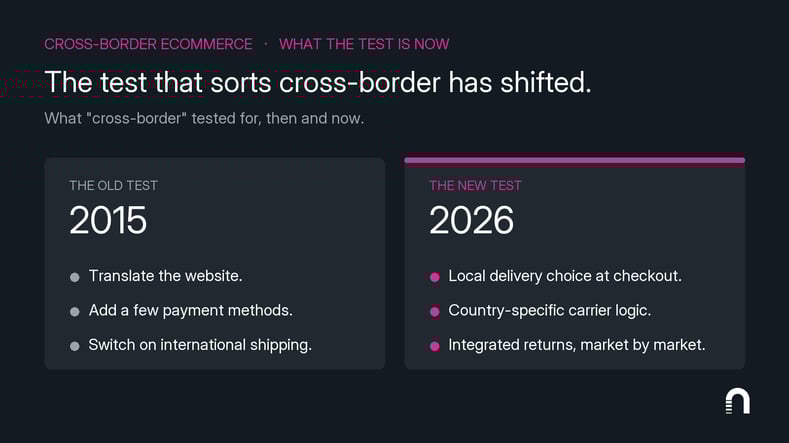
Reliability inside each market is the new cross-border moat
The first decade of cross-border rewarded reach across countries. The next decade rewards control inside each one. Visibility in more markets has become table stakes. The retailers pulling ahead have built something harder to replicate: reliability inside each market, with local delivery options, accurate tracking, and familiar return paths.
The ranking alone does not prove that delivery explains who wins. Alongside the IPC, IMRG, Geopost, and DHL data, it points to a clear shift. The click happens at the storefront. Whether the customer comes back depends on the delivery promise, carrier choice, tracking message, and return path that follow it.
The next stage of cross-border growth runs on one test: can the delivery operation keep the promise once the customer clicks buy?