
A local delivery partner looks like the right call when a retailer is focused on one market. Local carriers, familiar return routes, known service habits, the right pickup points and lockers. For a business building its first customer base, that focus works.
The constraint shows up when the customer is no longer local, and ecommerce delivery management suddenly needs to work across borders, carriers, and expectations the original setup was never built for. Structuring it as one enterprise delivery management program is how retailers keep that promise as they scale.
A shopper in another country sees a product, a delivery option, a return policy, a refund timeline. She assumes the brand can keep that promise where she lives. If the parcel gets stuck, the return turns expensive, the refund takes weeks, or support cannot explain what happened, she does not think about operating models. She thinks the brand failed her.
nShift analyzed 7,178 public customer reviews from five European fashion retailers spanning premium fashion, denim, fast fashion, menswear, and sustainable lifestyle. The customer bases, price points, and propositions were different. The pattern was the same.
When post-purchase operations fell short, customers saw one experience failing, from the delayed parcel through the confusing return to the slow refund and the support team that could not help. The promise made at checkout did not survive the reality of delivery across borders.
Customers experience delivery as trust. Retailers who treat it as infrastructure miss the risk.
In short: A local delivery partner can serve one market well, but cross-border growth adds carrier complexity, return-cost variation, customs friction, and support visibility gaps that a locally scoped setup cannot absorb. Retailers who build their post-purchase model around a local partner often discover the limitation through customer complaints, not internal reporting.
The hidden cost of building around a local partner
A locally focused delivery partner can be excellent inside the market it was built for. The risk starts when a retailer anchors its entire post-purchase operating model around that local strength.
At first, that looks efficient. Later, it becomes restrictive.
New markets introduce different carrier networks, delivery preferences, return-cost expectations, customs events, pickup behavior, refund norms, support languages, consumer protection rules, and payment flows. A local partner that serves the home market well may leave the retailer absorbing every gap outside it.
Those gaps land as customer friction. A return process that works in one country becomes confusing in another. A refund timeline that seems acceptable internally feels unreasonable to the customer waiting for her money. A carrier event that should be visible is missing from the support screen. A parcel is marked delivered, but the customer has no package.
From the customer's perspective, none of this reads as a strategic gap. It reads as bad service. And it compounds with each new market, because each market adds its own version of the same structural weakness.
Growth debt turns public fast.
7,178 reviews tell the same story
Retailers often treat post-purchase complaints as isolated incidents. A courier missed a scan. A customer typed the wrong address. A warehouse backlog delayed a return. A payment process held up a refund.
All of that happens. But the review data points to something structural.
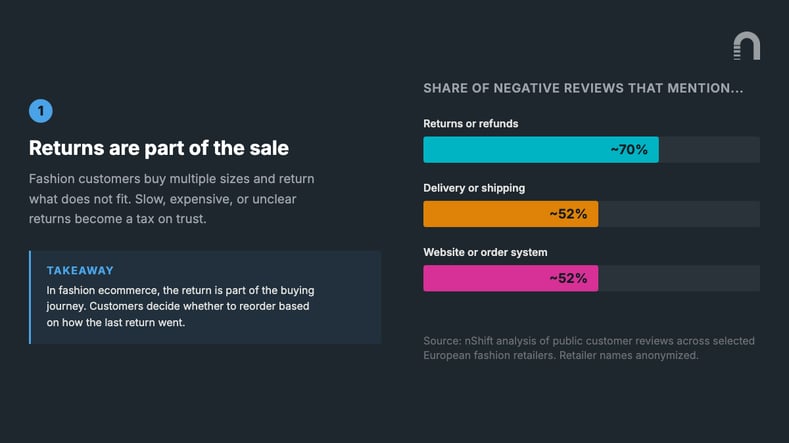
In the largest dataset nShift analyzed, around 70% of negative reviews mentioned returns or refunds. Around 52% mentioned delivery or shipping. Around 52% mentioned website or order-system friction. The complaints clustered around the operating layer between checkout and resolution, exactly where the delivery management platform either holds the experience together or lets it fragment.
A delayed parcel is annoying. A delayed parcel with unclear tracking and no one taking ownership becomes a brand problem. A return fee may be commercially rational, but when the customer believes the size guide misled her, the item arrived faulty, or the product did not match the listing, the fee feels like a penalty for trusting the retailer. A slow refund may be a process issue inside the business. To the customer waiting for her money, the retailer appears to be holding both the item and the cash.
Delivery and returns sit inside the buying experience, not beside it.
Where the promise breaks down
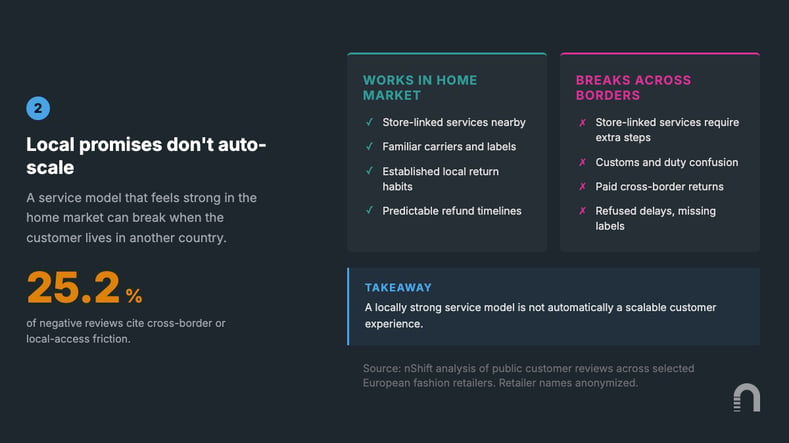
One of the clearest signals came from a retailer whose post-purchase promise depended on local access. Public reviews revealed a service experience that worked well when the customer lived near the right store, return route, or support infrastructure, and deteriorated when she did not.
Across the reviewed retailers, local-access friction took different forms: return routes that assumed proximity, store-linked services unavailable to remote customers, pickup options that varied by market, customs handling with no clear communication, and support teams without the visibility to resolve issues quickly. In that dataset, cross-border or local-access friction appeared in 25.2% of reviews. Customers were reacting to a promise that became harder to access depending on where they lived.
A brand promise can carry emotional power in the home market and fall apart operationally in another one. Easy returns, fast refunds, local drop-off, convenient pickup, store-linked support, and proactive customer care all sound straightforward when the infrastructure is nearby.
The experience still looks polished at checkout. The cracks appear when something goes wrong. And cross-border ecommerce generates plenty of those moments.
Returns shape buying confidence before the order
Fashion retailers understand this better than most. Customers buy multiple sizes, compare fit at home, and return what does not work under the right of withdrawal. That is the online version of the fitting room, and the return experience directly affects whether a customer felt confident enough to buy in the first place.
If customers believe returns are clear, trackable, and fair, they buy more freely. If they believe returns are expensive, slow, or opaque, they hesitate. And once a customer has waited weeks for a refund, she remembers.
In one premium fashion retailer dataset, returns and refunds appeared in 48.1% of reviews, delivery or courier issues in 49.2%, and customer-service mentions in 69.8%. The recurring thread ran deeper than missing parcels or slow refunds. Customers felt they had to chase, prove, escalate, or wait without anyone clearly owning the resolution.
The gap between the retailer's internal return process and the customer's actual experience widens with every market. A process that functions internally may still feel unclear, slow, or unfair to the customer waiting for her money. And that perception needs to hold across every market the retailer enters.
A local-first delivery setup may handle return orchestration in the home market. The harder test is whether it can support return choice, status visibility, refund reconciliation, and support ownership for a customer in a different country.
When it cannot, the customer becomes the integration layer. And that does not scale.
Who sees the exception first?
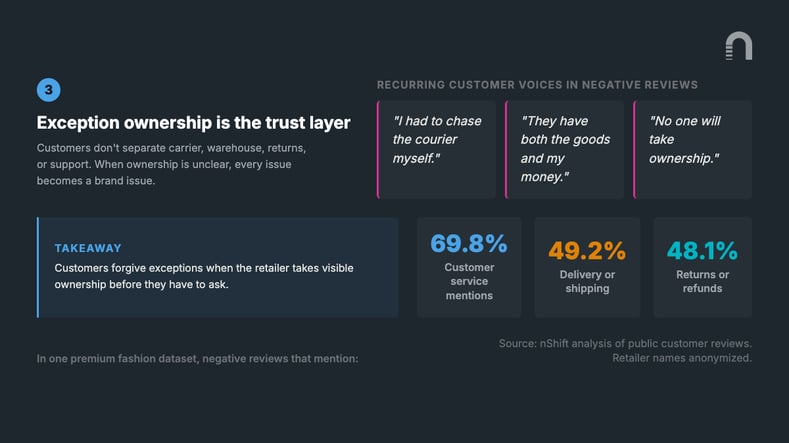
No retailer can prevent every delivery exception. Parcels will be delayed, tracking events unclear, returns slower during peak, items misrouted, carriers making mistakes, customs issues creating friction.
The question that separates strong post-purchase operations from weak ones is ownership. If the customer discovers the problem before the retailer does, the retailer is already behind. If support cannot see the same delivery or return information the customer is asking about, the customer becomes the investigator. If a refund depends on a process no one can explain, irritation turns into suspicion.
Strong post-purchase operations depend on visibility across carriers, markets, returns, refund triggers, customer notifications, and exception workflows, not on perfection. The goal is seeing what is happening and acting before the customer has to chase.
At scale, delivery works as a full operating model.
When growth outpaces the delivery setup
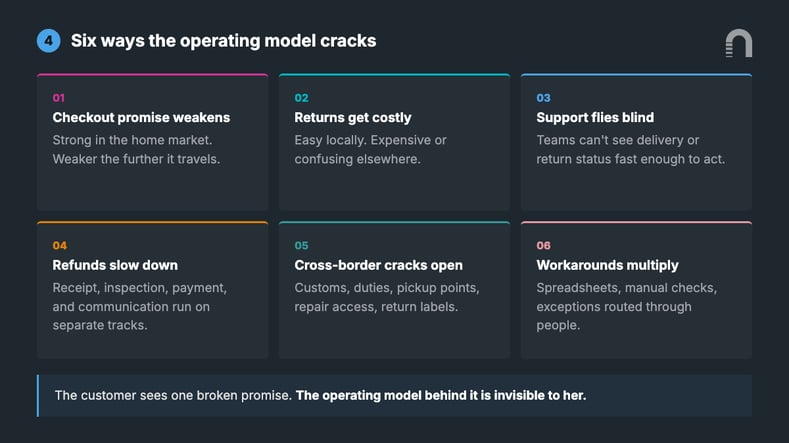
The weakness of a local delivery partner rarely shows on day one. Familiar carriers, familiar return routes, known pickup behavior, support teams who understand the usual exceptions. The home market runs smoothly.
The friction appears when the retailer tries to grow beyond that environment.
The retailer can still ship, but the customer promise becomes harder to control. Delivery options vary by market. Returns grow less predictable. Support teams lack the visibility they need. Refunds slow down because return receipt, inspection, payment, and communication are not connected tightly enough. Cross-border orders introduce duties, customs, pickup-point friction, return-label inconsistencies, and local-service gaps that home-market customers never experienced.
Internally, the business starts compensating. Local teams build workarounds. Customer service checks carrier portals manually. Finance handles refund exceptions one at a time. Operations relies on spreadsheets, support macros, and institutional knowledge that lives in specific people rather than in the system.
The customer sees none of those workarounds. She sees a brand that promised an experience it could not deliver consistently. And the lost confidence carries a higher cost than the operational inefficiency behind it.
Grow into the partner, not out of it
Retailers should ask the scaling question before international growth forces it into public view. By the time the weakness shows up in reviews, support tickets, refund disputes, and abandoned repeat purchases, the damage is already accumulating.
The better question: can the delivery partner we choose today still serve the customer we want to reach tomorrow?
That customer may live in a different country. She may need a different delivery option, expect a local return route, or require clear information about duties, pickup points, store-linked services, refund timing, and who owns the exception when something goes wrong. She will not care which carrier, warehouse, ecommerce platform, payment provider, or delivery management tool sits behind the experience. She bought from the brand.
Delivery infrastructure becomes more important as the business grows. A local delivery partner can help a retailer launch. Growth requires a post-purchase model the retailer can grow into: carrier breadth across markets, return orchestration across borders, clear tracking and customer communication, support visibility before customers chase, refund and payment reconciliation, market-specific delivery rules, and for larger retailers, transport governance across warehouses, stores, carriers, returns, and cost.
The lesson from 7,178 public reviews is sharper than "delivery failures happen": when the delivery model is too local for the growth plan, the customer finds out first. And by then, the conversation has moved from delivery operations to brand trust.