
In Nordic ecommerce, the damage rarely starts at the doorstep. It starts earlier, when the delivery promise becomes vague, the sender name changes, support goes quiet, and the customer realizes she is now managing the exception herself.
Jenny is a pseudonym, and her story is not unusual. She was renovating her apartment, preparing it for sale, and buying furniture against a hard deadline. The delivery plan broke first, then trust followed.
When a purchase becomes a deadline
Before she placed a single order, Jenny had already converted every item on her list from a purchase into a deadline.
She was standing in an apartment being prepared for sale. The old furniture had already been thrown out or sold. The realtor wanted the listing live quickly; the photographer needed a date; the apartment had to look complete, calm, and desirable. So the sofa was no longer just a sofa and the rug was no longer just a rug: every item had quietly turned into part of a schedule.
Delivery promises work like that in real life. They stop being a logistics detail and become the hidden infrastructure behind someone’s plan.
The pressure points in Nordic ecommerce
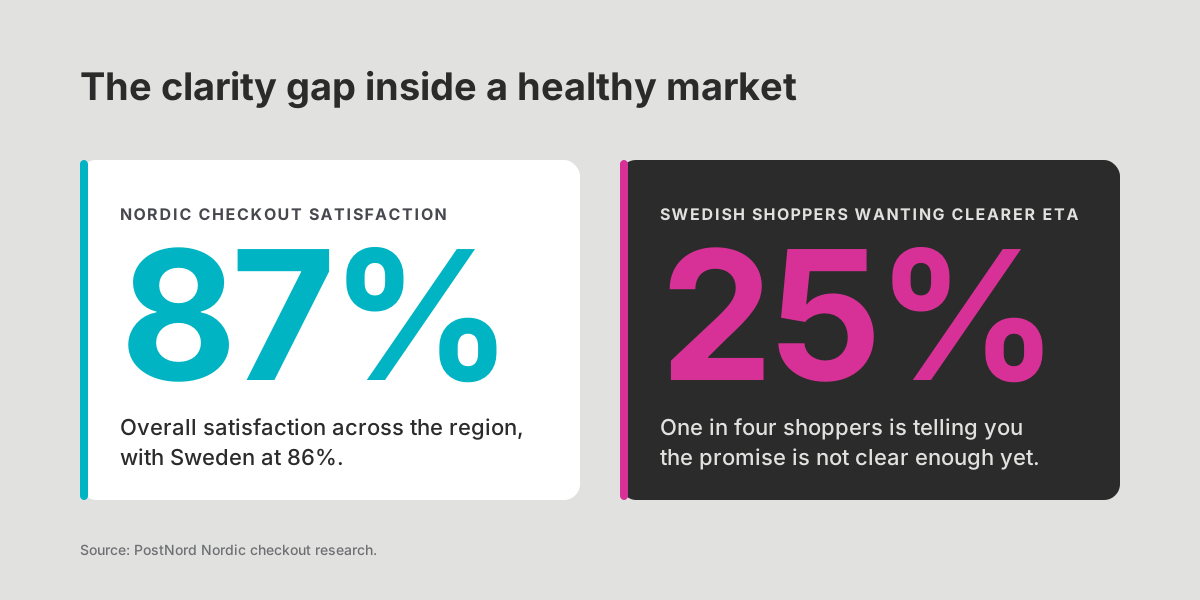
From a distance, the Nordic ecommerce market looks healthy enough. PostNord’s latest Nordic checkout research shows overall checkout satisfaction at 87% across the region, with Sweden at 86 percent. But the same research shows that clear delivery information remains one of the most important drivers of checkout satisfaction, and 25% of Swedish shoppers still say they want clearer delivery information in checkout. Retailers should take that contradiction seriously. The market is mature enough that shoppers now notice the subtle ways trust starts to fray.
The tension runs deeper in home furnishings, where the purchase is expensive, visible, and hard to improvise around. PostNord’s E-barometern annual report, published in 2026 on 2025 data, shows that Swedish ecommerce in furniture and home furnishings grew 18 percent in 2025 to SEK 9.3 billion, with ecommerce share in the category rising to 15 percent. More people are now buying consequential home items online. More purchases come attached to room logistics, delivery coordination, and deadlines that sit well outside the checkout flow itself.
How shoppers really evaluate delivery promises
Jenny quickly learned something many consumers already know and many retail organizations still underweight: when you are buying with a hard deadline, you do not really shop on product pages. You shop in the space between product page and checkout. You click into item after item not to compare design first, but to test whether the promise survives scrutiny. Can it come in time? Is the delivery method workable? Is the service level realistic? If something slips, can you actually do anything about it?
Each retailer made her answer those questions differently.
The first retailer: manageable on paper, harder in practice
One well-known Swedish furniture retailer, which I’ll call the Swedish furniture retailer, had a logic that was relatively explicit, if not always simple. The retailer says customers can choose home delivery or store pickup, and for some products parcel-point delivery as well. Pickup to store is always free. It also says delivery timing depends on the product, location, stock status, and whether the customer chooses pickup or home delivery. It groups availability into practical time buckets such as direct availability, 0–5 days, within 10 days, or within two weeks, and offers a pickup filter for items available from store within 60 minutes. It also offers higher-service options such as carry-in and assembly.
Manageable on paper, more complicated to live with. The sofa Jenny wanted from the Swedish furniture retailer was available fast, but only if she collected it herself from one of a small number of Stockholm stores. Same-day access existed, but only for the customer who could turn store stock into transport. Jenny lives in the city and no longer owns a car. Renting one would cost time and money she was already burning. Delivery, meanwhile, operated on a different schedule.
So she adapted: she chose the remaining items that could be delivered home instead, and also ended up paying more to preserve the timeline. In her case, that promise held.
The second retailer: when a clear promise starts to unravel
A large online furniture chain, which I’ll call the online furniture chain, offered a different kind of promise. Its terms say the default is delivery to the curb or property boundary unless smaller items qualify for pickup-point delivery. It also offers add-on services such as evening delivery, timed delivery, and carry-in by two people into the room of choice. But availability depends on postcode and product, and the online furniture chain is clear that estimated delivery times are preliminary, shown on the product page and in the order confirmation, and can differ depending on the delivery option selected.
So Jenny found a sofa there that appeared to fit the deadline. She paid for a more expensive one, because she picked a sofa that fit the deadline. She arranged for a family member to help carry it in because the last few meters mattered - a small detail until you think about what furniture delivery really is. The distance from the entrance to the apartment door may be short, but commercially it becomes a separate service layer, a separate cost, and in many cases a separate risk.
When the sender name changes, trust shifts with it
Then the carrier notification arrived. At first, it felt like good news: progress, confirmation, relief.
But the sender name was not the online furniture chain she bought from. It was a company name she had never heard of.
From an industry perspective, the detail may be explainable. The online furniture chain sells products from external furniture brands, and one such manufacturer is tied to a known Scandinavian home-furnishing label sold through that store. From the operations side, the chain may make sense. From the customer side, that is not how it lands: she bought from a familiar retail brand, and the parcel trail now introduced a name she did not recognize.
The mind fills the gap immediately. Who really sold me this? Is this the same product I thought I bought? Has something gone wrong? Can Jenny expect quality from this company she never heard of? It is an expensive sofa. The trust problem starts before any official failure has even occurred.
The real break happens before the parcel is officially late
Then the updates stopped.
A delivery promise breaks at that moment. Not when the item is formally late, earlier: it breaks when the customer can no longer form a believable picture of what is happening. Is the original date still true? Has the shipment stalled? Can I still cancel? Will anyone answer fast enough to save the plan?
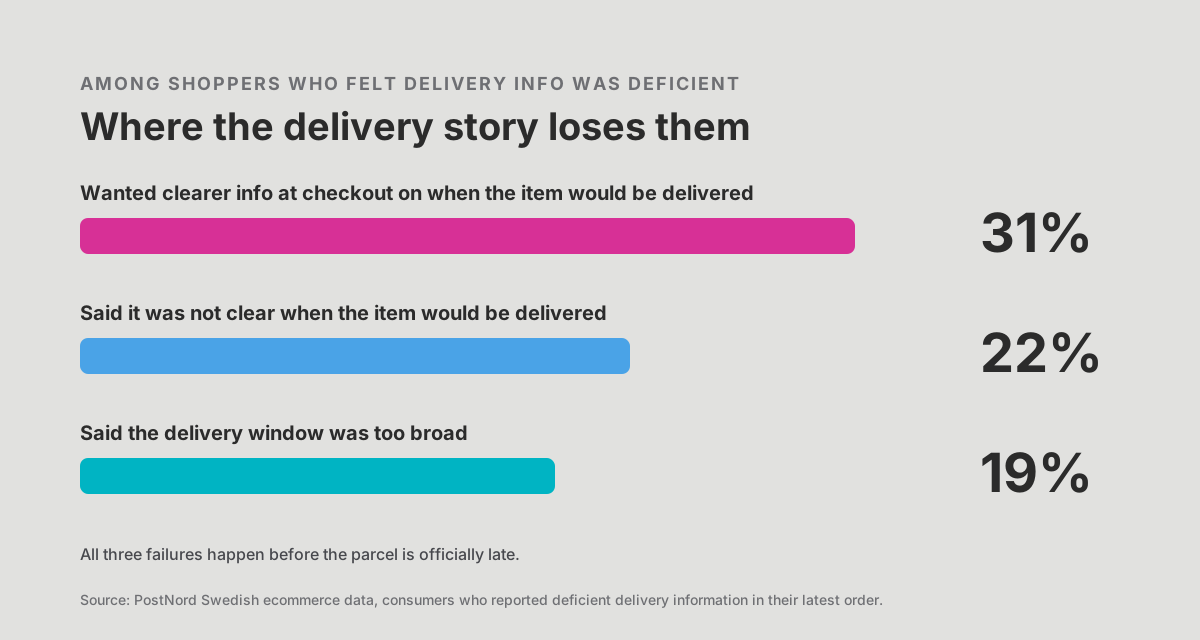
PostNord’s Swedish ecommerce data makes this painfully concrete: among consumers who felt delivery information was deficient in their latest order:
-
31% wanted clearer information at checkout on when the item would be delivered
-
22% said it was not clear when the item would be delivered once the shipping option had been selected
-
19% said the delivery window was too broad
PostNord also notes that retailers and logistics operators share responsibility for delivery-time information, and that one in three consumers wants delivery tracking in an app that holds the relevant information in one place.
Jenny’s week, compressed: the estimate helped her decide. Then it became vague, then useless.
When support exists, but not in time
She could see the photoshoot deadline approaching as she understood the sofa would probably miss it. She wanted to cancel and buy something else that might still save the schedule. But what she needed at that moment was not a broad help center, a brand film, or another AI greeting. She needed fast, human, empowered intervention.
Instead, she found the deadest form of modern support: the one that exists in theory, but not in time. She tried chat, then email, got an auto-response, and heard nothing back. The practical question was simple: can someone stop this before it destroys the rest of the plan? But the answer path was asynchronous, and that was enough to make it functionally useless.
This is not a fringe expectation from a demanding customer. E-barometern shows that 91% of consumers say clearly indicated customer-service contact options are important when choosing an online store, while 85% say clear return procedures matter. The online furniture chain’s own terms raise the stakes further. Cancellation is free only before an order has been handled; once handled, it generally cannot be stopped and return costs may apply instead. Operationally, that may be reasonable; from the customer’s point of view, it means the moment support matters most may be exactly the moment it is hardest to activate.
Another promise slips
Then a large global fashion and home retailer, which I’ll call the global fashion and home retailer, slipped too when she needed two bedside tables.
Its Swedish delivery information says standard delivery is typically 2–4 business days, with the current delivery time shown in checkout and in the order confirmation. It also says that if an order contains products from multiple brands, some delivery options may disappear and items may be shipped separately. For larger home products such as furniture or rugs, only home delivery is available, with a delivery fee of 149 SEK, and those items cannot be returned in store or in a parcel box. The global fashion and home retailer also lists major home-delivery partners for certain Swedish orders.
So when the last-mile delivery partner notified Jenny that the item was coming and then canceled the same day, the damage was larger than a missed slot. She had already reorganized her day around that promise. Retailers often underestimate this. A customer does not experience late delivery as a neutral operational variance. She experiences it as forced replanning. The retailer has handed exception management back to the buyer.
What good delivery feels like
And then the Swedish furniture retailer delivered.
On time.
A smaller carrier arrived and was, in Jenny’s words, fantastic.
When the stakes are high, competence feels personal, like someone understood the assignment: protect the plan, not just move the item.
What broken delivery promises actually reveal
This is what the story behind broken delivery promises actually looks like. The damage rarely begins at the doorstep. It begins when the customer realizes the promise sounded clearer before payment than it does after. Once that happens, the brand is no longer being judged on design, assortment, or price. It is being judged on whether its internal operating model can keep a promise coherent across checkout, carrier handoff, notifications, support, and the last few meters to the home.
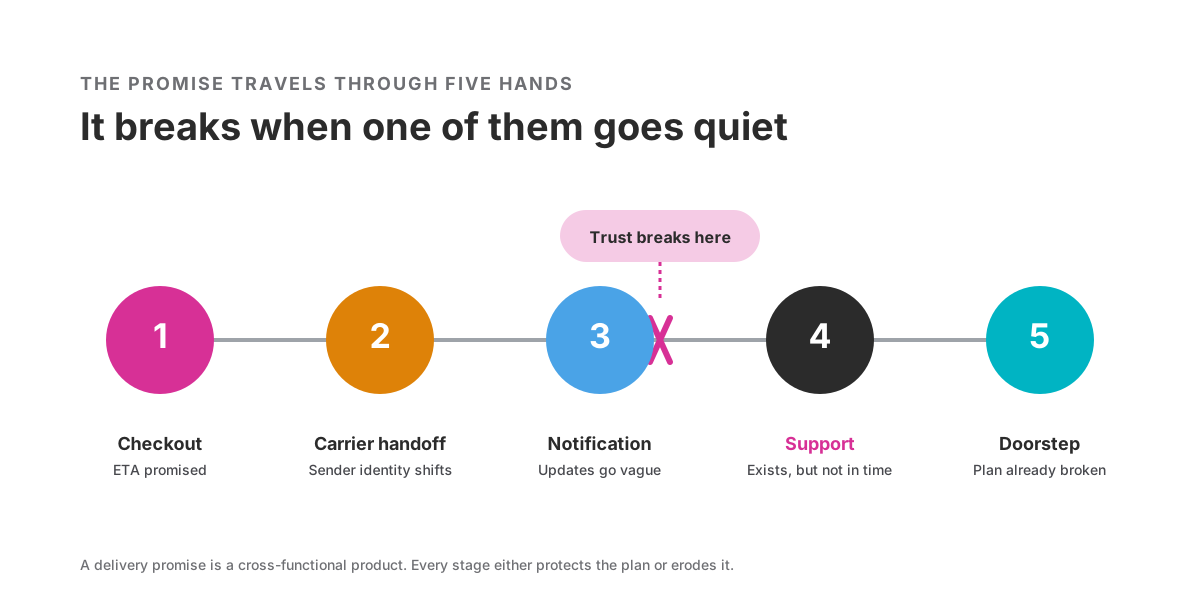
For retailers, the practical implication is this: a delivery promise is a cross-functional product made up of availability logic, service options, carrier orchestration, exception handling, and support access. If the ETA is only provisional, it needs to be presented in a way a customer can actually interpret. If the legal seller, carrier sender, or manufacturer name may differ from the storefront brand, that chain should feel legible before a notification introduces confusion. If the delivery slips, the customer should not have to excavate the truth through bots, inboxes, and silence.
In mature Nordic ecommerce markets, shoppers already assume the basics work. What they are judging now is whether the promise survives contact with reality. PostNord’s own data makes that clear: delivery clarity, flexible options, and visible support remain central trust drivers even where checkout satisfaction is already high. The problem is no longer simply getting the customer to click “buy”, it's making sure she still believes you after she has completed the purchase.
The photo shoot was postponed; Jenny missed a peak time for selling the apartment, and she stood alone outside her apartment building receiving the sofa too late, with no one there to help her carry it in.
If you want to explore how other retailers are approaching these issues in practice, our customer stories offer real examples across checkout, delivery visibility, and the post-purchase experience.