
I recently visited the PostNord headquarters in Solna, Stockholm, to sit down with two experts who live and breathe the details of the delivery experience. Johan Hellman, VP of Product at nShift, spends his days solving complex shipping problems for global retailers. Jan Jakobsson, a spokesperson for PostNord, has tracked the industry since 1995, when it was still primarily referred to as "mail order."
We discussed the findings from the latest E-barometern and E-commerce in the Nordics reports. These studies, based on surveys of 4,000 consumers across Sweden, Denmark, Norway, and Finland, provide a clear roadmap for where retail is headed in 2026 and 2027. PostNord has since published E-barometern Q2 2026, and we cover its delivery and returns findings in our Q2 2026 analysis.
Watch now - The new shape of Nordic e-commerce: PostNord insights
Key takeaways in one glance
- Nordic e-commerce is moving again, with online retail continuing to outperform physical retail in the latest market picture.
- Cross-border demand is strong, but retailers need more than sharp pricing to win. Local relevance still decides trust.
- Delivery choice is not a standard template. Home delivery, parcel shops, lockers, and carrier-brand visibility all vary by market.
- Circular commerce is no side trend anymore. It is becoming part of mainstream retail behavior across the region.
- AI shopping agents are moving the industry toward machine-readable commerce, which makes delivery data more strategic, not less.
The macro outlook: a recovery led by online growth
The Nordic economy is entering a period of stabilization. Jan pointed out that household purchasing power is improving as inflation settles and interest rates ease. This shift is supporting real wage growth across the region.
While consumers remain cautious and continue to prioritize savings, there is light at the end of the tunnel. In Q2 2025, every Nordic country except Finland saw positive retail growth. Crucially, online retail remains the primary growth driver. As we move into 2026, the improved financial position of households will provide extra room for consumption, further boosting the retail trade.
Related reading - The future of delivery: Key trends shaping 2026
The "blurring" of cross-border commerce
One of the most interesting parts of our discussion focused on the changing nature of international shopping. Eight out of 10 Nordic consumers shopped from abroad during 2025. However, Johan noted that the lines between local and foreign stores are blurring.
Many international retailers now offer localized sites, local delivery options, and local currency. A shopper might think they are buying from a Swedish store because the last-mile delivery is handled by PostNord, even if the product is shipping from across a border.
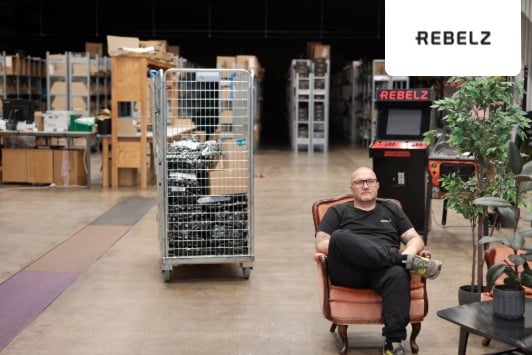
This globalization works both ways. Johan shared the example of Rebelz, a specialized martial arts retailer. Despite being a relatively small business, they sell to 40 different countries. By finding a strong niche, they have attracted customers from as far away as New Zealand. The bottom line? For Nordic retailers, the global market is a significant growth opportunity.
Customer story - How Rebelz powers faster fulfilment with a next-generation checkout
Why there is no "one size fits all" for the Nordics
A common mistake for international brands is treating the Nordic region as a single market. The data shows that consumer behavior and infrastructure preferences vary significantly by country.
-
Sweden: This is the most mature e-commerce market in the region. Swedish consumers are more content with domestic offerings and rely less on international sites than their neighbors.
-
Finland: Parcel lockers are the dominant preference here. Nearly half of all Finnish deliveries now move through lockers.
-
Norway and Denmark: These shoppers place a high priority on personalized customer service and specific local payment options.
Payment preferences are equally distinct. While Swedes prefer Swish and Norwegians rely on Vipps, Finnish consumers often prefer direct bank payments. To succeed, retailers must understand the local ground before they enter the market.
Related reading - EU parcel locker growth: What it means for retailers
Building the infrastructure for a circular economy
The rise of secondhand commerce is perhaps the most visible trend in the 2026 reports. Nearly 70% of Nordic consumers have bought or sold secondhand items in the last quarter. For Gen Z, secondhand is often the default choice.
This shift is being powered by platforms like Vinted that integrate shipping options directly into the checkout. This integration allows consumers to buy and sell across borders with the same ease as buying a new product.
For traditional retailers, this presents a challenge and an opportunity. Johan suggested that retailers need to build "recommerce" into their business models from the start. This might include authenticating used items, providing spare parts, or managing the logistics of refurbishing products. If a product is designed for a longer life, it can be sold two or three times, creating a model similar to "SaaS for products."
The next frontier: preparing for agentic commerce
We are moving past the initial hype of AI and into a practical phase. Jan and Johan both highlighted the emergence of agentic commerce. This is the shift from AI as a discovery tool to AI as an execution tool.
New protocols from OpenAI, Stripe, and Klarna are making it possible for AI shopping agents to find products and make secure payments on behalf of consumers. Whether you are buying "boring" household items like vacuum bags or "dreaming" about a new pair of skiing pants, AI agents will soon handle the heavy lifting of the transaction.
However, a gap remains in the delivery journey. For this model to work, retailers must provide the necessary data infrastructure to satisfy an AI agent's requirements for tracking, estimated time of arrival, and returns. To remain relevant, businesses must prepare for agentic commerce by ensuring their delivery platforms are ready for automated interactions.
Read the guide - The definitive guide to agentic commerce for ecommerce retailers
Conclusion: data-led decision making
The 2026 Nordic commerce landscape is complex, but the opportunities for growth are significant for those who use data to guide their strategy. Success will belong to the retailers who can balance global reach with local delivery trust and prepare their infrastructure for the era of AI-led shopping.
Further insights - Download the full PostNord report free.