
DELIVER Europe 2026 returns to Amsterdam on June 3–4, bringing roughly 1,000 retail and e-commerce decision makers into one room with the carriers, fulfillment partners, and technology providers who actually move their parcels. The agenda this year leans hard on the operating questions retailers are wrestling with right now: where AI earns its keep in the delivery stack, how cross-border programs scale without a replatform, and how returns stop quietly bleeding margin.
nShift will be at Stand B39 across both days. We came to Amsterdam to talk to retailers about one thing: gaining real control of the delivery lifecycle, from the checkout decision through the doorstep to the return.
Key event details
- Dates: June 3–4, 2026
- Location: Taets Event Park, Amsterdam
- nShift stand: B39
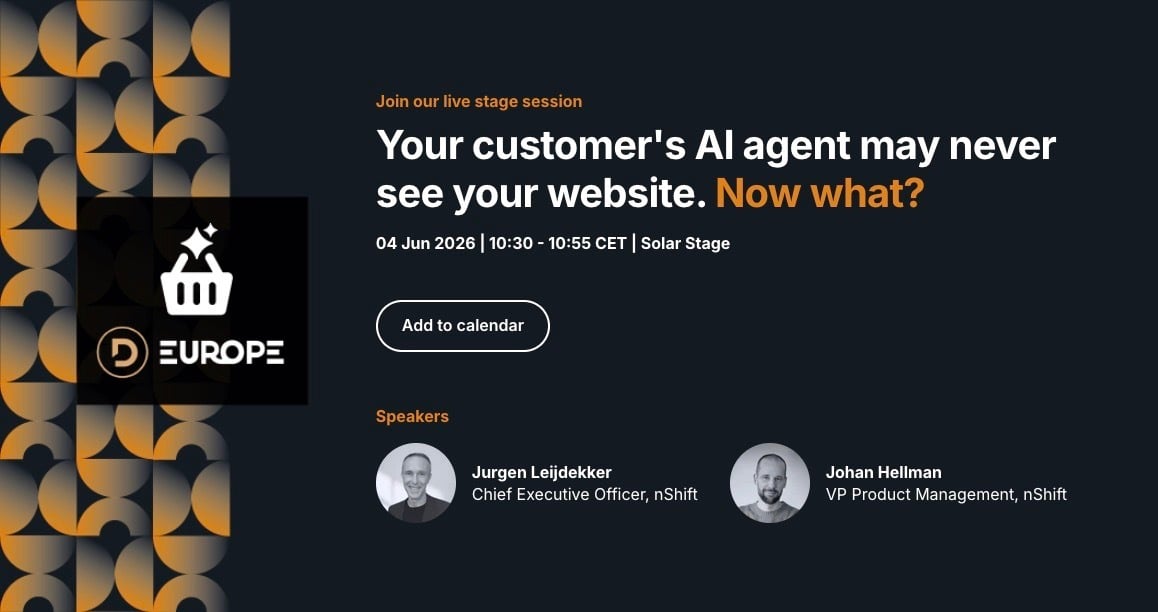
- Speaker session: Thursday, June 4, 10:30 CET, Solar Stage. Your customer's AI agent may never see your website. Now what? with Jurgen Leijdekker, CEO, and Johan Hellman, VP Product Management.
You can pre-book a 30-minute meeting with the team through the DELIVER Europe event page or walk up to the stand on either day.
What is the theme of DELIVER Europe 2026?
DELIVER Europe 2026 brings retail and e-commerce leaders to Amsterdam on June 3–4 to work through four operational questions: where AI earns its keep inside the delivery stack, how to orchestrate multi-carrier programs under peak pressure, how to grow cross-border without rebuilding the delivery layer, and how to turn returns into a retention channel.
Who is speaking from nShift
Jurgen Leijdekker, CEO of nShift, and Johan Hellman, VP of Product Management, lead the Thursday session on the Solar Stage. Their topic: when AI agents discover, compare, and complete purchases on the shopper's behalf, where does the brand earn trust, and what does that mean for the delivery layer?
AI in logistics, judged by the numbers it moves
AI in delivery only earns the conversation when it shows up in the figures the commercial team already tracks.
Predictive delivery promises lift checkout conversion. When the delivery date the shopper sees at checkout reflects current carrier capacity, regional cut-offs, and the parcel profile, fewer carts stall. Flying Tiger Copenhagen saw a 20% increase in conversions after shoppers could choose their preferred PUDO point during checkout, with nShift Checkout shaping the options on offer. PUDO is shorthand for pick-up/drop-off, the locker or store-counter alternative to home delivery.
Dynamic carrier allocation defends cost per parcel. Routing each shipment to the right carrier by lane, service level, parcel profile, and live performance keeps the cheapest viable option in play even when capacity tightens or rates move mid-quarter. The team picks the carrier mix; the engine picks the carrier per parcel.
Proactive exception management cuts support load. If an AI flow spots a delayed scan and triggers the rebook before the customer has to ask, the WISMO ticket never reaches the queue. WISMO stands for "where is my order," the single largest category of post-purchase support contacts for most e-commerce teams. ICANIWILL reduced delivery-related queries by 50% after moving to branded post-purchase communications with nShift Track.
Across all of them, AI lives inside the work itself, at the checkout decision, the carrier choice, and the tracking event.
The same orchestration layer is what serves the AI agents arriving on the other side of the buy decision. When a personal shopping agent or a retailer's storefront agent compares delivery options for the shopper, the API is what it reads. The checkout page might never load. The reliability, speed, and price the agent quotes back to its user come from the same orchestration engine that powers the human checkout.
For the operations team, that does not mean a separate IT project. The orchestration data already feeding peak re-routing and checkout promises is what the agent calls. Operational gain comes first. Agent-readiness arrives with it, which is the version of the story for the CTO conversation.
Orchestration is what holds the customer promise in peak
Most retailers we meet at DELIVER already run several carriers. Multi-carrier as a label has stopped being a differentiator. The sharper test is operational: when capacity tightens overnight, when a carrier slips on lead time, when a strike closes a regional hub, can volume move to the right carrier in hours, with no IT release behind it?
Carrier coverage on its own can become a dependency rather than a strategy. A retailer locked into three or four carriers without an engine to allocate per shipment loses the ability to switch when conditions demand it. The opposite trap is the same problem from the other direction: adding carriers without an allocation engine multiplies complexity, dilutes volume per link, and weakens negotiating position with each carrier signed. The question moves from "how many carriers do you have" to "how well do you allocate across the ones you have".
Orchestration is the allocation engine. It shows up where the operating team feels it:
- Peak resilience. When Black Week surge hits, the rules already exist to redirect volume by region, parcel type, or service level. The team is not calling carriers at 11pm to renegotiate capacity.
- Margin protection. Carriers compete for the parcels that match their strengths, so the retailer keeps the spread instead of paying premium rates on parcels the cheaper carrier could have handled.
- Customer-facing reliability. Promises hold even when one link in the network slips. The shopper sees an on-time parcel; the service-level explanation stays inside the operations team.
Proshop handled a 300% order surge without disrupting delivery speed or reliability after consolidating their carrier connectivity on nShift, with new carrier links going live in days, where their previous direct API model had taken months. Bauhaus configured all carriers for a ship-from-store model across European stores in 48 hours.
The standard a retailer should hold themselves to: when the next disruption hits, the operations team should have already moved the volume before the customer service team has to write the apology email.
DELIVER lands at the right moment for that work. June is the last clean window before most retail teams enter the Q3 change freeze, so decisions made in Amsterdam are still inside the implementation runway for Black Week and December.
Cross-border growth without rebuilding the delivery stack
For retailers eyeing new markets in NAM, APAC, or the rest of Europe, the typical blocker is the same. The current delivery stack works at home, breaks at the border, and the cost of fixing it region by region quietly eats the growth case.
The cleaner path is to keep the central platform and adapt the local layer around it. In practice, that means:
- Local carrier preferences in checkout. Shoppers choose the home, locker, or PUDO option that already feels familiar in their market, rendered in the local language.
- Localized tracking and notifications. Post-purchase messages, tone, and channel match what the local shopper expects, so the brand experience does not collapse into a generic carrier portal once the order leaves the warehouse.
- Localized returns flows. Return reasons, refund timing, in-country addresses, and exchange-first prompts tuned to the market the shopper actually lives in.
Stenströms increased international shipments by 153% after localizing delivery options in their priority markets, with the central delivery stack untouched.
The same logic runs in reverse. North American and APAC brands entering Europe meet a fragmented carrier landscape: roughly 30 national postal operators, country-specific PUDO networks, and locker schemes that shoppers in Stockholm or Madrid use by default. The retailer's home stack rarely speaks that language. The cleaner play is to bring one platform that already covers the country mix and skip the country-by-country integration phase entirely.
If the question you bring to Deliver is how to manage cross-border delivery at scale, the short answer is: orchestrate centrally, localize the visible layer, and use one carrier network broad enough that adding a country does not mean adding a project. Our network covers 1,000+ carriers in 190 countries, with the integration work sitting on our side.
Returns as a retention channel
Returns are the most under-managed line on the post-purchase P&L, and cross-border programs are where the mess shows up first. Customs paperwork on the reverse leg slows refunds. Regional return costs swing wildly, with the same parcel costing several multiples more to pull back from one country than another. Refund cycles stretch into weeks because the parcel passes through three handlers before the warehouse confirms receipt, and the shopper notices the brand has gone quiet at exactly the moment they were ready to spend again.
The same flow can defend revenue and bring the customer back. Three moves change the math.
- Exchange-first journeys. Offering a size, color, or alternative product at the start of the return flow keeps revenue inside the brand instead of refunding it out. Hunkemöller saw a 15% shift to in-store returns after building an exchange-friendly return experience, opening more touchpoints for assisted service and remarketing.
- Faster refunds where the exchange does not land. Shoppers who receive a quick, clear refund are far more likely to reorder. Slow refunds train the next purchase to happen elsewhere.
- Smart routing on the reverse leg. Sending returns through the right carrier and consolidation point, by item value and condition, brings reverse-logistics cost down without thinning the customer experience.
The product layer is nShift Returns. The retention-channel conversation is the one we want to have at the stand.
One platform across the delivery lifecycle
Most of the operational pain we see at DELIVER comes from the same source: a delivery stack assembled from a checkout plugin, a couple of carrier portals, a tracking app, a returns tool, and a spreadsheet that nobody admits to relying on. Each tool works on its own. The handoffs between them are where margin, visibility, and customer trust quietly leak.
Consolidating the delivery layer on one platform is the play we will be making at Stand B39. The nShift platform connects four moments in the customer journey:
- Pre-purchase: delivery choice, pricing logic, and promise dates inside the checkout
- Fulfillment: label printing, carrier booking, and shipping execution at scale
- Post-purchase: branded tracking, proactive notifications, and ETA visibility
- Returns: self-serve flows, exchange-first prompts, and reverse routing
Sustainability reporting sits inside the same data layer, so emissions on outbound and reverse legs are calculated from the same shipment record the operations team is already working from. No separate spreadsheet reconstruction.
When those four moments share the same data layer, the AI features described above stop being separate products and start compounding. Returns inform the carrier mix because the same record follows the parcel both ways. The nShift delivery management platform page picks up the platform story in more depth.
How to spend thirty minutes well at DELIVER
The booth team works best with a question already on your list. Pick the one your team has not finished answering yet:
- How many orders are you losing at checkout?
- Could you switch carriers tomorrow if you had to?
- Are returns costing you customers or winning them back?
- Can you make every market feel local?
The open paths to bring it through:
- Visit Stand B39. Walk the four hooks: checkout, carrier control, returns, and the connected post-purchase experience.
- Join the AI session on Thursday. Solar Stage, 10:30 CET. Same questions, sharper version of the agent angle.
- Pre-book a meeting. If you would rather arrive at the booth with a slot already in the calendar, the form on the DELIVER Europe page routes to the right rep.
Come ready with the number you want to move, the workflow slowing the team down, or the customer promise you need to protect. Bring the question. We will bring the proof.