Across Europe, returns have quietly become one of the largest controllable costs in e‑commerce. Online return rates sit between roughly 25% and 40% depending on category, and fashion in particular is a standout problem, with certain apparel categories seeing well over half of purchases come back. Recent benchmark data shows fashion return rates in leading European markets routinely exceeding 50%, especially for categories like dresses and shoes. For EU retailers, operating under a harmonised 14‑day right of withdrawal, a constant flow of returns is not an exception, it is the norm.
At the same time, global analysis from McKinsey estimates that retailers spend around 200 billion dollars a year processing and trying to recover value from returns, on close to 1 trillion dollars of merchandise sent back in 2024. DHL calculates that the value pool locked up in returned goods is around 62.5 billion dollars globally, much of it sitting in European stockrooms and secondary markets.
This guide sets out what “bad” and “good” returns operations look like, and what to look for in a returns product if you want to move to the right side of that line.
The real cost per return
Most retailers and brands know their return rate. Far fewer know their true cost per return. That number usually tells the uncomfortable story.
Recent industry analyses show that, for every 100 dollars in merchandise that comes back, the average cost to process and resell it is around 32 dollars once you factor in inbound shipping, handling, restocking and markdowns. Typical break‑down figures suggest:
- Return shipping: 8–12 dollars per item
- Processing and inspection: 5–8 dollars
- Restocking and storage: 2–4 dollars
On top of this, a non‑trivial share of returned items is damaged, worn, or otherwise unsellable at full price, particularly in fashion and footwear.
Zooming in on Europe, surveys of DACH‑region merchants indicate that more than half say each return costs them at least 10 euros, and a further segment puts that cost closer to 20 euros, yet more than a quarter of sellers admit they cannot specify their per‑return cost at all. McKinsey’s reverse‑logistics work adds another hard edge: most retailers only recover around 50% of a returned product’s value once all costs and markdowns are accounted for.
When you multiply that by tens or hundreds of thousands of returns per year, “we’ll just absorb it” stops being a strategy.
When you finally know your true cost per return, what does “good” look like, and how far away is your current process from it?
What bad returns looks like
“Bad” returns operations are usually easy to recognise, but difficult to change without the right tools.
1. One‑size‑fits‑all policies
McKinsey’s research with supply chain leaders shows many retailers are still running on the same blanket returns policies they put in place during the pandemic: simple rules designed for survival, not profitability. Loyal, high‑lifetime‑value customers get exactly the same terms as serial returners. High‑risk categories are treated the same as low‑risk staples. There is no segmentation by product, customer or channel.
2. Manual, default dispositioning
In McKinsey’s interviews, more than half of supply chain executives said that deciding what to do with a returned item (dispositioning) is their single biggest reverse‑logistics challenge, and most still rely on very basic data, or none at all, to make those calls. In practice, this looks like:
- Everything routed to a central warehouse, by default
- Standard inspection and repackaging, regardless of product or season
- Slow onward routing to discount partners or secondary marketplaces
McKinsey uses a practical example: a 100‑dollar holiday sweater returned in early December that follows this default path is likely to recover only about 50% of its value by the time it reaches a discount channel in January.
3. No visibility, no learning
On the customer side, the experience often still hinges on a paper label in the box, limited choice of drop‑off options, and slow refunds. On the operations side, warehouses receive inbound parcels with minimal pre‑advice and no structured information about why the item is coming back. That means no feedback loop to merchandising and product teams, no way to isolate problem SKUs, and no data model that would allow you to change the pattern.
The result: the retailer pays to ship the item out, pays to bring it back, and learns almost nothing in the process.
If this is what “bad” looks like, what would it take to flip returns from a cost you hide from the board to a lever you can confidently report on?
What European consumers now expect
European shoppers have become very clear about what they want from delivery and returns – and they are willing to walk away when they do not get it.
According to the DHL E‑Commerce Trends Report 2025, 81% of online shoppers abandon their cart if their preferred delivery option is not offered. That’s a clear signal that delivery and returns can make or break the sale.
A companion DHL deep‑dive into out‑of‑home delivery and returns highlights that 79% of Europeans abandon their basket if their preferred returns method is not offered, and that 53% of European shoppers mainly buy from retailers that provide free returns.
PostNord’s E‑commerce in the Nordics 2025 report adds regional colour:
- Over 65% of Nordic consumers say a clear return policy is important when choosing where to shop
- In Norway, that rises to 71%, the highest in the region
- Finland is “the parcel‑locker nation”: 37% of consumers say lockers are their preferred option for returns
At the same time, DHL’s surveys show that the main reasons for returns are not delivery failures. Incorrect sizing and poor product quality top the list, each cited by more than half of respondents. That is critical: a significant share of returns is preventable through better product information upstream, not stricter policies downstream.
If European shoppers are already this demanding, what happens to conversion and loyalty when your returns journey falls even slightly short of those expectations?
What good returns looks like
So what does “good” look like when you get returns right?
McKinsey’s 2026 framework for reverse logistics highlights six levers:
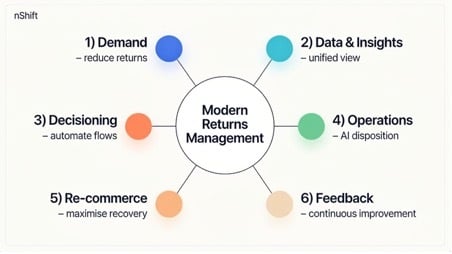
Taken together, they define what better returns management should deliver.
1. Prevention through better decisions upstream
Good returns operations start before checkout. Product pages carry accurate sizing tools, richer imagery and clear material descriptions. Returns data at SKU level feeds directly into merchandising to fix chronic fit or quality issues. DHL’s latest trends report notes a year‑on‑year rise in consumer frustration with poor product information, and a clear demand for better descriptions and imagery to reduce the need to “test buy”.
2. Intelligent, AI‑driven dispositioning
Instead of sending every item back to a central warehouse, leading retailers are using AI‑supported disposition engines that combine what they know about:
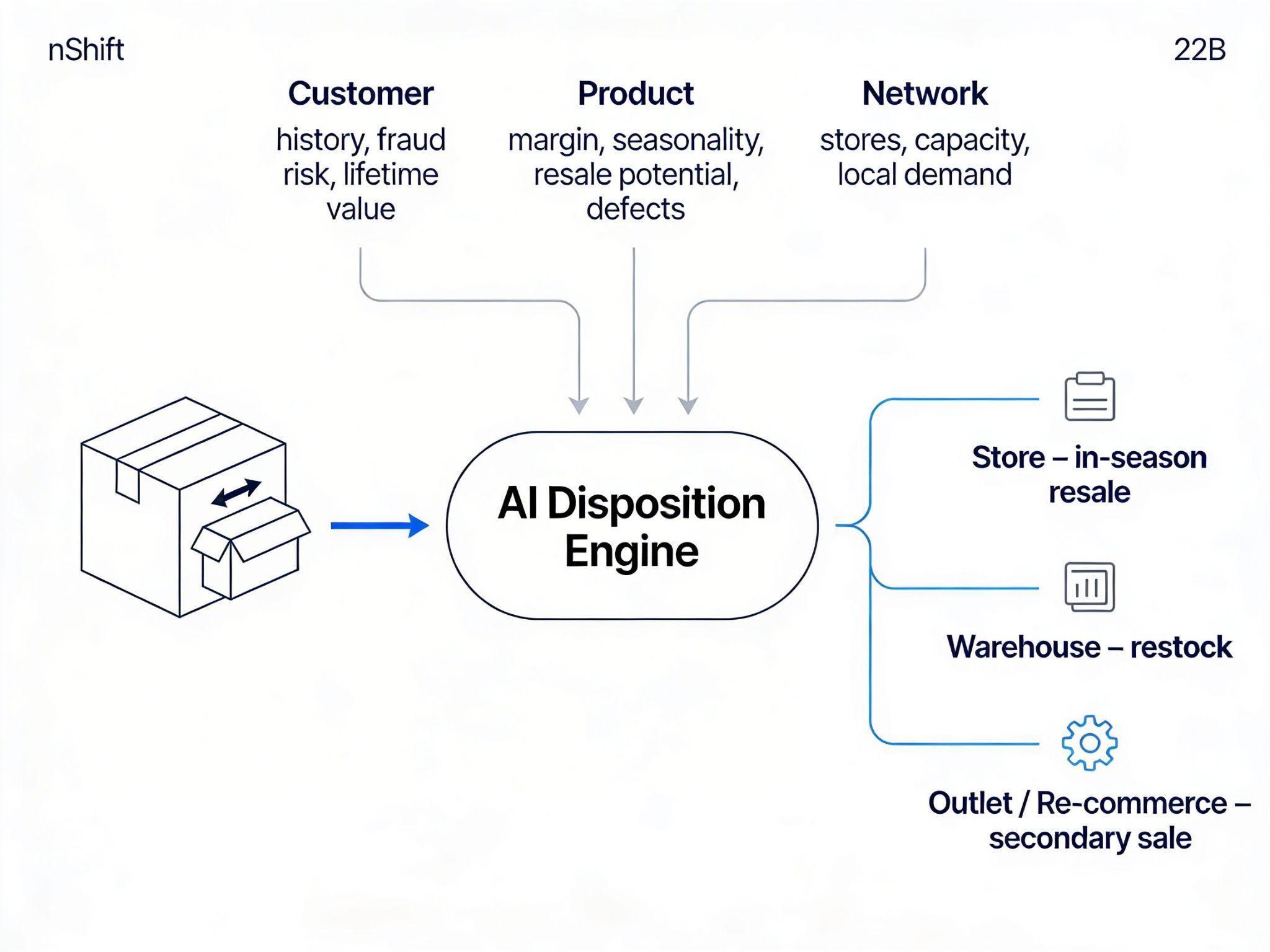
to route each return to its highest‑value outcome in real time.
Using the same holiday‑sweater example, McKinsey shows that a dynamic model which routes a December return straight to a nearby store for in‑season resale can lift value recovery from around 50% to roughly 75% on that item.
3. Dynamic, segmented policies
McKinsey’s consumer research suggests shoppers are more open to differentiated policies than many retailers assume. Around 71% of consumers say customer‑specific or product‑specific return policies would not make them less likely to shop with a retailer. That creates space to:
- Keep generous terms for low‑risk, high‑value customers
- Add appropriate friction for high‑risk patterns or low‑margin categories
- Adjust policy by geography, channel or campaign
without undermining conversion.
4. Automation across the journey
Industry case studies show that automating key steps in the returns process can materially reduce handling cost and significantly shorten restocking times, particularly by eliminating manual data entry and repetitive checks.
Good returns operations are therefore defined as much by speed of learning as by speed of handling.
If the levers are this clear on paper, how do you turn them into concrete requirements when you evaluate your next returns solution?
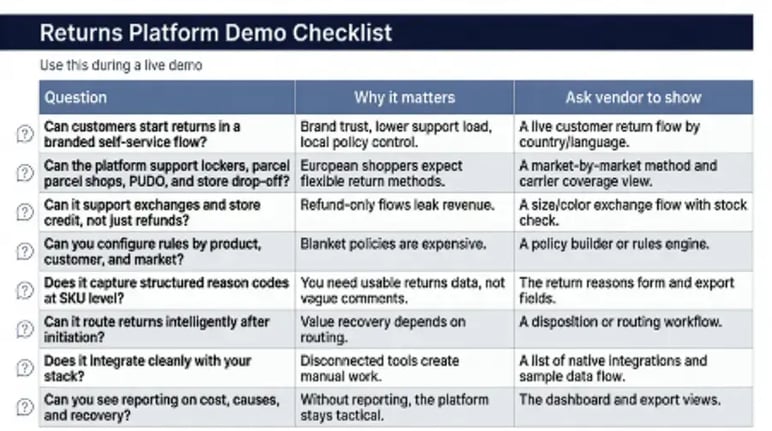
The evaluation checklist. What to look for in a returns product
When European retailers assess returns solutions, a few capabilities consistently separate the “nice label tool” from a strategic platform.
Branded self‑service portal
Shoppers should be able to initiate returns through a branded, intuitive interface that reflects your policies by country, language and channel. It needs to support the out‑of‑home options European shoppers now expect – parcel shops, parcel lockers, PUDO points and store drop‑off – not just home pickup.
Structured return reasons at SKU level
The solution should capture structured return reasons and condition data for every item, not just the order. That information must be easy to export to BI tools so merchandising, sourcing and CX teams can act on it.
Exchange‑first flows
Exchange‑optimized flows (for size, colour or product swaps) help convert refunds into retained revenue. The right product supports automatic stock checks, price/discount preservation and correct tax handling for cross‑border exchanges in the EU.
Smart refund triggers
Triggering refunds on carrier scan rather than warehouse receipt can materially cut “where is my refund?” contacts and build trust, because shoppers increasingly expect fast, predictable post‑purchase experiences. The DHL E‑Commerce Trends Report 2025 shows that 81% of shoppers abandon their cart if their preferred delivery option is not offered, underlining how much delivery and returns now “make or break” the sale.
Configurable rules and approvals
You should be able to define rules for when a return is:
- Automatically approved and labelled
- Routed for manual review (for example, high order value, cross‑border, outside usual window, repeated behaviour)
These rules are especially important given the complex VAT and customs landscape in European cross‑border trade.
Tight integration with WMS/ERP
On the operations side, the platform must integrate with your WMS and ERP so that return data, images and decisions flow automatically into inventory and finance. That is what enables rapid restocking, accurate stock visibility and clean accounting.
Analytics out of the box
Finally, you need built‑in reporting that lets you track:
- Return rates by country, channel and category
- Reasons by SKU
- Cost and recovery by route (restock, refurbish, outlet, recycling)
McKinsey emphasises the need for a single returns data product, a unified view with clear ownership – as the foundation for any AI‑driven decisioning or policy optimization.
The European regulatory backdrop
In Europe, efficient returns are no longer just a cost issue. They are becoming a compliance issue.
The Ecodesign for Sustainable Products Regulation (ESPR) introduces restrictions on the destruction of unsold and returned consumer products, with textiles and footwear among the first categories in scope. The European Environment Agency notes that bans on destroying returned textiles will require brands to improve reuse, repair and re‑commerce routes rather than relying on waste or low‑value destruction.
In parallel, the revised Waste Framework Directive brings Extended Producer Responsibility (EPR) to textiles, making producers financially responsible for the full lifecycle of products placed on the EU market. That increases the pressure to understand where returns go, how quickly they can be resold, and how often they become waste.
In this context, a returns product is not just a CX tool. It is part of your sustainability and compliance infrastructure.
If regulation is closing off the “cheap” options for handling returns, how long can legacy processes realistically keep you competitive?
The money on the table
When you add the pieces together, the business case for better returns becomes clear.
On a global level, McKinsey estimates that retailers spend around 200 billion US dollars a year on returns and can turn a significant share of that cost into value if they modernise reverse logistics with data and AI. For example, by lifting value recovery on individual items from roughly 50% to closer to 75% or more. At the same time, DHL describes returns as creating an “invisible value pool” of about 62.5 billion US dollars in untapped global revenue annually, when returned goods are treated as waste instead of being inspected, refurbished and resold.
For a European fashion retailer processing 100,000 returns a year at an average product value of 50 euros, simply lifting value recovery by 25 percentage points – from 50% to 75% – can mean around 1.25 million euros in additional retained margin, before even counting any reduction in processing cost, support tickets or marketing spend needed to replace lost customers.
Good returns management is what turns that theoretical opportunity into real P&L impact. Picking the right returns product is how you make it executable.
Good returns management is what turns that theoretical opportunity into real P&L impact. Picking the right returns product is how you make it executable. If you want to explore what this could look like in your own stack, you can learn more about nShift Returns and its role in European reverse logistics here.