Electrification is one of the defining 2026 delivery trends in Europe. Fleet decarbonization in Europe has moved into the center of logistics strategy: it is written into law and is already reshaping who wins tenders, where carriers invest, and how retailers talk about their brand.
For heavy-duty vehicles, the revised EU CO₂ standards agreed in 2024 set a clear trajectory: average emissions from new trucks must fall 15% by 2025, 45% by 2030, 65% by 2035, and 90% by 2040, versus a 2019–2020 baseline. To stay on that path, ACEA and ING estimate that the European zero-emission truck fleet needs to grow from around 13,500 vehicles at the end of 2024 to roughly 400,000 by 2030. That growth rate turns fleet planning into a multi-year transformation program.
At the same time, major carriers such as DHL, UPS, Geopost and Amazon are already deploying electric vans and trucks in European cities, and OEMs are bringing 400–600 km electric trucks like the Mercedes-Benz eActros 600, Volvo FH Electric / FH Aero, and MAN eTGX/eTGS into series production. AFIR, AFIF and the Connecting Europe Facility are channeling public money into high-power charging corridors and hydrogen infrastructure.
Electrification now sits alongside cost and service as a core pillar of delivery strategy for 2026 and beyond: a topic that touches who wins tenders, which routes are viable, and how “green” options appear at checkout, not just how ESG reports read.

Where Europe really is on green fleets in 2026
In 2026, the share of zero-emission trucks in new registrations is still in the low single digits, but the curve is rising every year. In leading European cities, a visible and growing share of last-mile and regional deliveries already runs on electric vans, cargo bikes, and other low-emission vehicles. City access rules and low-emission zones reinforce that direction and make investment easier to justify.
Fleet and procurement decisions now have a much broader checklist. Operators weigh:
- Compliance exposure under HDV CO₂ standards, ETS2, and city ZEZ/LEZ rules
- Total cost of ownership for EVs on specific routes
- Customer expectations around Scope 3 emissions
- Availability of depot and on-route charging or hydrogen refueling
The answer will not be identical for every lane. Dense urban and predictable regional routes are moving first because the economics and infrastructure are closest to viable. Long-haul international flows will take longer, but they are already under scrutiny in tenders and ESG discussions.
For shippers, emissions are starting to sit next to price and service as a primary selection criterion. For carriers, the fleet mix and the roadmap to zero-emission vehicles are now strategic issues. For platforms and technology providers, shipment-level emissions data and the ability to route volume toward greener options are becoming expected capabilities, not special projects.
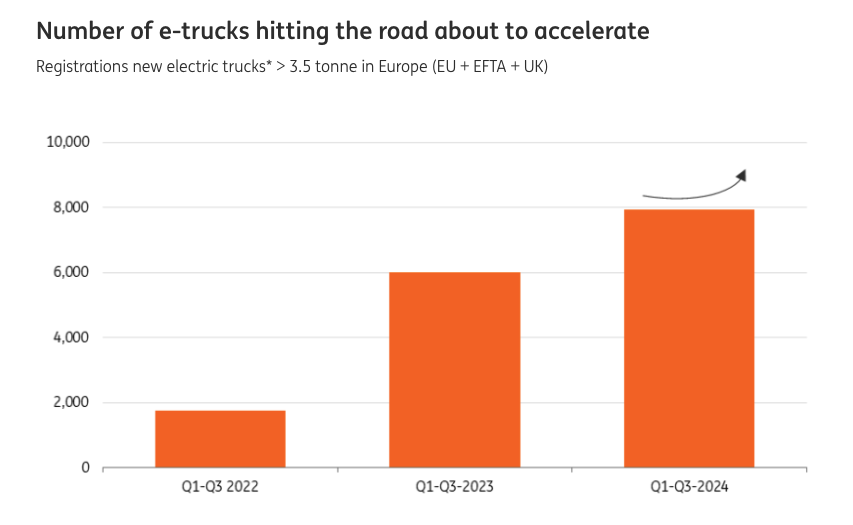
Source: think.ing
How electrification connects to other 2026 delivery trends
Electrification sits at the intersection of several other 2026 delivery and logistics trends, in very concrete ways:
- AI and autonomous decision-making: using data and AI for better route planning, capacity allocation, and charging optimization makes EV fleets more productive and easier to scale.
- Predictive analytics, control towers and digital twins: digital twins of networks and depots help test different fleet mixes and charging strategies before committing capital.
- Platformization and API ecosystems: emissions reporting and “green service” flags need standard, API-ready data models so retailers and marketplaces can surface low-emission options.
- Regulatory backbone and data: HDV CO₂ standards, ETS2, and local access rules create the regulatory baseline that gives direction to fleet plans.
If you are planning your 2026–2028 delivery strategy, you are really planning how all these trends come together in your network, with electrification as a central thread.
What this 2026 delivery trend means for different players
Retailers and brands: Turn emissions into a selection lever
Retailers and brands are under mounting pressure to show credible Scope 3 progress, especially around transport and logistics. In 2026, delivery strategy is one of the clearest levers.
What to expect
- More RFPs and tenders will include explicit questions on zero-emission fleets, route coverage, and emissions reporting.
- Customers, especially in B2B and premium B2C segments, will increasingly ask for low-emission delivery options at checkout or in contracts.
- Marketing and sustainability teams will look for proof points they can put into ESG reporting and customer communications.
Moves to prioritize
- Build emissions transparency into carrier selection. Ask for shipment-level CO₂ data, evidence of EV deployments by lane or region, and a roadmap aligned to your own climate targets.
- Treat “green” delivery as a product decision. Decide where to offer greener options by default (for example, urban areas with strong OOH and EV coverage) and where to present them as an upsell. Track adoption and impact on margin.
- Connect delivery systems with reporting. Make sure your delivery management platform can feed emissions data into ESG dashboards and customer-facing experiences (confirmation emails, tracking pages, account areas).
For nShift customers, this is exactly where delivery management and sustainability reporting capabilities work together: you can standardize delivery flows, calculate emissions by shipment, and then surface greener options and insights without stitching five tools together.
Carriers and logistics service providers: Make your EV roadmap a commercial asset
For carriers and LSPs, electrification is now intertwined with competitiveness. Shippers will increasingly ask, “Where are you on EVs for my lanes, and what does that mean for cost, reliability, and emissions?”
What to expect
- Tenders and renewals will push for more detail on ZEV coverage and plans, especially in major cities and core corridors.
- City authorities will keep tightening vehicle access and idle rules, indirectly rewarding operators with cleaner fleets.
- Capacity for genuinely low-emission services will command a premium in some segments.
Moves to prioritize
- Map where EVs already make sense. Identify depots and routes where daily distance, load patterns, and charging access support EV adoption. Build case studies and benchmarks you can share with shippers.
- Turn the roadmap into a story. Document how your fleet mix will evolve through 2026–2030, including milestones by city or corridor. Sales and account teams should be able to explain this clearly in every RFP.
- Expose emissions and performance data. Use APIs to provide shipment-level CO₂ estimates and clear service descriptions (e.g., “EV last mile,” “low-emission regional”) so retailers and platforms can highlight them in their own systems.
The more transparent you are, the easier it becomes for retailers to justify awarding volume to you, even when unit rates are not the absolute lowest.
Platforms and technology providers: Make emissions data usable
Delivery management, TMS, WMS, and analytics platforms are the connective tissue that turns electrification into day-to-day operational choices.
What to expect
- Customers will expect emissions calculations to sit next to price and transit time in configuration screens and APIs.
- RFPs will ask whether platforms support standardized emissions methodologies and can integrate with third-party data sources.
- AI-powered planning and agentic commerce will need emissions signals, not just cost and speed.
Moves to prioritize
- Standardize how emissions are calculated and stored. Support recognized methodologies and ensure emissions are available at service and shipment level, not just as annual aggregates.
- Expose “green signals” wherever decisions are made. In UI configuration, in pricing APIs, at checkout, in booking flows, and in service bots, make it easy to prefer low-emission options under defined constraints.
- Connect to reporting and compliance tools. Make sure your data structures and exports fit ESG and regulatory reporting requirements, so customers do not have to rebuild pipelines manually.
For nShift, this is the heart of the vision: one platform that connects 1,000+ carriers, calculates emissions, and lets retailers steer demand toward greener options while still balancing cost and service.
Policy makers and city authorities: Create a predictable path to cleaner fleets
Policy makers and city leaders are already shaping the context for electrification through CO₂ standards, ETS2, LEZ/ZEZ expansion, and funding schemes. The next step is predictability.
What to expect
- More cities will formalize zero-emission zones and time-window restrictions for fossil-fuel vehicles.
- Public funding for charging infrastructure and hydrogen corridors will target specific freight corridors and hubs.
- Data-sharing requirements will expand so that authorities can monitor impact.
Moves to prioritize
- Provide clear, multi-year frameworks. Carriers and shippers invest in vehicles and depots on decade-long cycles. Stable rules give them confidence to move faster.
- Coordinate infrastructure and access rules. Align funding for charging infrastructure with the areas where access rules are tightening, so operators can plan viable routes.
- Engage with platforms and industry bodies. Delivery platforms already aggregate data on routes, volumes, and emissions. Partnerships can help cities design policies that improve both climate outcomes and service levels.
The bottom line: Electrification is now part of everyday delivery planning
Electrification and green fleet transition have moved from abstract ESG talking points into concrete operational decisions. They now show up in routing, carrier selection, customer promises, and system design.
The organizations that move fastest will not be those with the boldest slogans. They will be the ones that:
- Know where EVs already work in their network
- Have data to prove emissions performance
- Use delivery platforms that can balance cost, speed, and carbon in real time
Get the full picture
 This article is part of our research on “The future of delivery: Key trends shaping 2026”, which covers ten interconnected trends across AI, platforms, regulation, resilience, and retail demand.
For the complete picture, with detailed data, references, and recommendations for each stakeholder group, download the full report: Future of delivery 2026.