
Checkout conversion moves when delivery choice feels useful at the exact moment a shopper decides whether to pay. Flying Tiger Copenhagen achieved a 20% increase in conversions after expanding PUDO delivery choices, and Sportsdeal increased conversion by 8% after making checkout delivery choice more flexible. Those results show how much commercial weight sits inside the final delivery decision.
That is why checkout deserves more credit as a delivery moment. The options on the page do more than complete fulfilment. They shape confidence, help customers understand the trade-off they are making, and set the tone for everything that follows after payment.
At a glance:
How delivery options affect checkout conversion
Delivery options affect checkout conversion because they shape the shopper's final decision to buy. When delivery choice feels relevant, transparent, and easy to understand, customers move forward with more confidence and complete payment more often. The conversion lift comes from fit, clarity, and a delivery promise that feels believable.
Summary:
Key results from nShift customers
- Flying Tiger Copenhagen achieved a 20% increase in conversions after expanding PUDO delivery choices, and 70% of customers preferred the new PUDO option.
- Sportsdeal increased conversion by 8% and average order value by 20% after improving checkout flexibility.
- RNB Retail and Brands now offers broader delivery choice across its retail brands, including pickup point, home delivery, mailbox delivery, and in-store collection.
Why does checkout conversion depend so much on delivery choice?
 Checkout conversion depends on delivery choice because customers make their final decision with delivery cost, convenience, and timing in front of them. The checkout earns momentum when the options feel relevant to the basket, the location, and the real-life way the customer wants to receive the order.
Flying Tiger Copenhagen had a PUDO setup that automatically selected locations for customers, even when those locations were inconvenient. Once shoppers could choose the pickup point that suited them best, conversion rose by 20% and 70% of customers preferred the new PUDO option.
As Sander van Enschot, Head of Digital Operations at Flying Tiger Copenhagen, puts it:
"Improvements made in delivery choice at the checkout have been a key success factor in increasing conversion and improving the customer experience."
How do relevant delivery options help shoppers commit?
Relevant delivery options help shoppers commit because they reduce hesitation in the final step. Customers want delivery choice that feels local, credible, and easy to understand. They want to know whether the option fits their location, their basket, and their schedule, without having to decode the fulfilment logic behind it.
Sportsdeal makes the customer expectation side clear. The retailer increased conversion by 8% and average order value by 20% after improving delivery and payment flexibility at checkout. COO Mathias Ingemo talks about giving customer a better fit at the exact point where conversion is won:
"Our customers think that the shopping experience is easy and very fast. They are also very pleased that it is now possible to choose the delivery method."
GetInspired.no adds the expectation shift behind this change. General Manager Sindre Landevåg gives one of the clearest explanations for why delivery choice belongs inside the conversion conversation:
"Customers have never been more concerned about delivery options than they are now."
Which checkout capabilities create the biggest lift?
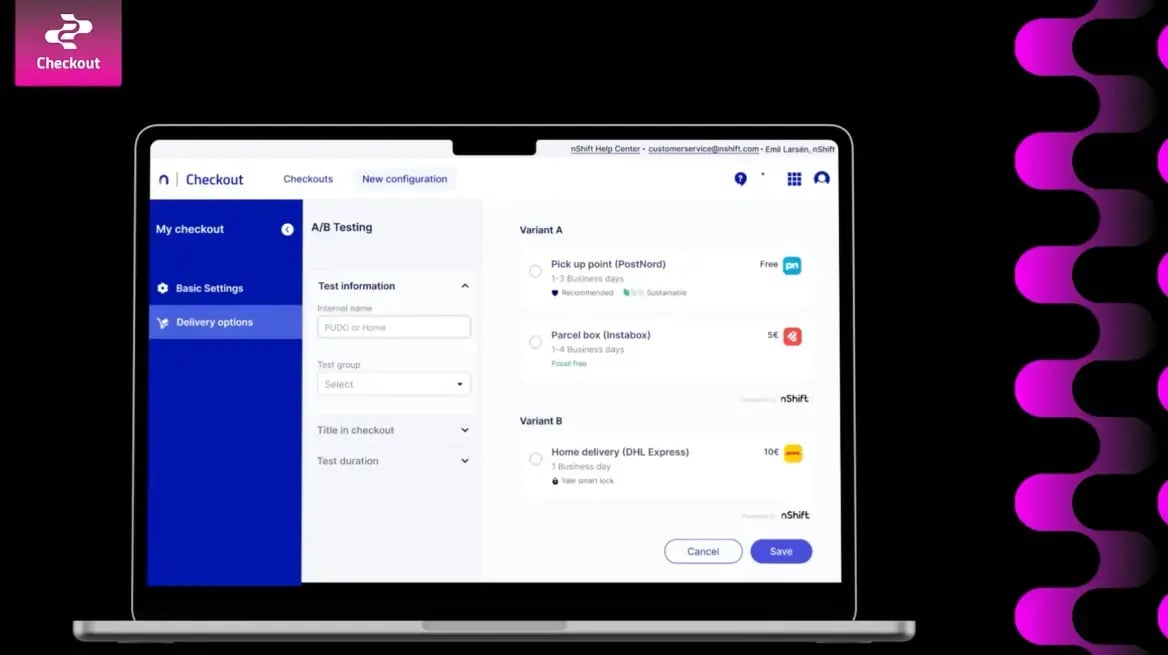
The biggest lift comes from ETA visibility, pickup relevance, rules that reflect the real basket, and experiments that let teams keep improving the page. Those capabilities turn checkout from a fixed list of shipping methods into a delivery-choice experience that feels more useful to the shopper and more controllable for the merchant.
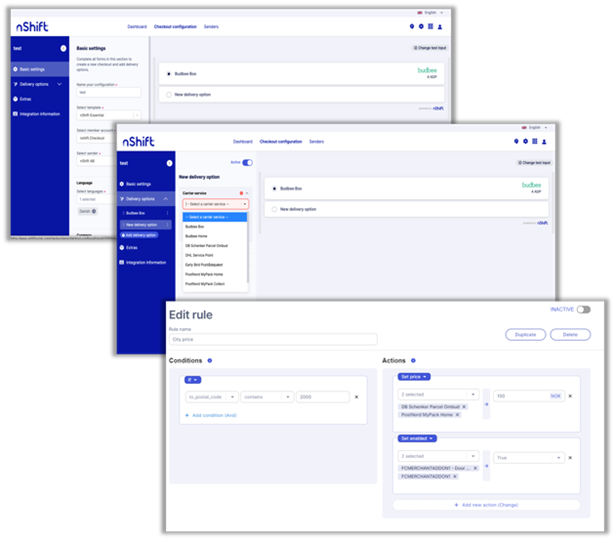
ETA visibility matters because timing shapes trust. nShift Checkout supports estimated delivery times so merchants can show delivery expectations based on postal codes and timing logic.
PUDO and click and collect are important because many customers want more control over where they receive orders. nShift Checkout supports custom pickup locations, PUDO filtering, and widget-based presentation of options on the page.
Rules and conditions are critical because different baskets, product categories, and markets need different logic. Postcode-based condition lists and price-step logic help merchants show the options that actually apply, and experimentation support helps teams keep learning what customers value.
What does a strong checkout put in motion?
|
Capability |
What the shopper gains |
What the merchant gains |
|
Estimated delivery times |
A clearer sense of when the order will arrive |
A more credible delivery promise at checkout |
|
PUDO and click and collect options |
More control over where the order is received |
Better alignment between delivery choice and shopper preference |
|
Rules and conditions |
Options that actually fit the basket and location |
Less clutter and stronger delivery logic |
|
Postcode-based pricing |
Clearer shipping cost visibility |
More precise, more manageable price presentation |
|
Experiments and testing |
A checkout that improves over time |
Faster learning without a full rebuild |
How should teams improve delivery choice without rebuilding the checkout?
Teams can improve delivery choice without rebuilding the checkout when rules, widget logic, pricing steps, and experiments already sit inside the product. That gives merchants room to refine relevance, presentation, and conversion performance as customer preferences, carrier options, and market conditions change.
MQ Marqet is the clearest proof on the usability side. Merchant-side flexibility is often what allows customer-centric delivery choice to stay strong over time. As Mattias Liljenberg, Head of Digital at MQ Marqet, says:
"Thanks to nShift Checkout, we now have a flexible solution that is easy to administer and gives the customer great freedom of choice."
RNB Retail and Brands shows why merchant control matters even more as checkout grows more complex. Martin Jungertst, Head of Logistics, says:
"When we went live with nShift Delivery, we changed our ecommerce carrier for Sweden and within the EU, which had not been possible before. Now, we are much more active in adding and changing carriers, which makes a huge difference."
That kind of control is what allows teams to keep delivery choice aligned with customer expectations instead of leaving it static. The same customer also shows what happens when delivery choice connects directly to retail operations. Customers across its brands can now choose pickup point, home delivery, mailbox delivery, or in-store collection depending on the offer. That is a strong reminder that the checkout can support speed, channel coordination, and customer fit as well as online conversion.
Why relevant delivery choice improves conversion
Relevant delivery choice improves conversion because it gives shoppers a clear decision with options that fit. The strongest pattern is better curation: show the options that fit, make the trade-offs understandable, keep the choice easy.
That is what makes nShift Checkout commercially useful. It helps merchants move beyond a static list of shipping methods and turn delivery choice into a more deliberate part of conversion strategy.
If your team wants to improve conversion with delivery options that feel clearer, more local, and easier to trust, nShift Checkout is built for exactly that job.
Book a demo to see how it helps retailers improve conversion with smarter delivery choice.