When did you last check the pulse of your delivery experience? If you’re like many eCommerce leaders out there, you might still treat shipping as a back-office task. But here’s the hard truth from industry veterans: every package you send is a make-or-break moment for your brand. One delayed delivery or lack of update can quietly churn a loyal customer. In fact, 17% of consumers would stop doing business with a brand they loved after just one bad experience, and 85% of online shoppers hesitate to reorder after a poor delivery.
Aren't these stats a wake-up call? Under mounting economic pressure, no business can afford to bleed customers due to avoidable missteps in the delivery journey.
So why are some retailers turning delivery into a competitive lever while others fall behind? With decades in the trenches of retail and eCommerce, we’re seeing a clear pattern: the winners are using delivery experience to drive conversion, loyalty, and revenue growth. They know something many overlook: the sale isn’t over when the checkout button is clicked; it’s only just beginning. And the Delivery health check assessment we’ve just launched is designed to benchmark exactly that: how strong your delivery game really is, and whether it’s fueling your growth or quietly undermining it (but more on that later).
Before we dive into the quiz as your next step, let’s explore why delivery experience is the new eCommerce battleground and how optimizing it can make you look like a hero, save you time, and make you money in the process.
From back-office ops to frontline experience
Not long ago, shipping a package was simply a cost center: get the order out the door and hope for the best. Today, deliveries are a frontline customer experience (CX), directly tying into your brand reputation. Every delivery is a promise kept or broken at your customer’s doorstep.
Think about it: if you don’t provide proactive order updates, 78% of customers will switch to a competitor. If a package arrives late or damaged without clear communication, you haven’t just lost one sale; you may have lost a customer for life. Modern consumers (especially the new generation) simply won’t tolerate a clunky delivery process. 85% of Gen Z shoppers say they’ll drop a retailer that doesn’t meet their delivery expectations.
The takeaway is clear: what happens after the buy button is just as critical as what happens before it. Leading eCommerce brands have realized that delivery is part of the product. They weave the delivery experience into their overall customer journey, rather than bolting it on at the end. And the mindset shift pays off.
(Quick: do you know how many customers you didn’t retain last quarter because of delivery issues? If not, you’re not alone - and that’s exactly why a health check is so valuable.)
Stop losing sales in the cart
Let’s start at the very beginning of the delivery experience: the checkout. This is where ambition meets reality: the customer wants your product, but do the delivery options seal the deal or scare them off?
For too many retailers, the checkout delivery options are an afterthought, leading to abandoned carts and lost revenue. Consider this: 62% of shoppers will abandon their basket if delivery is too expensive or too slow. And it’s not just cost: over 70% of online shoppers say a choice of delivery options is important to them.
If your checkout offers one overpriced shipping method arriving “someday next week,” you’re inviting potential customers to walk away.
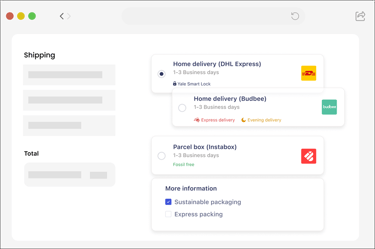
On the flip side, offering flexible, convenient delivery choices can significantly boost your conversion rates. Shoppers want options: standard home delivery, express shipping, click & collect, pick-up lockers, green delivery alternatives, you name it. By integrating multiple delivery options (with clear ETAs) right into checkout, retailers have seen conversion rate lifts as high as 20–30%.
For example, Flying Tiger Copenhagen expanded its pick-up/drop-off (PUDO) choices using nShift’s checkout solution and saw online checkout conversions jump by 20%.
Industry research backs this up broadly: retailers that provide a variety of delivery methods and show accurate delivery times achieve around 30% higher conversion at checkout. In other words, giving customers choices at checkout isn’t just a nice-to-have – it directly translates to more completed sales.
Why does this matter so much? Because delivery experience is now more influential than even price or payment options for many shoppers. A recent Retail Week study found that delivery options and reliability matter more to consumers than loyalty programs or even BNPL (buy-now-pay-later) offers. Shoppers are essentially saying: “Get my order to me how and when I want it, and I’ll hit ‘Buy’. Fail at that, and no coupon or loyalty points will save the sale.”
This is a big shift in customer expectations, and smart eCommerce leaders are responding by making delivery a core part of the value proposition. They highlight fast and free shipping thresholds (“Spend $X for free next-day delivery!”) and offer convenient alternatives like curbside pickup or local lockers. These not only reduce cart abandonment but can even increase average order value.
For instance, encouraging in-store pickup can lead to add-on purchases when customers come in (one study showed 85% of shoppers made an extra purchase when collecting in-store, resulting in up to 30% higher average order value).
The lesson: don’t treat delivery as a footnote in the checkout process. Treat it as a strategic lever to reduce friction and boost conversions, because your peers (and competitors) are already doing so.
How you communicate post-purchase turns buyers into fans
The moment a customer places an order, a new journey begins: the post-purchase experience. This phase is rife with emotion: excitement, anticipation, maybe a bit of anxiety (“Where is my order?”). How you manage these feelings can make the difference between a one-time buyer and a lifelong advocate.
The mantra here is automation, visibility, and communication. Customers crave information and reassurance. It’s simple: if you keep them informed, they stay happy; if you leave them in the dark, they get frustrated. In fact, 84% of customers say the ability to track their order is important to them. And as noted earlier, failing to provide updates drives customers away.
How do leading brands handle this? They proactively communicate at every step: order confirmed, package dispatched, out for delivery, delivered, even delays or exceptions. Each update is an opportunity to reinforce your brand’s reliability. It pays off in concrete ways.
For one, “Where Is My Order?” (WISMO) calls can drop dramatically when customers can self-serve via tracking. Companies that invested in robust tracking have seen customer inquiries plummet.
Similarly, industry data shows you can cut WISMO calls by up to 50-60% with clear, automated status updates. Consider what that means for your team’s productivity (fewer repetitive emails and calls) and your support costs (lower contact volume). It’s the classic “Save me time” win, for your customers and for your staff.
Aside from removing issues, great post-purchase communication is also about creating new opportunities. Branded tracking experiences (where customers see your website or app for updates, not the carrier’s generic page) keep the engagement going in a critical period. Customers are actively looking for information about their order – that’s a peak engagement window you don’t want to waste. By owning the tracking page, savvy retailers promote products or content there, essentially turning delivery tracking into a marketing channel. The result? Higher re-engagement and even additional sales.
For example, fashion retailer Quiz built a fully branded post-purchase journey using nShift Track, and their customers clicked through to the website at 5× the rate of typical marketing emails (industry average email click-through ~3%, versus ~15% via the branded tracking communications). Those are customers coming back to shop while waiting for their current order! No paid ads needed – it’s your delivery updates driving them back.
And let’s not forget the perception angle: when you nail the post-purchase experience, customers feel taken care of. They trust you more. Over time, this builds the holy grail of eCommerce: customer lifetime value. Satisfied customers are far more likely to buy again and even try new product lines.
In fact, research shows that when customers are satisfied with their experience with a brand, 68% are more likely to purchase from that brand again. Moreover, existing happy customers tend to spend more and explore more: 50% are more likely to try your new products and they spend 31% more on average than new customers.
All of this points to a simple truth: loyalty isn’t earned at checkout, it’s earned in the days that follow, when the product is en route. If you can keep that dialogue going through transparent communication, helpful updates, and responsive service, you’ll be rewarded with customers who come back often and sing your praises.
From refunds to revenue?
No discussion of delivery experience is complete without tackling returns, often seen as the ugly side of eCommerce. Yes, returns can be a headache operationally, and they might feel like a “loss” at first glance. But handled strategically, returns are actually a huge opportunity to build trust and even recapture revenue.
Here’s why: virtually every online shopper checks the returns policy before clicking purchase. If they don’t find a clear, easy returns process, many will simply abandon the cart. It’s reported that 85% of first-time customers expect to see a clear returns policy – it’s essentially a prerequisite to purchase. People want to know they’re not stuck if the item isn’t right. By providing painless returns, you increase the likelihood of that initial conversion.
Now, think about the post-purchase side: a customer wants to return an item. This moment is critical. It can either be a frustrating experience that ends the customer relationship, or a well-managed process that keeps the customer in your ecosystem (and maybe even leads to an exchange or future purchase).
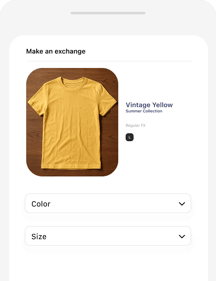
The difference lies in how easy you make it. Top-performing retailers treat returns not as a necessary evil but as another customer touchpoint to excel at. They offer self-service return portals, quick refunds or store credits, and even encouragement to exchange rather than refund.
The payoff can be significant: our data shows that making returns customer-friendly can help convert around 30% of returns into exchanges - meaning instead of losing that sale entirely, you retain revenue by helping the customer find something that works for them.
That’s 30% of potentially lost sales recovered simply by guiding the return toward an exchange or alternative product. Talk about “Make me money” in action!
Easy returns also feed back into loyalty. If a customer knows returns are hassle-free, they’re more confident buying from you in the first place (boosting conversion) and more likely to come back even after a return. Counterintuitive as it sounds, a smooth return can increase trust and repeat business: the customer thinks, “They made it so easy, I’ll shop here again because I know even if it doesn’t work out, I’m safe.”
On the other hand, a messy return experience (like having to email back and forth, print labels, or wait weeks for a refund) is a deal-breaker. It’s not just lost future sales from that customer; it’s a hit to your brand reputation through the dreaded negative reviews or word-of-mouth.
So, flip the script on returns: view them as a second chance to impress the customer. Communicate clearly, offer convenient options (like drop-off points or label-less returns), and consider incentivizing exchanges (e.g., a small bonus credit for choosing store credit over a refund). By doing so, you not only save the sale—you demonstrate authentic customer care. And that goes a long way to fostering loyalty and positive buzz. Remember, every returned item is a chance to show your customer-centric approach. The brands that seize this chance are effectively saying, “We’re confident you’ll love our products, but if you don’t, we’ve still got your back.” That’s the kind of message that turns one-time buyers into lifelong fans.
Automation will build you a future-proof delivery operation
You might be thinking, “This all sounds great in theory, but how do I execute a superior delivery experience consistently, especially as we grow?” The answer lies in automation and scalability: the unsexy work behind the scenes that makes the magic possible on the front end. As a seasoned eCommerce executive, I can’t stress this enough: you can’t deliver peak customer experience on peak volume using manual, brittle processes. If you’re relying on your team to, say, hand-sort shipping options or manually email every tracking update, you will hit a wall (and probably burn out your staff in the process). Automation is your friend, and it will save you time, save you money, and preserve your sanity.
First, let’s talk about handling growth and peaks. Peak season (holidays, Black Friday, etc.) is the ultimate stress test for your delivery operations. According to industry stats, eCommerce order volumes can jump about 55% during peak season.
That’s a massive spike. If your systems and processes aren’t ready to flex, you’ll disappoint a lot of customers at the most critical time of year.
Automation ensures that when order volume doubles overnight, your warehouse, carrier booking, and tracking communications don’t buckle under pressure.
For example, using an automated platform like nShift, retailers can print labels, book carriers, and send tracking info without human intervention, all at lightning speed. The impact on efficiency is huge: by automating carrier selection and label printing, businesses report up to 50% time savings in logistics operations. Imagine cutting your fulfillment time in half: your team can handle more orders per hour, or you can scale up without doubling headcount. And come peak season, you can manage the surge instead of scrambling to hire temporary help or, worse, delaying shipments.
Automation also reduces errors (no more manual address mistakes or wrong carrier services) and improves consistency. Each order gets the best-fit carrier and service level based on rules you set (speed, cost, destination, etc.) – in milliseconds. This level of efficiency has real financial returns:
- One, it lowers your operational costs (fewer labor hours per shipment, and less error-driven cost).
- Two, it can lower shipping costs themselves: for instance, automatically allocating orders to the most cost-effective carriers or service can trim your freight spend. Many retailers find that an intelligent delivery management system helps them reduce shipping rates by 10–20% via better carrier contracts and volume distribution.
- And don’t overlook the last mile – it’s often the most expensive part of the fulfillment chain (about 53% of total supply chain costs, just in last-mile delivery). Optimizing that through route automation, local carrier options, or batching deliveries can save a lot from your bottom line. Some nShift customers have reported around 8% cost savings by optimizing carrier managementIn a game of tight margins, those savings are gold.
Next, consider international scaling and omnichannel: two big growth opportunities that can become nightmares without the right infrastructure.
Say you want to start selling in five new countries next year. Without a scalable delivery solution, you’d have to integrate and manage a maze of local carriers, each with different labels, APIs, and requirements. That could take months (indeed, integrating a single carrier can take weeks of IT work). But retailers using nShift tap into a library of 1000+ carriers worldwide. That means you can turn on new shipping lanes and launch in new markets fast, without custom builds for each. Time to market shrinks dramatically: what might have been a 3-month carrier integration project can become a same-day configuration. The result? Your delivery capabilities won’t limit your expansion plans. You can enter new regions, offer local delivery options (which increase conversion in those regions), and even handle cross-border complexities with far less pain. This is the behind-the-scenes power that lets you scale internationally and still keep your delivery promises to customers.
For omnichannel retailers, a unified delivery management approach enables things like buy-online-pickup-in-store (BOPIS), ship-from-store, or return-to-store seamlessly. Those who master it see big benefits: offering click & collect can boost in-store footfall and even increase overall sales (recall the stat that 85% of click & collect users make additional purchases in store). With an integrated system, you can route online orders to the best fulfillment point (warehouse or local store) automatically, and handle returns in a centralized way. It’s all about being flexible on the back end so the customer has a frictionless experience on the front end. This level of agility and efficiency is what turns delivery from a headache into a strategic advantage.
Let’s not forget visibility and data. A modern delivery platform doesn’t just execute shipments; it also provides analytics and transparency. You (and your customers) can see where every order is, and you can track performance of carriers, delivery times, and costs. These insights help you continuously improve. For example, if one carrier consistently causes delays in a region, you can proactively switch to another. Or if you notice a spike in delivery inquiries, you might need to beef up your communication around that stage. Data-driven tweaks like these keep you at peak performance year-round. And when things do go wrong (they occasionally will), having centralized data means you can spot issues faster (e.g., a weather delay affecting a batch of shipments) and respond before customers start complaining.
In short, investing in automation and scalable delivery tech is about future-proofing your operations. It’s the “Save me time” and “Make me look good” combined: you save countless hours and headaches internally, and you deliver the kind of smooth experience externally that makes you look like a rockstar to your customers (and to your board, when they see the efficiency gains!).
In our years working with eCommerce executives, those who sleep easy at night during peak season are the ones who know their delivery machine is finely tuned and battle-tested.
Benchmark your delivery maturity in 2 minutes
By now, we’ve covered a lot and you might be feeling a mix of motivation (to capture all these opportunities) and maybe a bit of anxiety (wondering where you stand and what you might be missing). 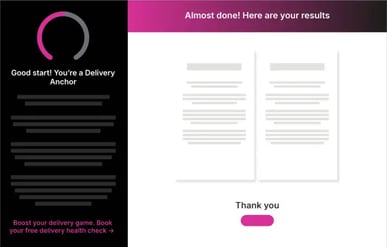
That’s exactly why we’ve created a new delivery health check assessment. Think of it as a free, 2-minute consultation to gauge your delivery operations and experience against industry best practices. How do you know if you’re lagging behind or leading the pack? The quiz will tell you - and give you a quick action plan to improve. It’s like a report card for your delivery strategy, without the pressure.
Why bother? Because what gets measured gets improved, and this assessment is tailored to give you immediate value. You’ll receive personalized recommendations based on your responses – quick wins for peak season prep, ideas to cut costs or improve customer comms, and so on.
Most importantly, taking this quiz sends a message (to yourself and your organization) that delivery experience matters. It’s the first step in turning what many see as an operational chore into a strategic weapon for growth. As we’ve discussed, the brands that treat delivery as part of the customer experience are winning: they’re enjoying higher conversion rates, larger basket sizes, fewer support issues, stronger loyalty, and more repeat business. If you want those rewards (and to avoid the painful pitfalls we highlighted) start by assessing where you stand. Maybe you’re already doing well and just have a few areas to tweak; or maybe you discover critical gaps that need urgent attention before the next peak season. Either way, knowledge is power.
Ready to see how your delivery stacks up? It’s free, fast, and could uncover your next big growth lever. At worst, you confirm you’re on the right track (and gain some bragging rights); at best, you uncover exactly what will make your customers happier, your operations smoother, and your business more profitable. That’s a few minutes well spent in my book, and your future loyal customers will thank you for it.
Take the quiz and get your personalized report here →