Delivery evaluation pack

nShift Delivery: The questions buyers ask, answered

Evaluating book-and-print for your warehouse? Start here. 
nShift Delivery overview

What operations, IT, security and procurement ask about nShift Delivery

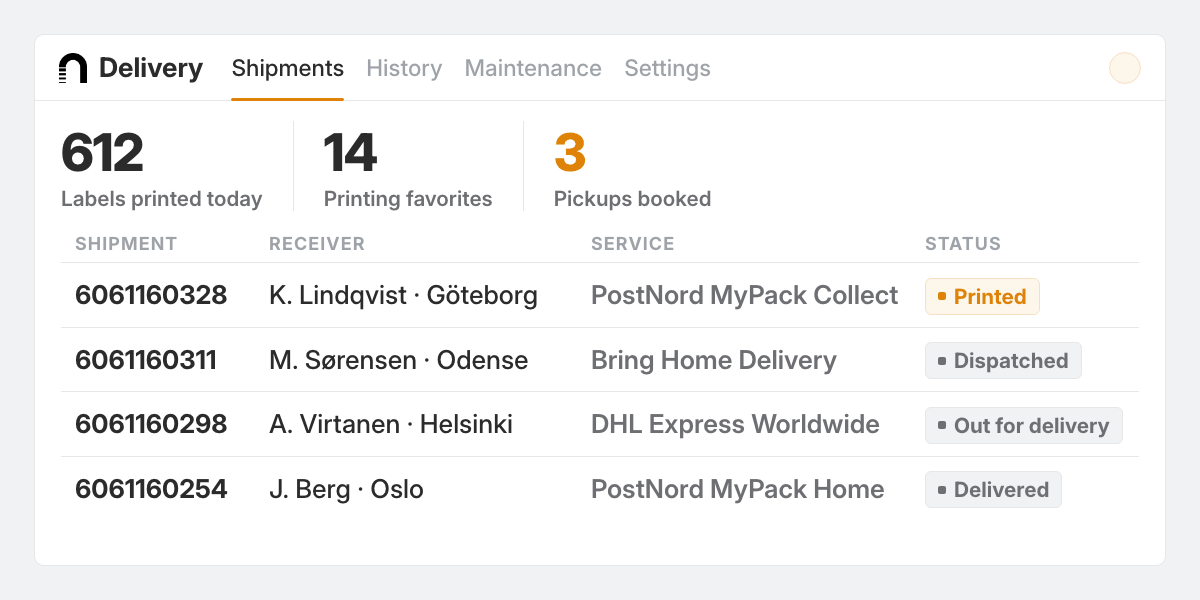
Delivery management gets judged at the packing bench, where a label either prints in seconds or a queue of parcels builds behind one screen. Every committee that evaluates book-and-print asks the same four questions: how fast staff can book and print, who keeps the carrier connections current, who can access what, and which commitments hold in writing. Every answer here carries the evidence beside it.
nShift Delivery, what operations asks view

What operations asks

Operations owns the dispatch cutoff, so they ask what every booking costs in seconds.

How fast can our team book and print?

GLOWiD cut order-processing time by 83% after moving booking and printing to nShift Delivery, from 3 minutes per order to 30 seconds. Errors fell by up to 50%, and the team freed 1.5 full-time equivalents. The numbers come from GLOWiD's own warehouse manager.

How quickly can we get our carriers live?

Bauhaus had all of its carriers configured within 48 hours and ran the implementation without additional nShift help, at roughly 750,000 orders a year. Day to day, you connect your own carrier agreements per sender and order new connections in the in-app webshop, usually handled the same day. Behind it sits the platform network of 1,000+ carriers across 190+ countries, 160+ of them with native Delivery connections.

Can it keep up with high-volume printing?

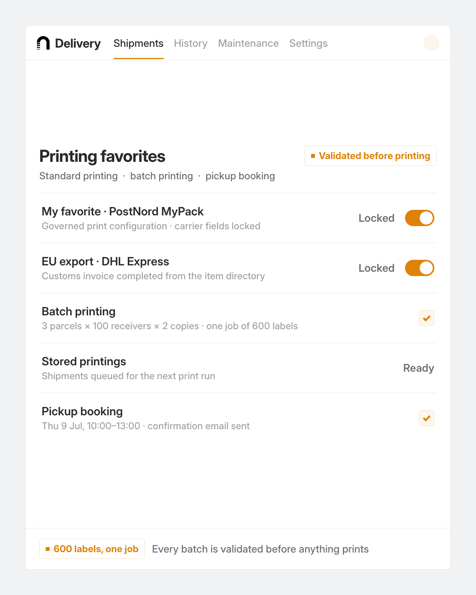
Yes. Batch printing produces validated label runs at scale: three parcels to 100 receivers in two copies is one job of 600 labels, checked before anything prints. Printing favorites lock a governed print configuration so staff cannot mis-key carrier settings, and labels print to 12 laser and 12 thermal media in PDF or ZPL.

How do returns work at the bench?

Four documented methods, including outbound and return label in one step and returns created from shipment history, with addresses inverted automatically. Link to print emails the customer a return-label link that only activates carrier EDI when used. One requirement to plan for: return services must exist in your own carrier agreement.

What IT asks

IT inherits the integration after go-live, so they ask what connects and who keeps the carrier side current.

How do we integrate it?

A REST API covering shipments, manifests, printing, addresses, prices, history, and alerts, plus an Order Management API with order channels and webhooks. Ready-made paths for Shopify and WooCommerce, custom order channels for everything else, and XML file integration through OnlineConnect in the Nordics. Developer documentation is public.

Who maintains the carrier connections?

nShift does. The FedEx new-API migration and the UPS OAuth 2.0 mandate were both completed in-platform, without customer development work. F-Box runs one million shipments a year through its WMS integration, 95% faster than before, and says that "for 99.9% of the time our employees barely even realize that nShift is there."

What does tracking look like across carriers?

Track and Trace gives one tracking page regardless of carrier, searchable by your own reference or order number, in nine languages, with status events from Printed through Delivered and Returned for most carriers. Coverage varies: some carriers need reporting activated, a few send none, so check your carrier mix during evaluation.

Can we test without shipping anything?
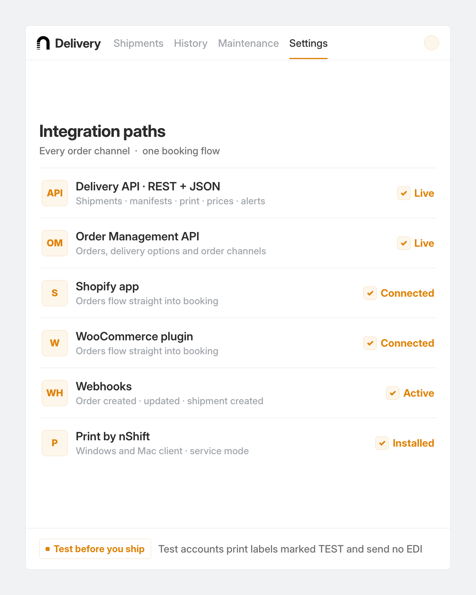
Yes. Test accounts produce labels marked TEST and send no EDI, so an integration can be built and verified end to end before a single real parcel is booked.
nShift Delivery, what it asks view
nShift Delivery, what security asks view

What security asks

Security asks who can get in, what they can see, and what happens to personal data over time.

What certifications do you hold?

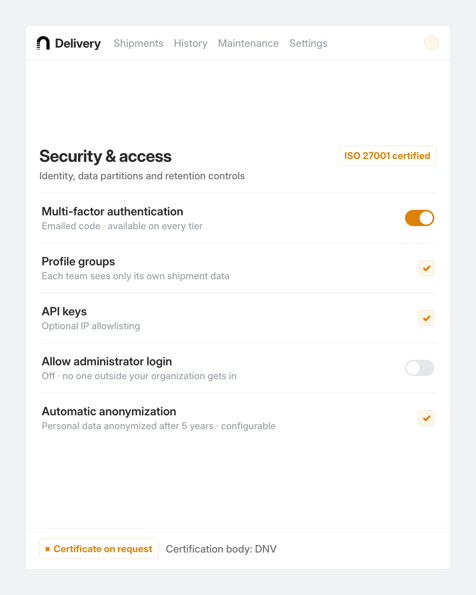
ISO 27001 certified, with DNV as the certification body and the certificate available on request. The certification covers the nShift platform.

How is access controlled?

Login is account, profile, and password, with multi-factor authentication available on every tier as an emailed code. Profile groups partition which shipment data each team sees, roles govern task rights, and API keys support optional IP allowlisting. An "Allow administrator login" toggle lets you block everyone outside your organization from entering the account, nShift support included.

What happens to personal data in shipment history?

It is anonymized automatically, after 5 years by default and configurable to your policy. Shipment history stays online for 6 months with a 5-year archive behind it, stored printings are deleted after 3 months, and report files are kept for 1 month.

What procurement asks

Procurement wants the commitment in writing and a way to check it without asking anyone.

Is reliability committed in writing, and can we verify it ourselves?

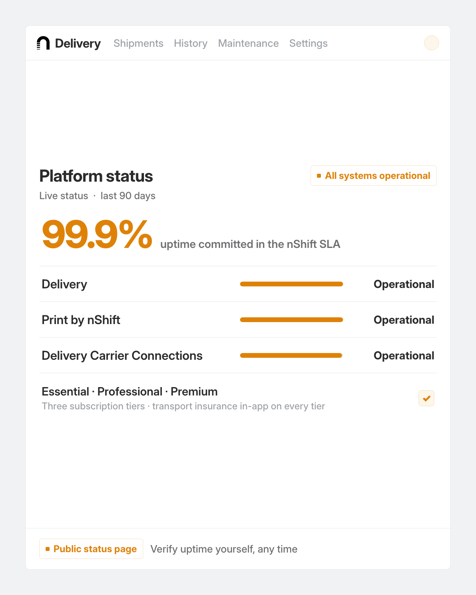
nShift commits to 99.9% uptime in its service level agreement, and verification is public: Delivery, Print by nShift, and Delivery Carrier Connections are named components on the nShift status page, each with live status and 90-day uptime history visible to anyone.

Can we see what shipments cost as we book them?

Yes, from your own carrier agreements. Price enquiry (a Professional-tier feature) shows live rates, chargeable weight, and pricing details during booking, and a price review runs automatically within 15 minutes after printing and stores the result for price reports.

How is the product packaged?

Three subscription tiers: Essential, Professional, and Premium. Batch printing, price enquiry, email pre-notification, and Link to print arrive with Professional; consolidated shipments, branded tracking, and scheduled reports with Premium. Transport insurance is an in-app purchase on every tier. Pricing is tailored per deal.

What do customers report after scaling on it?
Hairlust shipped 615% more orders and grew revenue by 642% while expanding into 10 new markets on the same platform, saving around 430 hours a year in the warehouse. Reference customers matched by size, sector, and geography are available on request.
nShift Delivery, what procurement asks view

The full answer set for your RFP

The Delivery RFP and Security Pack brings the security answers, the verified detail behind every claim on this page, and a ready-to-use response to the questions evaluation teams ask most.

Rather talk it through?

If your evaluation runs into a question this page does not answer, or you want the carrier coverage, the access model, and the integration path mapped to your own warehouse and markets, book a short demo. Bring the questions your committee still has and we will work through them together.