Transsmart evaluation pack

nShift Transsmart: The questions buyers ask, answered

Evaluating transport management that runs inside your ERP? Start here. 
nShift Transsmart overview

What logistics operations, IT, security and procurement ask about nShift Transsmart

Most Transsmart evaluations open with a single requirement: the team books, prints, and tracks without leaving the system they already work in. Everything the committee asks follows from it. Which ERP integrations are documented, what the API supports, how access is controlled, and what can be verified in public before anything is signed. Every answer here carries its evidence beside it.
nShift Transsmart, what logistics operations asks view

What logistics operations asks

The coordinator who books the daily run wants to know what changes about the working day, in hours.

What does it do to the daily shipping workload?

Hemimex cut the time its team spends on deliveries by 75% after connecting its M-Soft ERP to nShift Transsmart. Four hours a day became one. Trexico Logistics, running Boltrics WMS, made order entry 25% more efficient than under its old system.

How do shipments get booked?

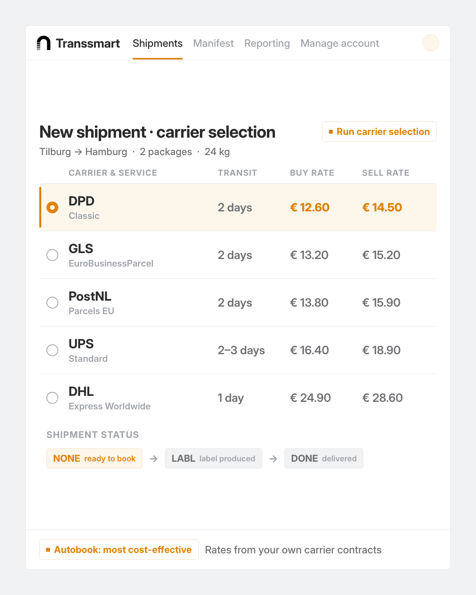
From the ERP through the API, or in MyTranssmart: manual entry, Excel mass import, or duplicating an earlier shipment. Booking profiles pre-fill recurring setups, consolidation groups same-day shipments to the same address for better contract pricing, and third-party billing and bill-to-receiver are supported.

Which carriers can we use, and who maintains the connections?

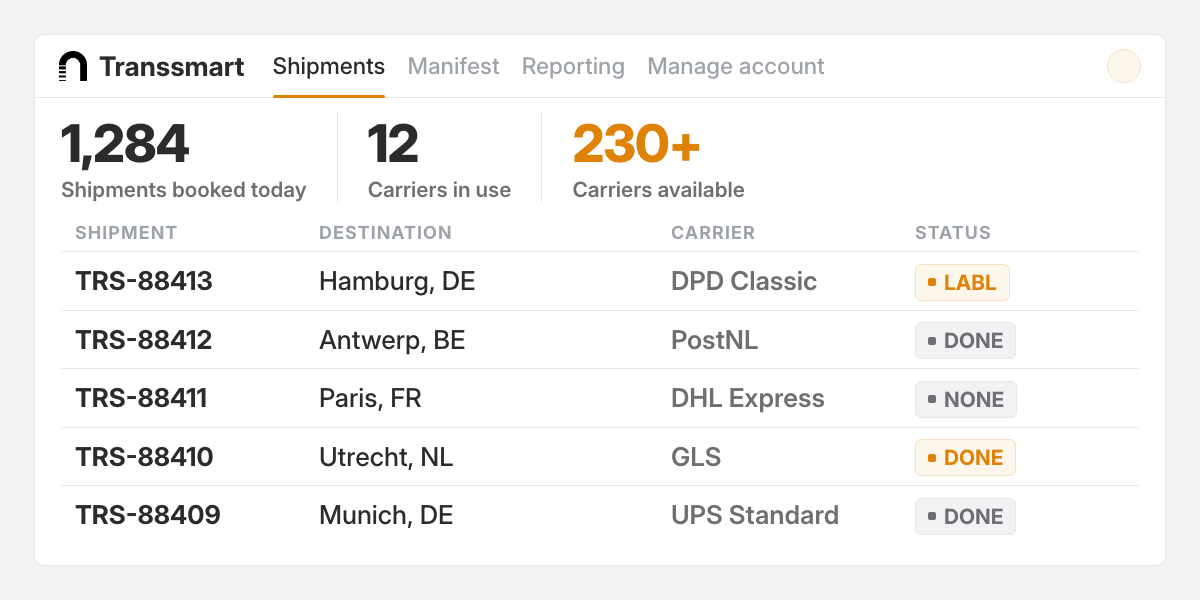
230+ carriers. You keep your own carrier agreements and rates; nShift records them, activates each carrier with your credentials, and maintains the connections centrally, with routing, label, and legislative updates in biweekly carrier release notes. Each carrier activation carries a one-time fee.

Can customers see where their parcel is?

Yes, on a 52-status harmonized model that reads the same across carriers, at shipment and package level. Track emails go out in your corporate identity, triggered per status, cost center, service level, and language, and TrackBox adds a branded tracking page as a paid add-on. One thing to plan around: carriers feed status updates on their own schedules, from every 15 minutes to twice daily.

What IT asks

ERP integration is why this product gets bought, so IT's questions decide the shortlist.

Which ERP systems are documented?

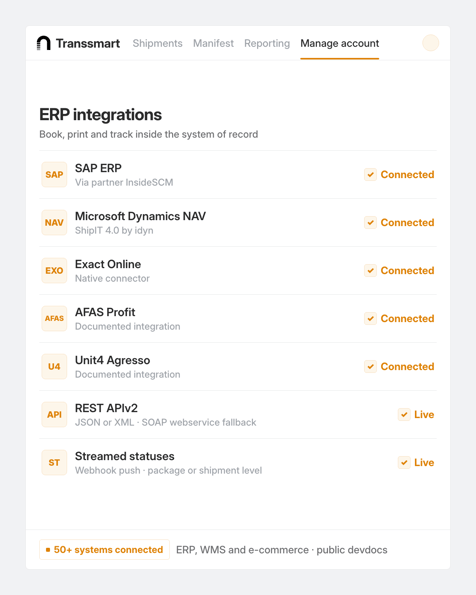
SAP through partner InsideSCM, Microsoft Dynamics NAV through idyn's ShipIT, Exact Online natively, Exact Globe through Twise and Prosigma, AFAS Profit, and Unit4 Agresso, with more than 50 ERP, WMS, and e-commerce systems connected in total. Solar Screen runs nShift Transsmart inside NetSuite via Cadran; the Van Gogh Museum runs it inside Exact Globe.

What does the integration change once it is live?

Solar Screen onboards new carriers about three times quicker and maintains one interface instead of one per carrier, with cost and tracking data feeding back into the ERP. At the Van Gogh Museum, the ERP selects the carrier automatically and shipments reach customers worldwide within 48 hours.

What does the API offer?

APIv2 is REST with JSON or XML, with a SOAP fallback, a Postman package, and public documentation. Rates return before booking, statuses stream by webhook at package or shipment level, and pick-up and drop-off locations return in a single call, including your own stores.

Can we test without booking real shipments?

Yes. Integration and acceptance testing runs in a separate Accept environment that mirrors production, and a booking made there never reaches a carrier.

How does label printing work across sites and hardware?
Labels output as ZPL, PDF, or base64 at 203 to 600 dpi. SmartPrint runs on Windows, macOS, and Linux including Raspbian, printing to a user or a printer, and your own documents can print alongside the carrier label.
nShift Transsmart, what it asks view
nShift Transsmart, what security asks view

What security asks

Security signs off on access, transport, and traceability before the deal moves.

How do users sign in, and how is access controlled?

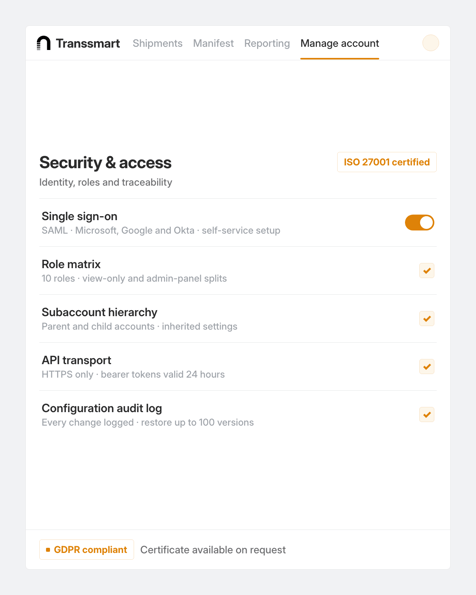
SSO via SAML, validated for Microsoft, Google, and Okta and configured self-service. Access follows a role matrix of 10 roles, including view-only and admin-panel splits, with at least one Administrator required per account and a parent-child subaccount hierarchy with inheritance.

How is API and data transport secured?

HTTPS only, on port 443. API bearer tokens are valid for 24 hours. IP allowlists are documented in both directions.

Can we audit configuration changes?

Yes. A full configuration audit log records changes with restore, keeping 100 versions, so a misconfigured setup can be traced and reverted rather than rebuilt.

What certifications does nShift hold?

ISO 27001 certified, with the certificate available on request. Certification body: DNV. Customer data is protected to GDPR obligations, and external penetration testing runs on nShift's cloud systems within a risk-based security program.

What procurement asks

Procurement wants commitments that hold up without a single email to nShift.

How can we check reliability ourselves?

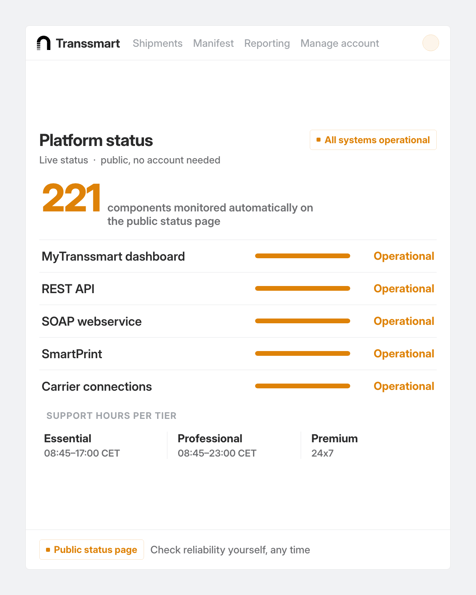
On the public status page. statuspage.transsmart.com lists 221 monitored components with automatic uptime monitoring, including the MyTranssmart dashboard, the REST API, the SOAP webservice, SmartPrint, and individual carrier connections. It is live and public; no account needed.

What support comes with which tier?

Essential includes support 08:45 to 17:00 CET, Professional extends it to 08:45 to 23:00 CET, and Premium is 24x7.

What is the pricing model?

Subscription tiers (Essential, Professional, Premium) plus paid add-ons such as SmartScan, Print&Ship, extended labels, and TrackBox, plus a one-time activation fee per carrier. Pricing is tailored to volumes and handled per deal.

Can you provide references?

Yes, matched by ERP, sector, and geography. Published Transsmart stories include Hemimex, Trexico Logistics, Solar Screen, and the Van Gogh Museum.
nShift Transsmart, what procurement asks view

The full answer set for your RFP

The Transsmart RFP and Security Pack brings the security answers, the verified detail behind every claim on this page, and a ready-to-use response to the questions evaluation teams ask most.

Rather talk it through?

If your evaluation has a question this page does not cover, or you want the integration path mapped against your own ERP, carrier list, and markets, book a short demo. Bring the committee's open questions and we will work through them one by one.