
Free shipping has more commercial power when pricing logic changes with the order. Harvey Nichols achieved payback in less than six months after moving beyond a rigid flat-rate model and automating carrier selection. Topformula increased order value by 28% and conversion by 4% with a more integrated checkout experience.
Those results point to the same principle: delivery pricing works better when it fits the order, the market, and the promise the brand is making at checkout.
That is the real job of a free shipping strategy. Teams decide when free shipping helps, when thresholds help more, and when a paid option deserves a clearer place on the page because it matches the shipment more accurately. When the logic is stronger, conversion and margin support each other.
Direct answer: How can ecommerce brands offer free shipping without losing margin?
Ecommerce brands can offer free shipping without losing margin by matching delivery price to basket value, parcel size, destination, and carrier cost, then testing thresholds and option order in checkout. Free shipping works best as one deliberate pricing tool inside a broader delivery-pricing strategy, applied where it supports both conversion and commercial control.
Key results from nShift customers
- Harvey Nichols achieved payback from the initial project costs in less than six months, with 20 to 30% of parcel volume now moving via a new letterbox service and substantial savings.
- Topformula increased average order value by 28% and conversion rate by 4% through an integrated checkout and payment experience.
- Pikkuvihreä recovered tens of thousands of euros in profitable orders by using rule-based delivery logic for more complex shipments.
- Sportsdeal increased average order value by 20% and cut packing time by 25% through a smoother, more flexible checkout.
Why does flat free shipping create hidden margin pressure?
Flat free shipping creates hidden margin pressure because fulfilment cost changes with parcel size, packaging, destination, postcode, and carrier choice. When checkout prices every order the same way, margin starts slipping through the low-value baskets, bulky shipments, and harder-to-serve geographies that deserve more precise logic.
Harvey Nichols is the clearest proof. The retailer had a premium next-day service with one flat rate for every parcel. That worked until the order mix changed. As lower-priced beauty items entered the basket, delivery cost began taking a much larger share of the order value. James Henry, Head of Multichannel Operations, describes the commercial pressure directly, saying delivery costs were "starting to eat away at our profit margins".
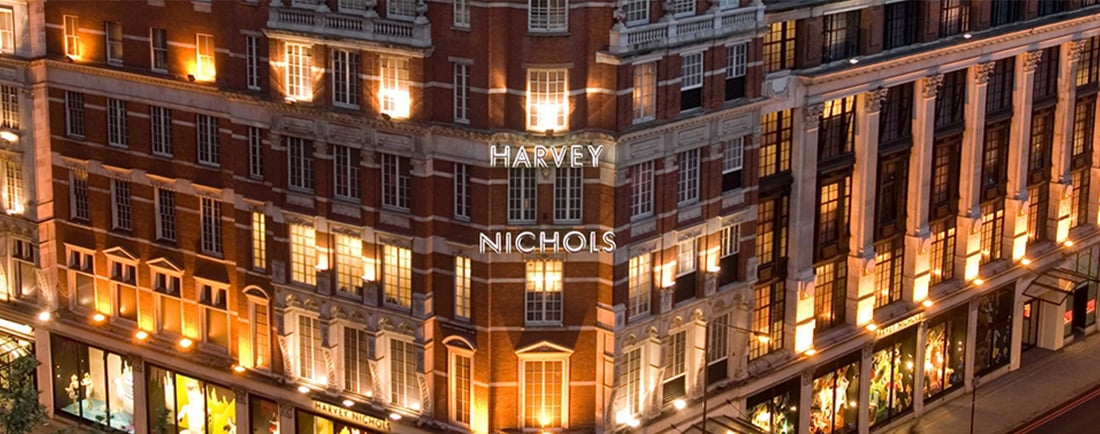
The improvement came from making the delivery decision more granular. Harvey Nichols used nShift Ship to automate carrier allocation based on product data including weight, size, packaging, and destination. That moved pricing and carrier selection closer to parcel reality, and the returns were fast. Henry says:
"The payback from the initial project costs was less than six months."
The same customer reports that 20 to 30% of parcel volume now goes through the letterbox service, creating substantial savings while making delivery more convenient for customers.
This is why delivery pricing and fulfilment logic belong in the same conversation. A price shown at checkout only works commercially when the execution layer can support it with the right service at the right cost.
How can brands protect margin and still keep delivery attractive?
Brands protect margin and keep delivery attractive when they turn pricing into a contextual choice. Free shipping thresholds, postcode-based prices, parcel-specific rules, and market-level delivery logic all give teams more ways to stay competitive while matching the commercial model to the real shipment.
Pikkuvihreä shows why this matters when shipment profiles vary sharply. The company sells products that range from items small enough for an envelope to large palletized outhouses. E-commerce Manager Eemeli Palo says:
"With nShift, I can code simple rule sets on how and which delivery methods are triggered for each customer or shopping cart."
That logic recovered profitable orders that would otherwise have been lost and protected the margin on more complex baskets.
Dermosil adds the flexibility angle. Ann-Sofie Strand says:
"We’ve also tried selling a service cheaper for a while to see how customers react."
That is why pricing strategy has to include clarity as well as arithmetic. If customers understand the choice and trust the promise, teams get more room to price intelligently.
Dermosil also shows how pricing flexibility can stay manageable. The team can add carriers and transport services directly in checkout, try new setups, and remove them again if the result is weak. Customers get a clearer choice, and the merchant gets a cleaner place to manage rate logic.
This is where carrier connectivity strengthens pricing strategy. Access to a wide carrier network creates more room to align price, service level, and geography, which gives checkout logic a stronger base for shaping the right delivery promise for each order.
Which pricing capabilities create the biggest lift?
The biggest lift comes from pricing controls that help checkout reflect shipment reality without slowing the customer down. Free-shipping levels, postcode and price-step logic, custom price lookups, and experimentation all help teams make delivery pricing more relevant while keeping the page easy to use.
nShift Checkout supports shipping price configuration, including levels for free shipping, and the Rules Engine can apply logic based on inputs such as cart value, postcode, and weight. Condition lists support price steps, which is useful when the economics of the shipment change with size, quantity, or route.
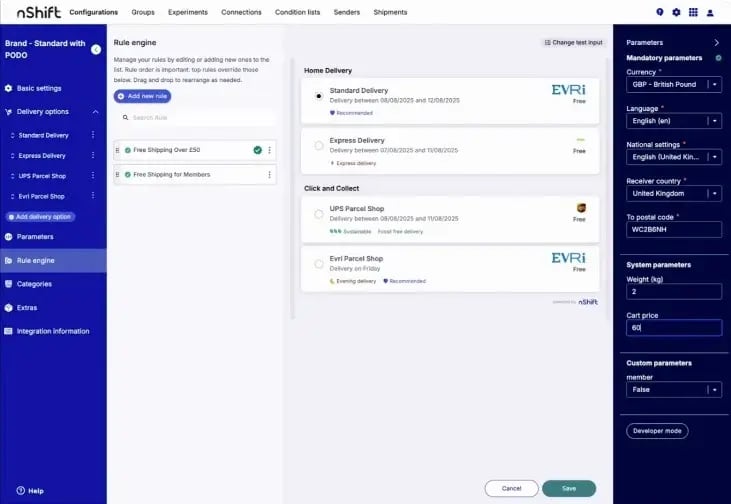
Checkout can also use custom price lookups from nShift Ship or nShift Transsmart, and the price a customer sees becomes easier to align with the execution data behind it.
-
Ship automates carrier selection by price, SLA, destination, and weight.
-
Transsmart supports routing rules, carrier select, and predicted transport cost.
Together, those capabilities give pricing logic a stronger operational foundation.
Topformula is the strongest commercial proof in this article. The retailer combined nShift Checkout with Walley’s payment module and achieved a 4% increase in conversion plus a 28% increase in average order value. Fredric Boson, CEO, says:
"We’re seeing a clear increase in customer satisfaction and conversion with a 4% increase in conversion and a 28% increase in order value."
The result shows that a more credible, integrated checkout can move both basket value and purchase confidence.

Sportsdeal adds a second commercial proof point. The retailer increased average order value by 20%, boosted conversions by 8%, and reduced packing time by 25% through a smoother checkout and delivery setup.
That tells us that pricing strategy works best when it supports both basket value and operational efficiency.
What does a smarter delivery-pricing setup put in motion?
|
Capability |
What the shopper gains |
What the merchant gains |
|
Free-shipping levels and thresholds |
A clearer sense of when an order qualifies for better delivery value |
More control over margin by basket value |
|
Postcode and price-step logic |
Delivery prices that feel specific to the real order |
More accurate pricing by geography, size, or shipment profile |
|
Custom price lookups from Ship or Transsmart |
A more believable delivery promise |
Pricing that stays closer to execution cost |
|
Rules Engine and relevant option display |
Fewer irrelevant choices at checkout |
Cleaner commercial control over which options appear |
|
Pricing and option-order experiments |
A checkout that keeps improving over time |
Faster learning on conversion, uptake, and margin performance |
How should teams test thresholds, pricing, and option order?
Teams should test thresholds, pricing, and option order with a narrow commercial question in mind. The goal is to learn which setup creates the strongest balance of conversion, basket value, and delivery economics for a specific segment, market, or shipment type. Stronger tests come from one clear variable, one clear audience, and one commercial outcome worth measuring.
Start with the orders that matter most. That could be baskets below the current free-shipping threshold, a market with high delivery cost, or a shipment profile where margin pressure is already visible. This is where nShift Checkout A/B testing experiments become useful. The platform supports testing different prices, testing delivery fees below the free-shipping threshold, and testing option order without rebuilding the checkout.
Dermosil is a strong example - the team actively tests delivery services and adjusts them based on customer response. The business can add a carrier, see how it works out, and even offer a service at a lower price for a period to test the result. That is the right mindset for delivery pricing: test where the economics are most sensitive and where the customer decision is most exposed.

Option order deserves attention too. Some teams focus only on the fee, but the sequence of options changes what feels convenient, premium, or realistic at checkout. That is part of the commercial model. The order of delivery choices influences uptake, and uptake influences both cost mix and conversion.
This is also where merchant control matters. Pikkuvihreä highlights the value of rule-based logic applied to real basket differences. Pricing strategy improves faster when commercial teams can adjust logic, learn, and refine again as part of the normal operating rhythm.
What should teams measure after rollout?
After rollout, teams should measure the metrics that show whether delivery pricing is becoming more commercially useful. Conversion rate matters. Average order value matters. Margin by basket type matters. Delivery-option uptake matters. Service contacts tied to delivery pricing also matter because pricing only works well when customers understand it.
Topformula is a reminder that a strong checkout can move more than one number at once. Conversion and order value both improved because the delivery and payment experience felt more credible and easier to use. That is why measurement should stay connected to the full checkout outcome, including the delivery fee and the wider checkout result.
Harvey Nichols shows why parcel mix is worth watching closely. When 20 to 30% of parcel volume shifts into a lower-cost service, the commercial effect is immediate. That kind of metric helps teams see whether their pricing and carrier logic are actually changing the economics of fulfilment.
Sportsdeal adds the service layer. When order value, conversion, and packing efficiency all improve together, it becomes easier to see delivery pricing as part of the wider commercial model. Delivery pricing earns its place when it supports margin, conversion, and clarity together.
Why free shipping strategy works best when pricing matches parcel reality
Free shipping strategy works best when it starts from delivery reality and then turns that reality into a clear customer choice. That gives teams more room to protect margin, shape demand, and present delivery options that feel fair and understandable.
This is where nShift is strongest on the topic. nShift Checkout helps teams manage thresholds, price logic, relevant option display, and experimentation in the customer-facing layer. nShift Ship and nShift Transsmart help line that pricing up with the execution data behind it. The result is a pricing model that supports both commercial control and customer confidence.
If your team wants to improve delivery pricing, conversion, and margin together, nShift Checkout is a strong place to start.
Book a demo to see how nShift helps retailers build a smarter free shipping strategy.