Three weeks ago I wrote that 81% of shoppers will abandon a purchase if their preferred delivery option is not available at checkout. The DHL data made the point sharply, and today we watched it become concrete in a live session.
We ran Solved episode 3. My colleague Josh built a checkout configuration from scratch in front of the audience: carrier connection, PUDO options, pricing rules, estimated delivery times. It took under ten minutes. Then I opened Companion on the configuration he had just built.
What it found was more useful than what I had planned to show.
What Companion found first
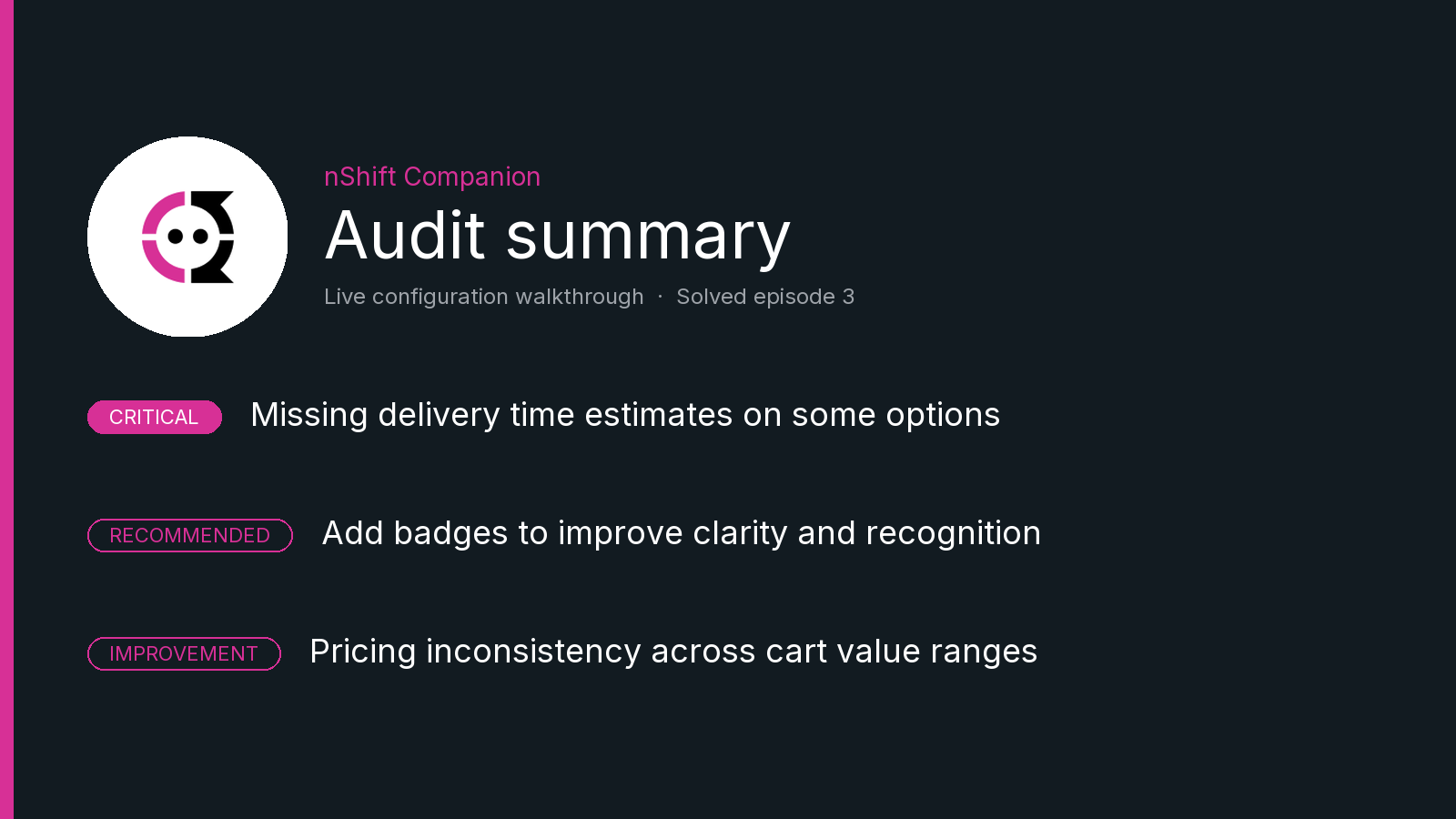
The first gap Companion flagged was missing delivery time estimates on some of the options Josh had configured. Josh had actually spoken to this during his demo, and the observation has stayed with me: shoppers who don’t see a delivery date don’t always abandon the basket outright. Some leave the checkout page to find the information somewhere else. That detour is enough to lose them.
Companion classified missing ETAs as critical. That is the right call: a delivery option without a realistic arrival date is not really a delivery option, it's a placeholder the shopper has to trust without evidence.
The second flag was a pricing inconsistency. The rules Josh had set up did not cover all cart value ranges cleanly. The kind of edge case that is hard to catch manually when you are building rules in a live session, but that a customer will find the moment their cart happens to fall in the gap.
Neither suggestion was generic. Companion read the actual configuration: the specific carrier mix, the rules that existed, the values they covered and did not cover. General checkout best practices are easy to find; a tool that reads your specific setup and tells you where it breaks is far more valuable.
Companion reads the configuration. The merchant decides.
Companion does not make changes; it reads a configuration, surfaces gaps and suggestions, and explains its reasoning. The merchant decides what to act on. That's intentional: the whole premise of nShift Checkout is to give commercial teams direct control over the delivery step without going through a developer. Companion adds a layer of analysis on top of that control. It does not take it away.
During the session, I also showed it on a more complex configuration, one with a VIP rule that changed delivery option ordering, pricing, and display text simultaneously depending on whether a customer was flagged as VIP. Companion explained the entire rule in plain language, including what triggered it and what changed.
A merchant who inherits someone else’s configuration while that person is on leave can use Companion to understand the full logic without reverse-engineering every setting manually.
The predefined prompts (summarize the configuration, explain a specific rule, suggest improvements) give you a starting point. You can also ask free-text questions about your own setup. The suggestions that come back are based on your data, not a generalized checklist.
The test that tells you whether a change actually worked
Knowing what to change is one question. Knowing whether the change converted is another.
We showed a pre-configured A/B experiment in the session: two configurations running simultaneously, with traffic split automatically. The only difference between them was whether one delivery option carried free shipping. The conversion difference between the two was clear in the results view.
The data in that demo was illustrative, not a production benchmark to lift directly. But the principle transfers: you can run that test against your own traffic and get an answer specific to your customers and markets, rather than borrowing an industry average and hoping it applies.
Flying Tiger Copenhagen know what this looks like in practice. When they gave shoppers the ability to choose their own pickup point rather than being auto-assigned one, 70% of customers chose it and conversions rose 20%. The capability had been technically available for months before it went live. Speed and confidence were the missing pieces. Configure it, prove it works, roll it out.
Topformula saw a 28% increase in average order value and a 4% increase in conversion rate after taking direct control of the delivery step at checkout. In their CEO’s words:
“We’re also seeing effects in the form of customers contacting us and thanking us for the opportunity to choose what best suits them.”
Customers calling to say thank you for a delivery option. Checkout configuration is a customer experience product, and shoppers judge it as one.
The delivery promise starts at configuration
Tom Bailey wrote recently about what a broken delivery promise looks like from the customer’s side. He followed one shopper navigating a high-stakes furniture purchase against a hard deadline, watching the promise unravel at each handoff: the ETA that turned vague, an unfamiliar sender name appearing in the carrier notification, a support queue that moved too slowly to save the plan.
Most of that damage traces back to gaps that existed before the order was placed: options not configured for the customer’s market, arrival dates absent or too broad to be useful, pricing rules that did not cover every scenario.
Checkout configuration is where delivery promises get made. The formal promise is what ends up in the order confirmation. The implicit promise is what happens at the delivery options step, when a shopper sees a specific option, a specific price, and a specific expected arrival date and decides to buy on that basis.
Companion makes the gaps in that implicit promise visible before a customer finds them. Experiments let you test changes against live traffic before they become permanent policy. Together they shift the question from “what should we try?” to “here is what actually works for our customers.”
That shift, from configuration as a one-time setup to configuration as a feedback loop, is where checkout delivery is heading. The retailers who close the gap between commercial intent and checkout reality first are the ones who stop losing customers at the last step.
If you missed the session, the recording is available on demand. And if you want to see what Companion suggests for your own configuration, speak to your nShift contact.