Audit evaluation pack

nShift Audit: The questions buyers ask, answered

Evaluating carrier invoice audit? Start here. 
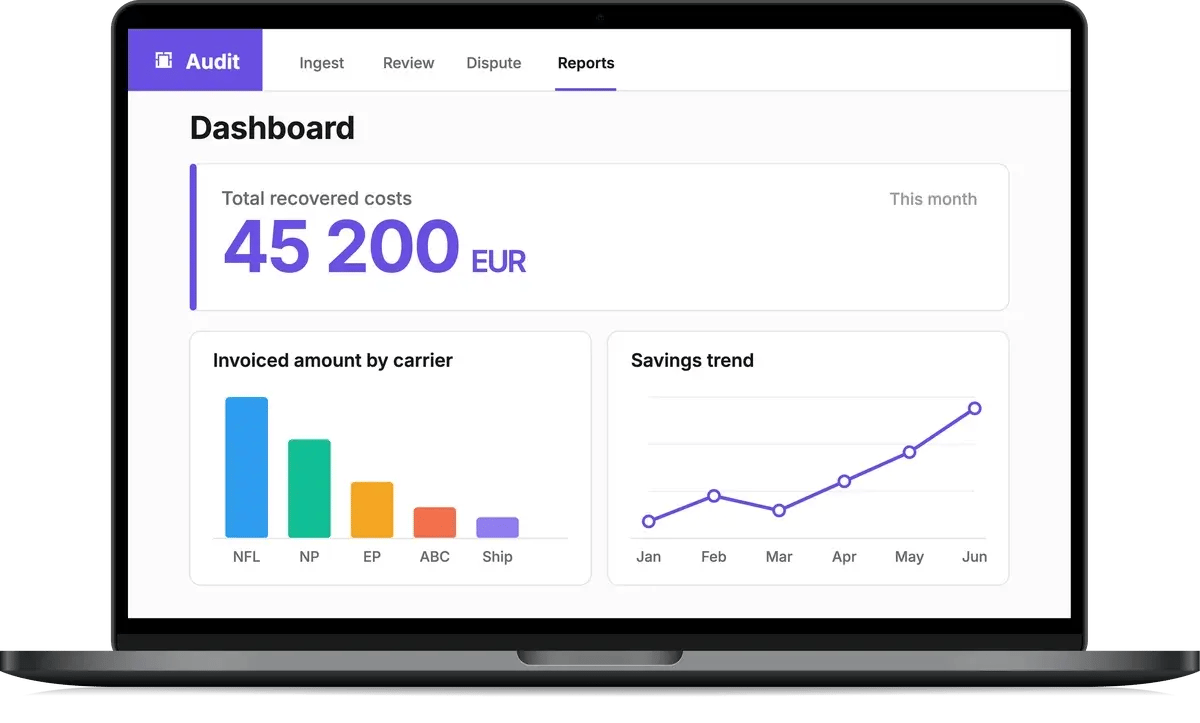
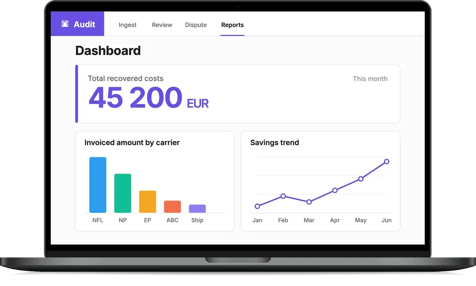
nShift Audit dashboard showing total recovered costs, invoiced amount by carrier and savings trend

What logistics, finance and procurement, IT and security ask about nShift Audit

nShift Audit is carrier invoice audit and recovery software. A freight operation pays what the carrier bills unless someone can prove otherwise, and an evaluation of an audit tool involves four teams: logistics, finance and procurement, IT, and security. Each team asks different questions, and this page answers each one directly. To see the workflow first, watch the 14-minute recorded demo.
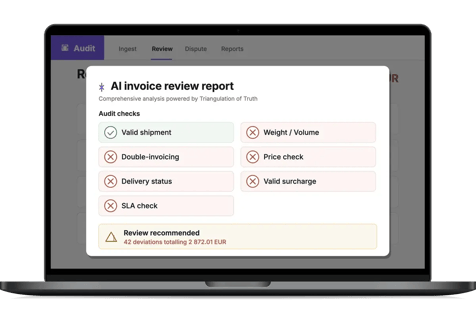
nShift Audit AI invoice review report showing the seven deviation checks

Audit coverage

Logistics owns the invoice queue, so they start with what gets checked: every line of every invoice, before anyone opens it.

What does nShift Audit check?

Every invoice line goes through seven audit checks. Each compares the invoice with your shipment data in nShift Portal: valid shipment, double-invoicing, delivery status, service-level compliance, weight and volume, price within your configured tolerance, and surcharge validity. You can switch each check on or off per company. Before the checks start, the invoice arithmetic is validated (header versus line sums, tax, credit notes). Each deviation comes with a type, a severity, a monetary impact, and a plain-language explanation.

Which invoice formats are supported?

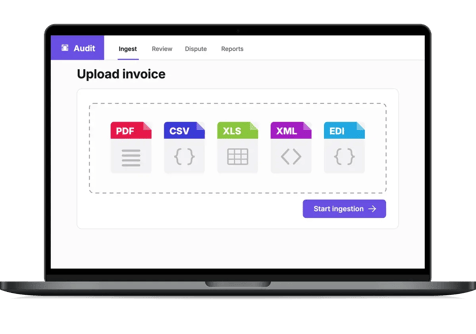
Raw carrier formats arriving as text-based PDF, CSV, Excel, XML, or EDI are supported. Image-only scanned PDFs and composite invoices (a summary document plus separate line-level files) are not supported. nShift Audit uses AI to read each document's structure when it arrives, so no format library limits which carriers you can audit.

How much setup does a new carrier need?

One validation. The first invoice from a new carrier format gets a guided human check; after that, the format is processed automatically, and corrections keep improving how it is read. There are no carrier-specific templates, rules, or mapping projects to build or maintain.

What happens when the AI is not confident?

Processing pauses. Below a set confidence level, a person checks the result before processing continues. Corrections are added to a carrier knowledge base, and anything learned from your invoices stays isolated to your account until it has been independently validated.

How accurate is the extraction?

In pre-launch validation, extraction accuracy was 99.5%+ on roughly 200 carrier invoices across 9 carriers. From launch, accuracy is re-measured continuously on production volume.

Matching and evidence

Next, logistics asks what each line is checked against: the rate in the contract, and the shipment as it was delivered.

What is the invoice matched against?

Two sources: your contracted tariffs, and your shipment records. Freight has no purchase order, so there is nothing standard to match an invoice against. nShift Audit uses what replaces it: the rate you agreed and the shipment that took place, including weights, services, and delivery events. Checking the invoice against both gives a three-way match: invoice, tariff, shipment.

How do our rate cards get in?

Your contracted rates are set up in nShift's Freight Rate Calculation service, and the expected cost of every shipment is calculated from them. Each invoice line is compared with that expected cost in the Price and Valid Surcharge checks. Rate cards follow how your carriers price: country, postcode or distance zones, weight and volume weight, loading meters, pallet types, minimum and maximum prices, and fees such as a diesel surcharge. You can build them from an Excel template or in nShift Portal, or have nShift Professional Services set them up, and you update prices and fees in Portal when a carrier changes them. If a shipment's expected price can't be calculated, the line is marked unable to verify rather than flagged.

Where does the shipment data come from?

For nShift customers, from nShift Portal automatically: shipments executed through nShift Ship, Delivery, TMS, or Transsmart are available to Audit without re-entry or file exchange. For companies not shipping through nShift, shipments are uploaded to nShift Portal through the Shipment Data API. Invoice lines with no matching shipment in Portal can still be reviewed in the Invoice Explorer, but a full audit needs the shipment record.

Can we tune what gets flagged?

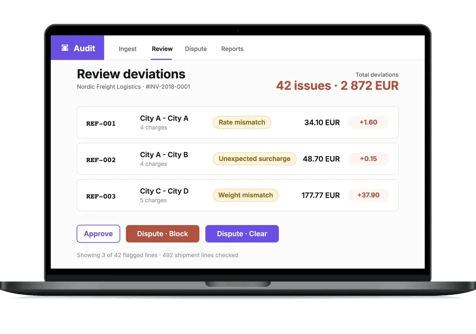
Yes. Auto-approval thresholds clear small deviations without review, and expected deviations can be accepted so they never enter a claim. The review queue holds only what needs a human decision, ranked by monetary impact.
nShift Audit review screen showing flagged invoice lines with the reason and amount for each
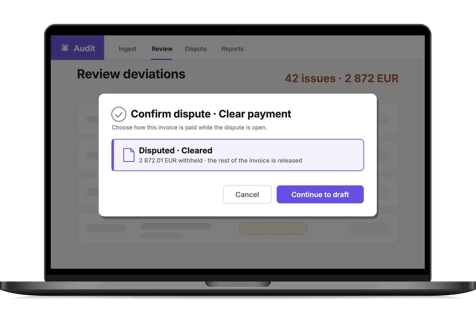
nShift Audit confirm dispute dialog clearing the rest of the invoice for payment

Dispute, recovery and reporting

Then logistics asks how a flagged charge is claimed back while invoices still get paid, and what spend looks like across every carrier.

How does a flagged charge become a claim?

You choose per invoice: approve everything; dispute and block payment; or the recommended flow, dispute and clear. With dispute and clear, the flagged charges are contested and the invoice is released for payment at the same time, so carrier operations, including label generation, continue undisturbed. The claim is generated with the evidence attached.

How are disputes tracked?

All carrier correspondence for a dispute stays in one thread, from submission through resolution or closure, including credit-note settlement. Recovered amounts and open disputes are visible on the dashboard.

Will auditing damage our carrier relationships?

The audit produces documented, factual findings, and you decide what to dispute. Nothing is filed without your approval. Carriers are paid on time under the dispute-and-clear flow, which keeps the conversation commercial.

What visibility does nShift Audit provide beyond deviations?

Normalized spend analytics across every carrier: spend per carrier, service, lane, and month; surcharge frequency and cost visualization; outlier flagging for abnormal cost per kilogram, surcharge ratios, weight factors, and zero-amount charges; and a recovery dashboard showing disputed amounts, recovered costs, and the auto-approval rate.

Can we get the normalized data out?

Yes. Ingested invoices are normalized into a standard structure and exportable, so the same data can feed your own BI and finance processes.

Finance and procurement

Finance and procurement ask for the business case, what the audit does beyond recovery, and who stands behind it.

What is the business case?

Freight audit benchmarks put recoverable overcharges at 3 to 7% of freight spend. One in five freight invoices is inaccurate (Journal of Commerce benchmark study), and in nShift customer research roughly three in four companies audit freight invoices manually or not at all. Those errors are flagged and claimed back with the evidence attached, and the dashboard reports what came back each month, so the case is re-proven from your own numbers. Companies see the most value from €1 million in annual freight spend.

How does pricing work?

Pricing scales with the size of your freight operation. The demo comes with a tailored quote sized on your operation, and a view of your likely recovery range at 3, 5, and 7% of your freight spend.

Does this help beyond recovery?

Line-level billing evidence changes carrier negotiations. When the carrier argues from their data and you argue from memory, you lose; with rate compliance, surcharge behavior, and service performance documented per carrier, the negotiation starts from your record. Contract compliance no longer depends on whoever last checked a spreadsheet.

Who is behind the product?

nShift is the delivery management platform behind 20,000+ businesses, with a carrier network of 1,000+ carriers across 190+ countries and shipping-software heritage since 1997. nShift Audit extends that platform to the money side of shipping: the company that has connected shippers to carriers for decades now checks the invoices those carriers send.
nShift Audit dashboard showing total recovered costs, invoiced amount by carrier and savings trend
nShift Audit upload screen with PDF, CSV, Excel, XML and EDI invoice formats

Integration and IT

IT asks what the setup needs from their team, and how invoices get in.

What does implementation require from IT?

For nShift customers, nothing beyond access: nShift Audit is a native nShift Portal application with single sign-on, and shipment data is connected automatically. For companies not yet shipping through nShift, shipment data is uploaded to Portal through the Shipment Data API. Either way, there is no server footprint to run.

How do invoices get into the system?

By upload, email, FTP or API, the way your carriers already send them. Carrier format changes do not break ingestion, because there are no per-carrier mappings to break.

Who maintains carrier coverage?

There is no connector list to maintain. Any carrier that can send you an invoice in a supported format is auditable, and extraction quality improves through the shared knowledge base as usage grows.

Security

Security has to approve before a contract is signed, so they start with how invoice data is stored and who can access it.

How is our invoice data protected?

Data is encrypted at rest and handled in a tenant-isolated architecture: each customer's data, corrections, and overrides stay scoped to that customer. Personal data is kept out of application logs. Users sign in through nShift Portal.

Is nShift certified?

nShift is ISO 27001 certified (certification body DNV) and operates under GDPR, with platform hosting in AWS Europe and annual independent penetration testing at platform level. Security questionnaires and requests for Audit-specific documentation (data residency, retention, sub-processors, AI data handling) route through the nShift Security Team and DPO.

Does the AI train on our data?

Customer-specific corrections remain isolated to the customer. Only document structure is added to the shared knowledge base, and nothing is promoted into it without independent validation across multiple customers. Questions on AI data handling route through the nShift Security Team and DPO during evaluation.
DNV certification mark for an ISO/IEC 27001 information security management system

The full answer set for your RFP

The nShift Audit RFP and security answers pack puts every answer on this page in one PDF, with source references, ready to share with your evaluation committee.

Rather talk it through?

Anything this page cannot settle in writing, a working session with your own invoices can. Book a short demo, bring the questions your committee still has, and we will work through them together.