Last update: 04.08.2025
In this blog:
- Intro
- Concern 1 — No one at home to receive the delivery (~36%+)
- Concern 2 — Delivery didn’t arrive at the promised time (~24.3%)
- Concern 3 — Delivery failed or parcel delivered to depot/post office
- Concern 4 — High delivery cost (~53.5%)
- Concern 5 — Delivery too slow (~31.4%)
- Concern 6 — Lack of delivery flexibility or options
- Concern 7 — I didn’t receive any delivery updates
- Why it matters — customer retention and cart abandonment
- Reassurance tactics summary
- Final thoughts — turn delivery into a competitive advantage
- Further reading: Delivery concerns FAQs
Intro
We surveyed customers via Maru, nShift, and IMRG to identify why orders often fall short. Understanding these concerns allows brands to build more reliable, trust‑boosting delivery experiences. By turning anxiety into assurance at the checkout stage and during delivery, companies can improve customer retention, reduce cart abandonment, and elevate their brand in a crowded e-commerce landscape.
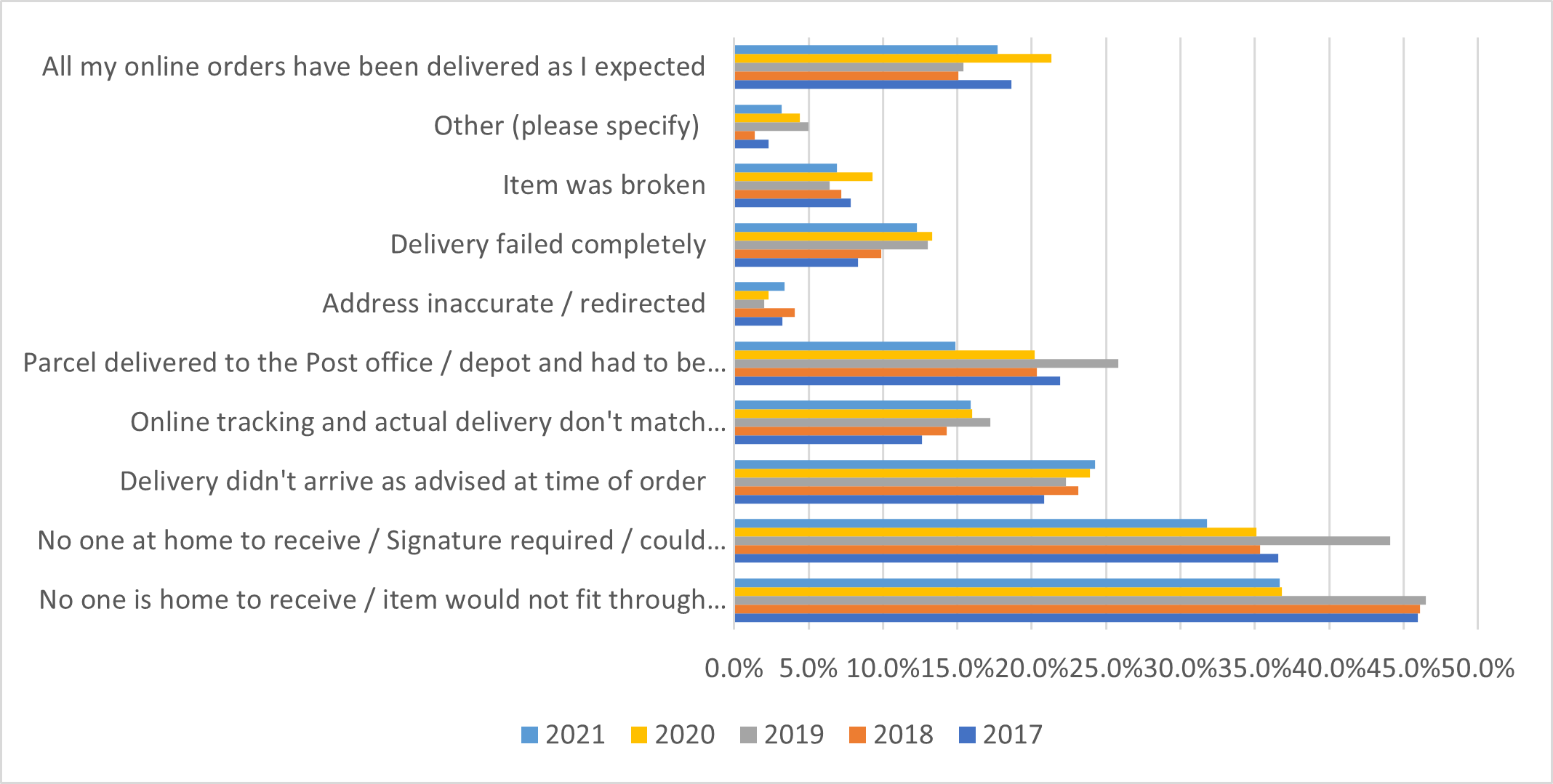
If orders have not been delivered to your expectation, what have been the most common reasons?
(Source: Maru, nShift and IMRG Home Delivery Report)
Concern 1 — No one at home to receive the delivery (~36%+)
This was the most frequently cited issue—even during the pandemic, this remained the top concern in 2020–2021.
Why it matters:
Parcels requiring a signature or too large for letterboxes lead to failed delivery attempts. Missed deliveries inconvenience the customer, increase costs for the seller, and often result in negative post-purchase feedback. Shoppers don’t want to rearrange their entire day around a vague delivery window or chase down parcels at depots.
How to reassure:
- Provide SMS/email alerts with a confirmed delivery time window.
- Allow safe-place or neighbor drop-off preferences.
- Use delivery lockers and click-and-collect options.
- Let customers choose delivery instructions at checkout.
Bonus tip: Highlight flexible delivery options during checkout to boost trust and reduce cart abandonment.
Concern 2 — Delivery didn’t arrive at the promised time (~24.3%)
Why it matters:
When a promised delivery doesn’t show up, it breaks the customer’s trust. This can have a long-term impact on retention, even if the product itself is excellent.
How to reassure:
- Set accurate and honest delivery expectations from the beginning.
- Use live GPS tracking to allow real-time visibility of the parcel.
- Send proactive communication if there are any delays or changes.
Additional advice: Consider offering a discount or free shipping on a future order when timelines are missed.
Concern 3 — Delivery failed or parcel delivered to depot/post office
Why it matters:
Failed deliveries force the customer to take on additional work and often delay the order by 1–2 days. For some, depot collection is a major inconvenience.
How to reassure:
- Work with couriers that have high first-attempt success rates.
- Let customers reroute packages mid-transit.
- Enable automated redelivery scheduling via the tracking page.
Strategic insight: Reducing failed deliveries also cuts your operational costs and support tickets.
Concern 4 — High delivery cost (~53.5%)
Why it matters:
Surprise shipping costs at checkout are one of the top reasons for cart abandonment.
How to reassure:
- Offer free shipping thresholds to encourage higher basket value.
- Bundle delivery costs into product pricing for simplicity.
- Provide multiple pricing tiers (economy, express, green delivery).
Bonus tip: Make the value of delivery clear—tracking, eco-friendly packaging, insurance, etc.
Concern 5 — Delivery too slow (~31.4%)
Why it matters:
While fast delivery is always appreciated, customers care more about reliable and transparent timelines than unrealistic promises.
How to reassure:
- Display exact shipping timelines (e.g., “2–3 business days”).
- Offer express delivery upgrades for urgent orders.
- Clearly communicate order cut-off times and holidays.
Concern 6 — Lack of delivery flexibility or options
Why it matters:
Consumers have different lifestyles and delivery needs. One size doesn’t fit all anymore.
How to reassure:
- Offer lockers, store pickup, or weekend delivery slots.
- Allow address changes and flexible delivery instructions.
- Include sustainable delivery options for eco-conscious shoppers.
Concern 7 — I didn’t receive any delivery updates
Why it matters:
Nearly 90% of shoppers expect proactive updates, especially same-day alerts. SMS is preferred by 45.6% of users.
Best practices:
- Send milestone updates: dispatched, in transit, out for delivery, delivered.
- Use a branded tracking page that reinforces your identity.
- Let customers choose their communication preference (SMS/email/app).
Bonus: Strengthening trust through communication - great communication reduces WISMO (Where Is My Order?) inquiries and improves post-purchase loyalty.
Why it matters — customer retention and cart abandonment
- 75% of consumers say poor delivery experiences lead them to abandon a retailer.
- Delivery concerns are responsible for up to 50% of cart abandonment.
- Repeat purchases increase when delivery is reliable and flexible.
Reassurance tactics summary
| Concern | Reassurance Strategy |
|---|---|
| No one home to receive parcel | Time-slot alerts, safe place options, lockers, neighbor delivery |
| Delivery missed promised window | GPS tracking, proactive alerts, honest ETAs |
| Failed delivery or depot collection | Reliable carriers, rerouting, automated rescheduling |
| Delivery cost too high | Free shipping threshold, bundled pricing, economy options |
| Delivery too slow | Transparent timelines, multiple speed tiers, cut-off times |
| Lack of delivery options | Locker, store pickup, delivery window choices |
| Poor communication | Branded updates, real-time notifications, customer preference controls |
Final thoughts — turn delivery into a competitive advantage
Meeting delivery expectations is no longer a bonus—it’s the baseline. Customers reward brands that:
- Give them control
- Keep them informed
- Offer real delivery choice
- Own every post-purchase moment
By addressing the most common delivery concerns head-on, retailers can reduce support costs, win trust, and increase lifetime value—all through a smarter, more customer-centric delivery experience.
Customers may be concerned with the whereabouts of their delivery, however, if you can reassure them by creating a trustworthy and effective system, then you’re sure to see the rewards of happy shoppers.
It’s all in the delivery
From checkout to emissions, nShift gives you full control of delivery management at every step — with branded experiences, smarter shipping, and access to 1,000+ carriers.
Explore the nShift platform