Last update: 16.09.2026
In this blog:
- What is reverse logistics?
- Where reverse logistics costs land
- How to reduce reverse logistics costs
- Further reading: Reverse logistics FAQs
What is reverse logistics?
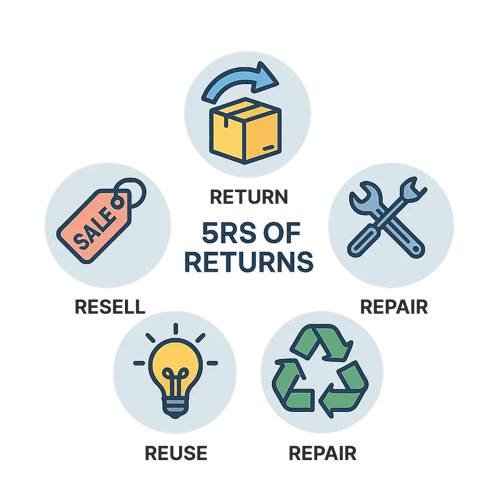
Reverse logistics is the flow of goods back from the customer: returns, repairs, recycling, reuse, and disposal. It runs in the opposite direction to normal fulfillment, and the aim is to recover as much value as possible from each item that comes back.
Handled well, managing returned goods protects margin and gives customers a reason to buy again. The cost of handling them shows up in four areas.
Where reverse logistics costs land
The costs of reverse logistics fall into four areas:
1. Transportation
Moving returned products back from the customer to the warehouse or manufacturer is usually the single biggest line. According to Deloitte, transportation can account for up to 60% of the total cost of reverse logistics.
2. Processing
Each item has to be inspected, tested, sorted, and repackaged before anyone knows what to do with it. A report by Statista found that processing costs can range from $10 to $40 per returned item.
3. Restocking
Getting an item back into sellable condition can mean refurbishing, repackaging, and relabeling, all before it earns revenue again.
4. Disposal: how returns management reduces disposal costs
> Items that cannot go back on the shelf are the most expensive returns you handle: recycling and scrapping carry fees, landfill carries a gate charge and a reputational one, and the lost sale sits on top. Returns management reduces that bill at the point of the request, before the parcel moves, by choosing a route for each item from the reason and the condition the customer declares.
A disposition rule turns that data into a route. An unworn item in original packaging goes back to sellable stock. A worn or opened item with no fault goes to a discounted or outlet channel, or to a recommerce partner that grades, refurbishes, and resells it. A faulty item goes to repair if the repair costs less than the recovered value, and to a manufacturer claim if it is under warranty. Items with no resale value go to donation before recycling, which keeps the disposal fee and the write-off off the ledger for anything a charity partner will take. Return partner Fugeetex, for example, works with retailers to keep returned garments in use rather than in landfill.
Which route an item takes depends on what the returns system captured at the request: the reason code, the condition code, the SKU, the market, and the customer's photos where the policy asks for them. With that record in hand at receipt, the receiving team grades against it rather than from scratch, and the share of returns that end in disposal falls because each item was routed while it still had value. How much it falls depends on the category, with apparel at one end of the range and opened consumer electronics at the other.
How to reduce reverse logistics costs
Most of the cost is set before the parcel ships back, in the product page, the returns flow, and how stock is planned. These changes target the biggest sources:
-
Make product pages match what arrives
Many returns happen when the delivered item differs from the photos and description in the web shop. Analysis of returns data shows which product pages drive the most returns, so you can fix the listings that cause them.
-
Make returns easy through one system
A single, self-service returns flow cuts the time and labor in each return and gives you clean data on why items come back.
-
Plan inventory to cut the returns it causes
Sharper demand and stock planning reduces the overstocks and stockouts that lead to returns. According to Accenture, this can reduce costs by up to 30%.
-
Use returns data to find the patterns
Tracking return reasons and trends shows where to act first. According to Gartner, using data analytics to identify trends and patterns can reduce costs by up to 10%.
-
Build returns into a circular model
Reusing, refurbishing, and reselling returned stock recovers value and lowers input costs, and it is where reverse logistics is heading. McKinsey has found that a circular economy model can cut costs by up to 50%.
When the returns process is automated and built around the customer, it stops being pure cost. nShift's Returns solution turns as much as 30% of returns into exchanges, so the sale stays with you and the customer has a reason to come back.
Make returns simple for your customers and smarter for you
nShift Returns delivers branded, self-service experiences while giving you the tools to prevent avoidable returns, automate refunds, and restock faster.
More than 20,000 businesses use nShift to run delivery and returns as one connected experience.
Explore nShift Returns

Author
Jyo Saikia
Product Specialist Director, nShift
With extensive experience in logistics, supply chain, and IT SaaS, Jyo specializes in helping businesses optimize operations and achieve sustained success. His deep industry knowledge enables him to craft innovative strategies that deliver tangible results, ensuring customers gain a competitive edge.