The issue is rarely knowing what should improve. It is the growing gap between commercial intent and the operational work required to make checkout changes safely.
Checkout is one of the most commercially sensitive parts of ecommerce. It is also one of the hardest places to improve once the business starts to scale.
That sounds counterintuitive. By the time a shopper reaches checkout, intent is already there. The product is chosen. The basket is built. The customer is close to buying. In theory, this should be one of the easiest places to optimize.
In practice, it rarely is.
Most ecommerce teams do not struggle because they lack ideas. They already know what they want to improve. They want to reduce abandonment. They want delivery options to feel clearer. They want to offer more relevant choices by market, basket value, or customer type. They want to protect margin without damaging conversion. They want to adapt faster when carriers, costs, or customer expectations change.
The real problem is that turning those commercial goals into live checkout changes is often much harder than it looks.
That gap matters because checkout friction still carries a measurable cost. Research from Baymard Institute (2024) puts average cart abandonment at roughly 70%, with delivery-related factors still among the most common reasons shoppers walk away. Extra costs, slow delivery, and unnecessary complexity continue to shape whether customers complete the purchase or abandon it. Baymard also reports that many leading ecommerce sites still perform only moderately on checkout UX.
Where checkout optimization starts to break down
On the surface, delivery choice looks simple. Show the right options. Present the right price. Set the right promise. But underneath that customer-facing layer sits a much more complicated operating model. Carrier combinations, regional differences, product constraints, click-and-collect logic, service availability, basket thresholds, business rules, and fulfillment dependencies all shape what can actually be offered.
As the business grows, that complexity compounds.
What starts as a straightforward checkout setup gradually becomes a living system of exceptions, decisions, and trade-offs. Commercial teams want agility. Operations teams need control. Ecommerce teams need speed. Developers need clarity. And all of it sits inside a part of the customer journey where even small mistakes can affect revenue, trust, and support volume.
That is exactly why checkout optimization becomes harder as ecommerce teams expand. The challenge is not just improving the customer experience on the surface. It is managing the complexity behind it.
The gap between intention and execution
This is why many checkout teams end up stuck.
They know a change is needed. They may even know exactly what outcome they want. But getting from idea to implementation can still be slow, technical, or risky. A simple question such as how to show more relevant delivery options for a specific customer group can turn into a longer process involving setup reviews, logic checks, technical interpretation, and internal coordination.
That is a consequence of complexity, not a failure of ambition.
And it is exactly why the conversation around AI in checkout needs to become more precise.
Why speed alone is not the right benchmark
Too much AI discussion still focuses on speed in the abstract. Faster answers. Faster workflows. Faster decisions. But speed in a live checkout environment only matters if it comes with accuracy and operational grounding.
The real benchmark is whether a system can help teams move faster while staying connected to operational reality. That means understanding the actual delivery setup. It means interpreting business intent in the context of real rules, services, and constraints. And it means helping teams act with more confidence rather than introducing new uncertainty into one of the most sensitive parts of the buying journey.
That is also why checkout cannot be treated in isolation. It sits inside a broader delivery management platform where shipping logic, visibility, customer communication, and post-purchase experience all connect.
What nShift Companion brings to checkout
This is the problem nShift Companion is built to address.
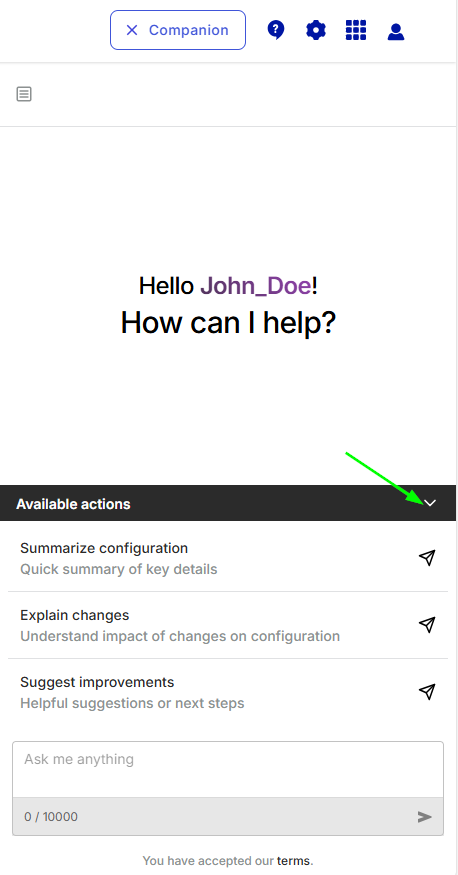
nShift launched Companion first in Checkout for a reason. Checkout is where delivery trust is created or lost. It is where commercial intent meets operational execution. And it is where teams often need the most help translating what they want to achieve into changes they can actually make. Companion works as a natural-language interface that helps users understand their checkout configuration, explore improvement options, and get guidance grounded in structured delivery data, business logic, and operational context.
That distinction is worth understanding.
A useful checkout assistant needs to be connected to how delivery decisions really work. It needs context, structure, and boundaries. Without those, it risks becoming another interface that sounds intelligent but cannot be trusted in production.
The more useful way to think about Companion is as a way to reduce the distance between intent and execution.
A team wants to improve conversion in a specific market. A merchandiser wants to understand why certain delivery options are appearing. An ecommerce manager wants to understand the logic well enough to act without waiting for a longer handoff chain. An operations leader wants confidence that changes reflect the real delivery setup. Companion is designed to support those moments.
Delivery experience as a brand signal
That is especially relevant now because delivery experience is no longer a back-end concern. It is part of how customers judge the brand itself.
Delivery options influence confidence before purchase. Delivery promises shape trust during purchase. Tracking and post-purchase communication affect how the experience is remembered after purchase. The whole flow is connected, and checkout plays an outsized role because it is where that promise first becomes visible.
That promise also extends beyond checkout itself. What happens after the order matters just as much. nShift Track helps brands stay in control of delivery communication after purchase, while nShift Returns helps reduce friction when the journey flows in the other direction.
nShift’s customer examples reinforce the point. Varby Färghall used Checkout to make delivery options more relevant and easier to navigate, while RNB Retail and Brands expanded delivery choice and flexibility across the Swedish market by connecting checkout more closely to their wider logistics setup.
That matters because better delivery experience is not just about service perception. It influences conversion, customer satisfaction, and the ability to scale without piling more manual work onto already stretched teams.
What kind of AI is worth trusting at checkout
So the more useful strategic question is not whether AI belongs in checkout. It is what kind of AI is actually worth trusting there.
For ecommerce leaders, that usually comes down to a few hard questions. Does it understand the real delivery setup? Can it interpret business intent in context? Can it reduce the need for specialist translation between teams? Can it help people move from question to action without increasing risk?
If those answers are no, the technology may be interesting but it is not yet operationally meaningful. When those answers are yes, AI starts to become more than a productivity story. It becomes an execution story.
The competitive advantage in checkout
The future of checkout optimization goes beyond offering more delivery choices or adding more automation. The real shift is in helping teams act on good ideas before complexity slows them down.
The businesses that win will be the ones that translate commercial intent into live customer experience faster, more safely, and with less internal friction. In a growing ecommerce environment, that ability becomes a real competitive advantage.
If you want to explore that bigger picture, the nShift product portfolio and customer stories show how checkout, shipping, tracking, and returns work best as part of one connected delivery strategy.
Learn more about nShift Checkout.