EU customs guide

EU product identifiers: what your carrier needs and where to enter it

Since 1 November 2026, every item you sell online to a consumer in the EU from outside the EU needs three codes on its customs declaration: your product code, the manufacturer's code and, when the product has one, its barcode number. The rule comes from Commission Delegated Regulation (EU) 2026/1022. Find what your carrier asks for, and where the codes go in your nShift product.

Last reviewed: 10 November 2026.

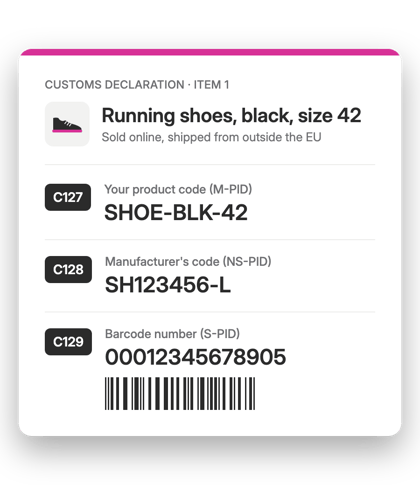
Customs declaration line for a pair of running shoes with its three EU product identifiers: SHOE-BLK-42 (C127), SH123456-L (C128) and barcode number 00012345678905 (C129)

Which carriers ask for the codes?

See what UPS, FedEx, DHL Express, Royal Mail, PostNord and five more carriers ask you for, and what happens without the codes.

What are the three codes?

What each code is, which shipments need them, and what the sources say about parcels worth more than 150 euro.

Where do the codes go in nShift?

Field names, carriers and setup instructions for nShift Delivery, Ship, TMS, Transsmart and Webshipper.

The basics

What are EU product identifiers?

EU product identifiers are three codes that tell customs which product is in your parcel. Commission Delegated Regulation (EU) 2026/1022, published on 1 July 2026, makes them mandatory from 1 November 2026 for every item sold online to a consumer in the EU and shipped from outside the EU.

  • Merchant product identifier (M-PID): your own product code, usually the stock keeping unit (SKU).
  • Non-standardized manufacturer product identifier (NS-PID): the manufacturer's model, part or style number.
  • Standardized manufacturer product identifier (S-PID): the barcode number, such as a GTIN or EAN, when the product has one.

Most of these codes already exist in your catalog, in your supplier's product data or on the packaging, as the European Commission points out. Your job is to send them with every consumer shipment into the EU.

Contact nShift about your EU shipments

EU product identifiers at a glance

Each code has its own document code on the customs declaration. The examples use a fictional pair of shoes.

M-PID:
your product code

Example: SHOE-BLK-42

Your own code for the item, usually the stock keeping unit (SKU). Customs document code C127.

NS-PID:
the manufacturer's code

Example: SH123456-L

The manufacturer's model, part or style number. Customs document code C128. A manufacturer may also use its barcode number here.

S-PID:
the barcode number

Example: 00012345678905

The GTIN, EAN, UPC or ISBN, when the product has one. Customs document code C129. No barcode? The declaration records that with code Y081.

Scope

Do your shipments need EU product identifiers?

Yes, if you sell online to consumers in the EU and ship from any country outside the EU, such as the UK, Norway, Switzerland, the United States or China.

Which shipments need EU product identifiers?

Every consumer shipment of goods sold online and shipped into the EU from outside it needs the codes, whatever the carrier. The European Commission's announcement of 3 November 2026 says the requirement "is mandatory and is enforced" from 1 November 2026.

Business-to-business shipments are "in principle not concerned" (Commission guidance).

EU product identifiers are part of the same customs reform that added a temporary 3 euro duty per item on consignments worth up to 150 euro and a 2 euro handling fee per item at any value (Commission guidance). Our guide to the EU customs changes of 2026 covers both.

Who provides the codes?

  • Using the Import One-Stop Shop (IOSS)? You still need the codes. They apply under IOSS, the special arrangements and standard import VAT alike. What is IOSS?
  • The declarant reports the codes on the customs declaration. In most cases the declarant is the IOSS holder, the operator of the special arrangements or a customs representative.
  • Selling through a marketplace? The guidance gives the merchant code to "the online seller, marketplace or platform", so check whether your marketplace supplies it.
  • Your carrier usually asks you for the codes when you book. Find your carrier.

Do EU product identifiers apply to parcels worth more than 150 euro?

The sources differ. The Commission's guidance sets a 150 euro limit and says the law is being amended to match; we have not found an adopted amendment yet. Our advice until the law is settled: send the codes on every consumer shipment into the EU. Your carrier and the destination country's customs authority have the final word.

Positions on the 150 euro value limit, as published by each source
SourceWhat it says about valueDate of the source
European Commission, guidance for Member States and tradeApplies to goods worth up to 150 euro; the Commission "is in the process of amending Annex B", the annex that lists customs declaration data, to state that limitVersion of 5 October 2026
Commission Delegated Regulation (EU) 2026/1022The note for the H1 and H6 declarations, the standard EU import declarations, names no value limit; the reduced H7 declaration covers consignments worth up to 150 euroOfficial Journal, 1 July 2026
European Commission, announcement"The requirement applies to goods sold in distance sales." No value limit stated3 November 2026
Irish Revenue, eCustoms notification 14/2026Mandatory "regardless of value"31 July 2026
Dutch Customs, news pageUnder current law the obligation also covers shipments above 150 euro; limiting it to 150 euro is an intention that has yet to be adopted (our translation)Updated 2 October 2026
CarriersDHL Express, FedEx, Evri, DPD Ireland, Posten Bring and Posti state a limit of 150 euro; PostNord states any valueLate October and November 2026

Consequences

What happens to a shipment without EU product identifiers?

Refused at booking

Refused
at booking

Royal Mail's Click & Drop applies no postage until your product SKU and the manufacturer's ID are added.

Delayed or charged a fee

Delayed or
charged a fee

UPS warns that shipments without the codes "may be delayed, returned or incur a Pre-Release Notification Fee".

Held at the border

Held at
the border

DHL Express says customs "may be unable to release the shipment at the point of entry into the EU".

Returned to you

Returned
to you

PostNord Sweden, Posten Bring and Posti say shipments without the codes can be returned.

Carriers

Which carriers require EU product identifiers?

Each carrier on this page has published its own rules for EU product identifiers. They differ on which codes they ask for, the value limit and what happens when the codes are missing. Carriers update these rules, so check your carrier's notice before you change your process.

Express and international carriers: UPS, FedEx, DHL Express and Asendia

Express and international carriers
CarrierWhat it asks you forValue limitIf the codes are missing
UPSYour product code and the manufacturer's code; the barcode number where one existsNo limit statedDelay, return or a fee
FedExYour product code and the manufacturer's code; the barcode number if it existsUp to 150 euroTransition period expected to early 2027
DHL ExpressYour product code and the manufacturer's code; the barcode number if availableUp to 150 euroCustoms may not release it; possible return to origin
AsendiaAsk your Asendia account managerNot statedNot stated

UK and Irish carriers: Royal Mail and Parcelforce, Evri and DPD Ireland

UK and Irish carriers
CarrierWhat it asks you forValue limitIf the codes are missing
Royal Mail and ParcelforceProduct SKU and manufacturer's IDNo limit statedNo postage until added
EvriEvri creates the codes at bookingUnder 150 euroNot stated
DPD IrelandAll three product identifiersUnder 150 euroNot stated

Nordic postal carriers: PostNord, Posten Bring and Posti

Nordic postal carriers
CarrierWhat it asks you forValue limitIf the codes are missing
PostNordSKU, supplier and barcode where availableAny valueMay be returned (PostNord Sweden)
Posten BringYour product code and the manufacturer's code; barcode if anyUp to 150 euroRejected or returned
PostiThree product identifiersUp to 150 euroReturned to the sender

What UPS asks you for

UPS asks for your product code and the manufacturer's code for every product, plus the barcode number where one exists, on each line item of a consumer shipment into the EU. Shipments arriving without them from 1 November 2026 can be delayed, returned or charged a fee.

  • What it asks for: "a Merchant Product ID and Manufacturer Product ID for every product, as well as a Standardised Product ID where one exists"
  • Shipments covered: Business-to-consumer shipments into the EU: "Three product identifiers required for each line item as of 1 November" (2026). Business-to-business shipments: "Not required"
  • If the codes are missing: "may be delayed, returned or incur a Pre-Release Notification Fee"
  • In nShift: nShift Delivery: all three codes. nShift TMS: the manufacturer's code and the barcode number
  • Source: UPS United Kingdom, Adapting to EU De Minimis Changes

What FedEx asks you for

FedEx asks for your product code and the manufacturer's code, plus the barcode number where it exists, on consumer shipments worth 150 euro or less. Its guide of 30 October 2026 expects EU Member States to allow a transition period until early 2027. It says the requirement still stands and asks you to keep providing the codes without delay.

  • What it asks for: Merchant product identifier "MANDATORY"; non-standardized manufacturer product identifier "MANDATORY"; standardized manufacturer product identifier "MANDATORY IF IT EXISTS"
  • Shipments covered: "shipments valued at €150 or less, sold in distance sale to consumers (B2C)". Shipments to a recipient with a VAT number: "No PIDs required"
  • If the codes are missing: "EU Member States are expected to support a temporary transition period until early 2027, where shipments may continue to move if PID information is not available"
  • In nShift: nShift Delivery, Ship and TMS (TMS: the manufacturer's code and the barcode number)
  • Source: FedEx, Change to EU import rules: Product Identifiers (PIDs), dated 30 October 2026

What DHL Express asks you for

If you ship with DHL Express, your product code and the manufacturer's code are mandatory and the barcode number is required if available, for consumer goods worth up to 150 euro, and DHL Express warns that customs may hold a shipment that lacks them at the EU border.

  • What it asks for: Merchant and non-standardized manufacturer product identifiers mandatory; standardized manufacturer product identifier "Required if available"
  • Shipments covered: "B2C e-commerce shipments" of goods "with an intrinsic value not exceeding EUR 150 that are imported into the EU"
  • If the codes are missing: "customs authorities may be unable to release the shipment at the point of entry into the EU or impose other measures", including return to origin
  • In nShift: nShift Ship, through MyDHL, the DHL Express booking connection: all three codes. nShift TMS: the manufacturer's code and the barcode number
  • Source: DHL, Product Identifiers

What Asendia asks you for

Asendia says product identifier requirements apply to eligible EU-bound e-commerce shipments from 1 November 2026, and refers questions to your Asendia account manager.

  • What it asks for: "New Product Identifier (PID) requirements"
  • Shipments covered: "eligible EU-bound e-commerce shipments"
  • In nShift: nShift Ship: the manufacturer's code and the barcode number
  • Source: Asendia USA, home page notice

What Royal Mail and Parcelforce ask you for

Royal Mail and Parcelforce ask you to add a product SKU and a non-standardized manufacturer ID to items posted to the EU, and Royal Mail's Click & Drop will not apply postage until both are there.

  • What it asks for: "a Product SKU and a Non-standardised Manufacturer ID"
  • Shipments covered: Items posted to the EU from 1 November 2026: Royal Mail items with the customs declaration category for e-commerce goods, and Parcelforce services. Items sent from Northern Ireland to the EU are excluded
  • If the codes are missing: In Click & Drop from 26 October 2026, "postage cannot be applied until they are provided"
  • Source: Royal Mail Click & Drop Help Centre, How international customs works in Click & Drop

What Evri asks you for

Evri creates the product identifiers for each item when you book a consumer parcel to the EU worth under 150 euro, and you can check and edit them during booking.

What DPD Ireland asks you for

DPD Ireland expects you, as the sender, to supply all three product identifiers for consumer goods under 150 euro shipped from outside the EU, and lists them as mandatory for clearance from 1 November 2026.

  • What it asks for: Merchant, non-standardized manufacturer and standardized manufacturer product identifiers, "a mandatory requirement for clearance on November 1, 2026"
  • Shipments covered: "consumer goods under €150", supplied "by the sender for shipments originating outside the European Union"
  • Source: DPD Ireland, Customs Update for Consumers

What PostNord asks you for

PostNord expects EU product identifiers on consumer imports into the EU of any value from 1 November 2026, and PostNord Sweden says a shipment may be returned if the information is missing and cannot be completed.

  • What it asks for: The product's SKU, supplier, and "where available, its GTIN (Global Trade Item Number), EAN (European Article Number) or UPC (Universal Product Code)" (PostNord's group website)
  • Shipments covered: "mandatory for all B2C imports of any value from 1 November 2026" (PostNord's group website)
  • If the codes are missing: "A shipment may be returned if mandatory product information/PID is missing and cannot be completed, and no approved transition procedure applies" (PostNord Sweden)
  • In nShift: If you use nShift Delivery: PostNord Sweden and PostNord Finland: in development for nShift Delivery. PostNord Denmark: planned.
  • Sources: PostNord, EU Customs Reform 2026: Shipping to the EU and the Nordics; PostNord Sweden, FAQ about VAT on shipments

What Posten Bring asks you for

Posten Bring, the Norwegian postal company, asks for your product code and the manufacturer's code on every line of a consumer shipment to the EU worth up to 150 euro, plus the barcode number when the product has one. Shipments missing either of the first two can be rejected or returned. Posten Bring expects most EU countries to accept shipments without the codes for a transition period, and adds that practice may vary between EU countries.

  • What it asks for: Merchant and non-standardized manufacturer product identifiers on every line, both mandatory; standardized manufacturer product identifier (GTIN, EAN, ISBN or UPC) when the product has one
  • Shipments covered: Business-to-consumer shipments to the EU worth up to 150 euro; not shipments between private individuals or between businesses
  • If the codes are missing: Shipments missing your product code or the manufacturer's code "can be rejected or returned" (our translation)
  • Source: Posten, Nye tollregler for sendinger til EU fra 1. november 2026 (in Norwegian)

What Posti asks you for

Posti, the Finnish postal company, says three product identifiers must be declared from 1 November 2026 for online purchases of up to 150 euro arriving from outside the EU, and returns a parcel to the sender when it cannot be cleared.

  • What it asks for: "three different identifiers", declared at customs clearance from 1 November 2026 (our translation)
  • Shipments covered: Online purchases of up to 150 euro from outside the EU
  • If the codes are missing: If the shipment's details are insufficient and clearance is not possible, "the shipment has to be returned to the sender" (our translation)
  • Source: Posti, notice on the new EU handling fee (in Finnish). Published 26 October 2026

Setup

Where do you enter EU product identifiers in nShift?

Each nShift product has its own fields for EU product identifiers.

nShift Delivery icon
nShift Delivery
All three codes on each customs line, in the screen or the API. Examples of carriers: FedEx, UPS, DPD UK and Maersk. PostNord Sweden and PostNord Finland: in development for nShift Delivery. PostNord Denmark: planned.
nShift Ship icon
nShift Ship
All three codes in the Details fields of each customs line for FedEx and MyDHL (DHL Express), and the manufacturer's code and barcode number for Asendia and Maersk.
nShift TMS icon
nShift TMS
For UPS, FedEx and DHL Express, the manufacturer's code and the barcode number go on each customs line, up to 70 characters each. For your own product code, submit a request in the Help Center.
nShift Transsmart icon
nShift Transsmart
All three codes as the attributes M-PID, NS-PID and S-PID on each delivery note line. Your commercial and proforma invoices now show them.
Webshipper icon
Webshipper
All three codes as the product attributes m_pid, ns_pid and s_pid, read from Shopify, WooCommerce or another order channel, or sent through the API.
Another nShift product? icon
Another nShift product?
Setup instructions for every nShift product are in the nShift Help Center. If the fields are missing for your carrier service, submit a request there.

Checklist

Get each EU product identifier from your catalog to your carrier

Six checks for each product range and each carrier service you use.

Check: Name an owner
Name an owner
Your team owns your product code; your supplier owns the manufacturer's code and the barcode number.
Check: Find the codes
Find the codes
Locate each code in your catalog, ERP or shop platform, for every product.
Check: Map the fields
Map the fields
Match each code to the field or attribute your nShift product uses, such as m_pid, ns_pid and s_pid in Webshipper.
Check: Plan for no barcode
Plan for no barcode
Agree who records a missing barcode number with code Y081: your declarant or your carrier.
Check: Test each carrier
Test each carrier
Book one test shipment per carrier service and confirm the codes reached the carrier.
Check: Watch for changes
Watch for changes
Carriers revise their notices and suppliers change their codes, so recheck both regularly.

FAQ

Your questions about EU product identifiers

What the three codes mean, when they became mandatory, what to do without a barcode, and what your carrier fills in for you.

Contact nShift about your EU shipments →

What do M-PID, NS-PID and S-PID mean?

They are the three EU product identifiers. M-PID is the merchant product identifier, your own product code. NS-PID is the non-standardized manufacturer product identifier, the manufacturer's own code such as a model number. S-PID is the standardized manufacturer product identifier, usually the barcode number (GTIN, EAN, UPC or ISBN). Their customs document codes are C127, C128 and C129.

When did EU product identifiers become mandatory?

On 1 November 2026. Commission Delegated Regulation (EU) 2026/1022 let you provide the codes voluntarily from 1 July 2026 and makes them compulsory from 1 November 2026. Some carriers asked for them earlier in their own booking tools: Royal Mail's Click & Drop, for example, requires your product SKU and the manufacturer's code from 26 October 2026.

Why does the EU want product identifiers?

To help customs find unsafe and non-compliant products. The European Commission's announcement of 3 November 2026 says the requirement "will help customs authorities detect non-compliant and dangerous products more effectively and at scale". The same announcement says fuller product data requirements will follow in July 2028, once the EU Customs Data Hub for e-commerce is deployed.

Is a product identifier the same as an HS code?

No. The Harmonized System (HS) code classifies the type of goods for the customs tariff, while the product identifiers name the specific product. PostNord says product identifiers "identify the specific product crossing the border" rather than "just its tariff category". You still declare the HS code as before.

The nShift platform

One nShift platform connects you to more than 1,000 carriers. Add your product codes in the same place you manage shipments.

Explore the platform →

Delivery & Experience Management PlatformnShift platform: products, AI and data layers, carrier network and connected systems.3PL/4PLCXECOMMERCEERPLOGISTICSMARKETPLACESOMSPAYMENTSWMS3PL/4PLCXECOMMERCEERPLOGISTICSMARKETPLACESOMSPAYMENTSWMSCarrier networkDelivery & Experience Management Platform Checkout Deliver Track Return AuditData fabricAgentic AIDelivery & Experience Management PlatformCheckoutDeliverTrackReturnAudit3PL/4PLCXECOMMERCEERPLOGISTICSMARKETPLACESOMSPAYMENTSWMSAgentic AIData fabricCarrier network3PL/4PLCXECOMMERCEERPLOGISTICSMARKETPLACESOMSPAYMENTSWMS

Sources

Sources for this page