
Plenty of companies can follow a parcel to the customer's door and still cannot say when the container of stock they ordered will reach their own warehouse.
In September I wrote about Europe's supply chain visibility gap at the warehouse door, on the outbound side, where parcels leave for customers. Jon Jacobsson, one of our senior solution architects, has been at nShift for 15 years and now specializes in the other side of that door: the freight coming in. Before he joined, he was an nShift customer, using the platform himself.
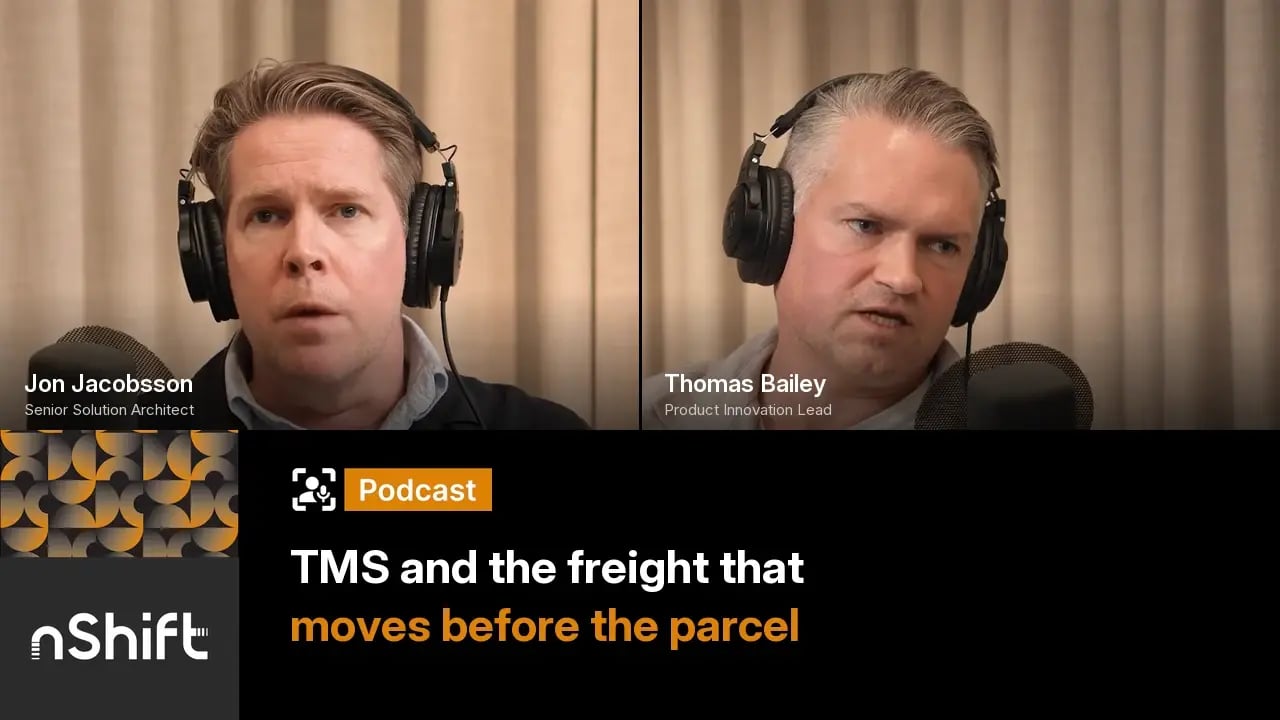
I sat down with Jon to record a podcast about transport management systems. The conversation kept coming back to one point: inbound logistics is where the next round of digitalization is happening, and many large shippers are only at the start of it.
Key takeaways
- Outbound parcel shipping is largely digital at Europe's bigger shippers. Inbound and internal freight often still runs on phone calls, carrier websites and a shared spreadsheet.
- A carrier moves the goods. A freight forwarder organizes cross-border transport and customs for you, usually buying the capacity from carriers.
- For many shippers, an exact arrival time is worth more than a fast one, because freight that arrives early can be as disruptive as freight that arrives late.
- A carrier's delay status is most useful when it reaches the person who owns the customer relationship, inside the system they already work in.
- The common mistake in a TMS rollout is trying to do everything from day one. Start with bookings, then the integration, then pricing.
What is inbound logistics?
Inbound logistics is the movement of goods into a business: raw materials, components and finished stock traveling from suppliers to factories, warehouses and stores, along with transfers between a company's own sites. Outbound logistics covers the other direction, from the warehouse to the customer.
The inbound stretch Jon works with looks like this in practice: containers shipped from East Asia to European ports, pallets moved from the harbor to a warehouse, line-haul between distribution centers and stores, and shipments between two warehouses of the same company. All of it happens before anything is packed into a parcel.
For most of the past two decades, investment went to the outbound side. Jon traced it back to when booking transport meant a phone call, a fax or an email. Platforms like nShift then built direct integrations with carriers, starting with outbound shipments because that is where most of the volume sat.
“I would say that the outbound transportation is very much digitalized today on pretty much most of the bigger companies in Europe. There are still a lot of things to do, improvements to be done, but the transport itself is digitalized. When it comes to inbound transportation, we have a lot to do here.”
The pressure to change comes from the consumer side. Anyone who orders from a webshop expects an email and a tracking link. Buyers inside B2B companies now expect the same for a pallet of stock or a transfer between two warehouses. As Jon put it, companies “expect to have the same kind of visibility, control, predictability also on your internal transportation as you have always had with your B2C, sort of normal, parcels.”
Why inbound freight is still booked by phone
When I asked Jon how most companies handle this today, his answer was the part of the conversation that surprised me most:
“You would actually be surprised on this one, because many big customers today have a completely manual flow for this type of backbone transportation.”
Inbound freight is expensive and often sourced one shipment at a time, so a buyer calls two or three forwarders or carriers to compare price and lead time. The booking then happens on that carrier's website, the purchase order goes into a shared spreadsheet, and someone types in a tracking link by hand.
“Honestly, we all know the shared Excel sheets. As long as everyone is in place and doing the work, it works.”
Then someone is off sick, leaves the company, or deletes a tab. The routine for booking a shipment from Malaysia to Rotterdam is stored in one person's inbox instead of in a system.
Jon described companies, “and these are also huge organizations,” that “have little or zero visibility of all the incoming goods.” Stock arrives without anyone knowing in advance when it will land. Suppliers book with whichever forwarder they choose, sometimes without the purchase order number on the shipment. Negotiated freight prices sit in email threads, so at contract renewal there is no clean record of what each lane cost last year.
A transport management system (TMS) puts every booking through the same process, in one place. Statuses, estimated arrival times reported by carriers, prices and documents collect on the shipment record. With nShift TMS, suppliers can book under your carrier contracts in their own view, so inbound shipments arrive with the right forwarder and the right paperwork from the start.
What is the difference between a carrier and a freight forwarder?
A carrier physically moves the goods with its own trucks, terminals and networks. DHL, DSV and Bring are the familiar names on European roads. A freight forwarder organizes transport on a shipper's behalf, usually across borders by air and sea. It handles customs clearance and paperwork and buys the capacity from carriers, often without owning the trucks, ships or planes. Jon described a forwarder as one that takes “care of everything for the customer, as an extended logistical department, you could say.”
Inbound freight usually involves both, plus shipping lines, express couriers and small local hauliers. That mix is why Jon puts connectivity at the top of any TMS evaluation:
“I would say that the core is collaboration with your carriers, your forwarders, because a TMS system without that connectivity...”
Large carriers connect through integrations, while a small haulier may have no IT department at all. For those, nShift TMS prints a QR code on the label and drivers scan it with a phone to update the shipment status, with no app or login. Jon's example: if he and I started a haulage company tomorrow, our drivers could report statuses from day one.
Why an exact arrival time beats a fast one
For many shippers, knowing exactly when freight will arrive matters more than how quickly it gets there. Many companies now hold small stock buffers, so the next step in production or sales depends on the load arriving on its date.
“There's more and more demand for, I would say, not quicker transportation, but exact.”
A production line for car parts stops if components miss their slot. Medical equipment may need to arrive on a set day. Early freight causes its own trouble, as Jon explained: “If it comes too early, there might be no one there to take the goods, no space to store the parts.”
Jon's example of how urgency changes the choice was a German company sending pallets to its own warehouse in Spain every week. When the load can travel any day in the next two weeks, price leads the decision. When it has to arrive on a set date, the carrier's track record on that lane matters more than the price.
Historical lead times let you calculate which transport mode will make the date. If you know how long a route from Bangladesh takes, including customs and port handling, you know when ocean freight will be too slow and air freight is needed, or when only express will make the date. With prices and lead times held for each option, you can compare them on screen before you book.
Our guide to OTIF (on-time in-full) covers how to measure whether deliveries arrive when promised.
Getting a delay to the person who can act on it
Jon walked through how a single delay should travel. A carrier reports an exception on a shipment, for example severe weather or flooding along the route. A good carrier also sends an updated arrival time. Both land on the shipment in nShift TMS.
Nobody should have to search for that. Instead, you set notification rules on the important flows, such as “not delivered within three days,” and the status passes back to the ERP or WMS. In Jon's example, the sales order in SAP gets flagged with the new arrival date, so the sales rep sees it on the order they already work from. They can call their customer days ahead, explain the weather delay, and agree what happens next.
“If it was just going to be two days late for that sales rep, that would have been a problem. Now instead you build trust.”
Jon added a caution about the other extreme: “No one wants to be updated all the time on everything.” With the connection to the ERP, the status reaches the person who owns that order, in the system they already use, instead of going to everyone by email.
The manual check that saves money on irregular freight
Shortly before we recorded, I visited Permobil, which develops and manufactures advanced mobility solutions, including powered wheelchairs. The chairs leave production at broadly similar sizes but in very different configurations, and the protective packaging changes with them, so the weight changes too. Not long before my visit, much of their transport booking was still done by hand.
I asked Jon how a TMS handles goods like that. His answer depended on how predictable the shipment is. A webshop sending headphones ships the same small box every time, so booking can run fully automatically. A sofa, two chairs and a table is different: one packer fits the order on two pallets, another uses four.
Most of Jon's TMS customers keep a middle step for this kind of freight. The integration from the ERP or WMS prepares the shipment, then the warehouse team checks the pallet count and weight before the booking goes to the carrier.
“Someone might say, OK, but this sounds like a completely unnecessary middle step. But I would say no, it's not. Because if you skip this, then you will always send something to your carrier that is six pallets, but in reality it's four.”
Jon's dividing line is how completely the data describes the shipment. Permobil's order data already holds each chair's configuration, so with nShift TMS, carrier bookings for its powered wheelchair flow are now created automatically from that order data, and shipping labels print as part of the process.
~34
powered wheelchair bookings automated each day
~5 min
saved per powered wheelchair
2 h 50 min
of manual work removed each production day
Permobil, powered wheelchair flow, with nShift TMS
Martin Barkman, Logistics Manager EMEA at Permobil, described what changed:
“The advantage for us is that the transport process becomes part of the production flow. We don't want our teams jumping between different systems and manually handling every shipment. With nShift TMS, we can automate that process and still have the flexibility to work with different carriers as our needs change.”
How to implement a TMS without trying to do everything at once
I asked Jon what goes wrong when companies choose a TMS. His answer was about scope:
“In all honesty, I think the biggest mistake that many of our customers make is to do everything. And that might sound a bit weird, but to try to build everything from day one.”
The sequence he recommends for a company moving off a shared spreadsheet:
- Start making the bookings in nShift TMS, using templates in place of the spreadsheet.
- Build the integration with your ERP or WMS, so shipments arrive prepared.
- Add pricing, so each shipment carries its cost, then start comparing carriers and lanes.
“Take it step by step, because this can also sometimes affect your own organization a bit.”
Someone used to phoning a forwarder can keep phoning. The booking happens in the system first, then the call. Over time, every booking follows the same structured routine, which Jon said frees the team's time for other work.
On choosing a system, Jon listed the checks he would use:
- Check how many of your carriers, forwarders, couriers and local hauliers it already connects to.
- Make sure every shipment can carry its price, so you can track actual spend against contracted rates.
- Let customs agents and suppliers add documents and shipment details without a login.
- Make sure switching carriers is a configuration change: “You don't want that to be an IT project. You don't want to be locked down to a specific carrier over time.”
Larger companies often add one more requirement: the raw shipment data pushed into their own data warehouse, where their analysts build their own reporting.
As I said to Jon near the end, the software, features and data are maybe half of the equation. The other half is the competence, experience and knowledge to set it up for the way your operation actually works.
What a year of shipment data does to the next carrier negotiation
To close, I asked Jon for a customer story. He kept it anonymous, so I will too: the company runs a central warehouse and many stores across a region. The stores operate a bit like separate businesses, shipping goods to each other all the time, and the store that orders the goods pays for the transport.
Before nShift TMS, there were as many ways of booking transport as there were stores. Now each store books through its own login in a branded booking portal that looks like part of the company's own systems. Transfers between sites run as shipments, with the cost allocated to the right store automatically, while the head office can take the combined volume to carriers and ask for their best price.
At contract renewal, the reporting gives the head office a year of evidence. Jon described the conversation that follows:
“They say it will always take three days to transport between these countries. Here we have one year of data, and most often it takes three days, but kind of often it also takes four or five days. Dear carrier, what's your response to this?”
With a year of lane data behind the question, the carrier has to answer on the record, and the next contract can be priced on what happens on that lane. Bringing inbound and internal freight into the same transport management system as your outbound shipments gives you that record for every flow.
Watch the full discussion
Jon and I spend about 45 minutes on inbound freight, carriers and forwarders, exception handling and TMS rollouts. Watch below, or on the podcast page with our notes.
Bring inbound freight into one system.
nShift TMS lets suppliers book under your carrier contracts, runs transfers between your sites as tracked shipments, and keeps statuses and costs on one shipment record.
Explore nShift TMSRead next
- What is a transport management system (TMS)?: what a TMS does, from booking and labels to analytics.
- Europe's supply chain visibility gap starts at the warehouse door: the outbound side of the same problem.
- OTIF (On-Time In-Full): how to measure whether freight arrives when it was promised.
- Permobil cuts nearly 3 hours of transport admin from every production day: the full customer story.