
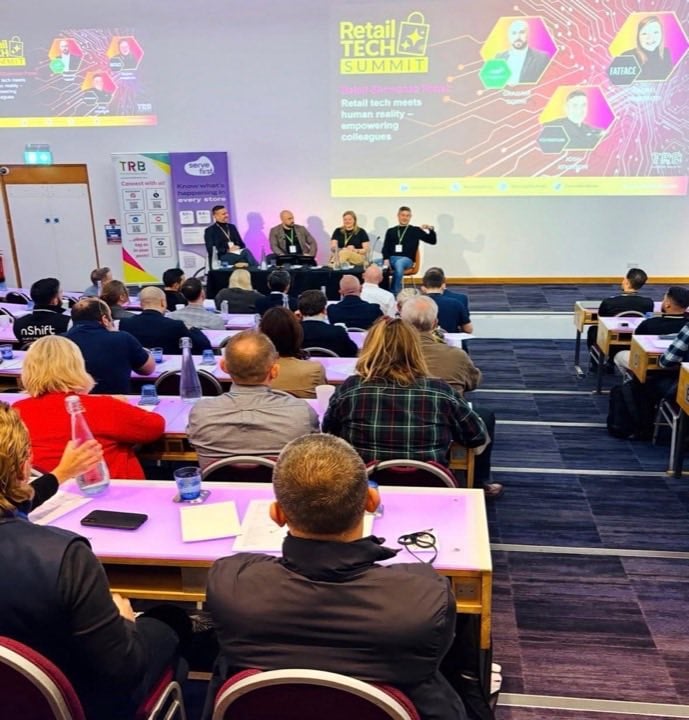
At The Retail Bulletin's Retail Tech Summit 2026 in London on 4 November, most sessions came back to the same idea: retailers want AI working alongside their people, with the computing power and the human judgment each doing their own part. Susannah Schofield, Director General of the Direct Selling Association, said AI "does the data bit" while "humans do the alchemy".
I spent the day talking with retail leaders at our table and listening in the sessions. The speakers who could point to results talked about two things before they talked about AI: the state of their data, and how they brought their teams along. I work on how nShift connects to the other systems a retailer runs, so the first point stayed with me most.
AI frees up people only when the systems behind it are connected
Darren Sanderson-Williams, General Manager at Specsavers and the day's chair, asked the room to imagine AI taking away the boring, repetitive work so people can concentrate on what needs human insight. Speakers on the later panels described what has to be in place before that happens.
Lalit Suryawanshi, Head of Architecture at N Brown, said boards want AI but are often unsure what it should achieve. His advice was to "sort out your data first", with an integration layer that connects the retailer's systems. Aman Bhattarai of ThoughtSpot added that teams still working from spreadsheets get stale insights. From the partner side, that matches what we see. AI can take repetitive work away only when order, stock, carrier and customer data move between systems without someone rekeying them. When the ecommerce platform, the warehouse system and each carrier hold their own version of an order, a person ends up reconciling them, which is the kind of repetitive work AI was supposed to remove.
Teams adopt the tools they helped choose
The second theme was adoption. Several speakers said people come on board when they get the context: what the business is trying to do with AI, and why. Rachel Ormerod, Product Operations Manager at FatFace, described an "AI September" of workshops covering tools, guardrails and policy. It was also, she said, a chance to "myth-bust on people's fears". She added that FatFace is a customer service business, so AI would need to be "phenomenal" before it could replace store staff.
Josh Atkinson, Retail Sales and Operations Manager at Footasylum, said the retailer surveys its store teams before introducing new technology. Staff turnover has fallen from 130% to 70% since teams bought into those plans. "Tech has reduced our churn," he said.
Automation works best where customers choose it
The Retail Bulletin's own wrap-up was blunt about self-checkout. It was supposed to make shopping faster, but shoppers now deal with glitchy machines while one worker looks after a row of screens.
Other speakers showed where automation does work. David Fradgley, Head of Marketing at Aramark, said two walk-out stores at a football stadium have been "a raging success", while students at Aramark's university stores prefer to talk to staff. Aramark's approach is to give customers the choice, so they use technology where it suits them.
I heard another version of this more than once during the breaks. Many shoppers now research a product with AI before they visit, then want a person in store to confirm it. Store teams can only do that if they see the same information as the website: the product details, the stock position and when an order will arrive.
Jeremy Michael, Chief Revenue Officer at Serve First, framed the decision retailers face. They can save money by taking staff off the shop floor, or they can invest in their teams to win more conversions and better retention.
When a delivery goes wrong, customers still want a person
My colleague Jacob Hopewell, who spent the day on our table too, came away with one addition: retailers want technology that improves the experience in store and at the doorstep, because repeat customers are harder to win while the cost of living stays high.
Retention came up in the afternoon sessions. Kate Murray, Digital Director at Nobody's Child, said retailers "spend to acquire customers but then forget about them". Shetal Bhatt of Costa Coffee said Costa is careful not to add friction when it adds new technology: "it's about simplicity."
Friction at the doorstep is common. In Ofcom's 2026 survey of UK parcel recipients, 71% had experienced a delivery issue in the past six months, up from 68% a year earlier, and average satisfaction slipped from 78% to 75%. When something goes wrong, the summit's point about people comes back. In Ofcom's 2025 survey, fewer than half (47%) of recipients who contacted a delivery company were satisfied with how it went. Among those who were dissatisfied, 53% said there was no way to reach the company by phone. Citizens Advice found that 47% of people who had a delivery problem then hit a further issue trying to resolve it, including automated systems such as chatbots.
A retailer can act on two things here. Clear tracking updates answer "where is my order?" before the customer has to ask. When a delivery does fail, the customer needs a quick route to someone who can see the whole order. Both depend on carrier data reaching the retailer's systems while it is still current.
What I'm taking back to retailers and partners
These are the questions I'll be asking retailers and partners over the coming months:
- Which customer-facing teams can see the same order, stock and delivery information as the website?
- Where does someone still rekey data between the ecommerce, warehouse and carrier systems?
- When a delivery fails, how quickly can a customer reach a person who can fix it?
- Did the team that uses your newest tool have a say in choosing it?
At nShift, connected data is the work we do with our partners: linking checkout, carriers, tracking and returns to the ecommerce and warehouse systems retailers already run, so their teams spend less time reconciling and more time with customers.
Thanks to The Retail Bulletin for a well-organized day, and to everyone who stopped by to speak with our team. If any of these questions apply to your business, get in touch.
For more on how integration affects launch speed, read Mark's article on logistics APIs in 2026.