
What is delivery tracking?
Delivery tracking is an essential part of the ecommerce experience, giving both businesses and their customers insights into the status of shipments. 60% of shoppers say a good delivery experience has encouraged them to purchase again, according to a new report by IMRG, making effective delivery tracking a business imperative.
But what powers this level of visibility? How does delivery tracking software work behind the scenes to keep customers informed?
Delivery tracking software is a digital solution that enables businesses to monitor the status of shipments from warehouse to delivery, providing customers with automated updates on order status, estimated delivery times, and proof of delivery. Typically, this software integrates with carrier networks, warehouse systems (WMS), order management systems (OMS), and ecommerce platforms to ensure seamless tracking and communication.
Let’s break down how it works—and why it’s a paradigm shift for online retailers.
How do delivery companies track packages?
Delivery companies track packages by scanning the barcode on the shipping label at every handover, and each scan becomes a timestamped event tied to the parcel's tracking number. The label is printed when the order is packed. The first scan happens when the carrier collects the parcel or the retailer drops it at the depot, and from then on the parcel is scanned in and out of every building it passes through: the local depot, the linehaul truck or plane, the regional hub, the delivery depot, the driver's van. Two scans matter most to the customer: "out for delivery", when the driver starts the route, and "delivered", which may come with a signature, a photo or a safe-place note. Problems and exceptions generate their own events too, such as an address query, a missed delivery attempt or a parcel being held at a pickup point.
Each tracking number covers one shipment. The carrier issues it when the label is created. Because the tracking number exists before the parcel moves, "label created" is often the first status a shopper sees. The first physical scan starts the journey through the carrier network. The delivery scan, or the collection scan at a pickup point, closes it.
Tracking becomes less clear in the gaps between scans and when parcels move between carriers. A parcel on a linehaul truck overnight generates no event, so a customer who checks in the morning sees the same status as the night before. Every carrier names its events in its own words and its own language: one carrier's "in transit" is another's "arrived at sorting center", and a Nordic carrier reports the same step in Swedish. Cross-border parcels change hands between two carriers, and the first carrier's last scan and the second carrier's first scan can sit days apart with a customs status in between. A retailer using several carriers can therefore end up with several tracking timelines that read nothing alike, while customer service agents have to learn each carrier's vocabulary to answer the same basic question.
A multi-carrier platform standardizes those different timelines. It receives the carriers' raw events, maps each status to a common category and presents the same set of steps regardless of which carrier has the parcel. nShift Track, for example, has mapped hundreds of different carrier statuses into seven main categories, so customers see a consistent tracking journey across shipments. It can also flag an unexpected gap in tracking events, giving the retailer a chance to investigate before the customer gets in touch. One platform connects you to 1,000+ carriers, and that consistency is what makes the count usable: customers see one timeline, and customer service teams learn one vocabulary.
Core features of delivery tracking software
A great delivery tracking system does more than just show where a package is—it keeps customers informed, minimizes delivery issues, and helps businesses manage logistics more efficiently.
The latest tracking solutions offer:
- Real-time visibility into shipment status across multiple carriers.
- Automated notifications via email, SMS, or branded tracking pages.
- Proof of Delivery (POD), including digital signatures and photo confirmations.
- Seamless integration with ecommerce platforms, warehouse systems (WMS), and order management systems (OMS).
With these capabilities, delivery tracking software provides a centralized view of shipments, reduces WISMO (“Where is my order?”) inquiries, and enhances the overall post-purchase experience.
Let’s take a closer look at how it works behind the scenes.
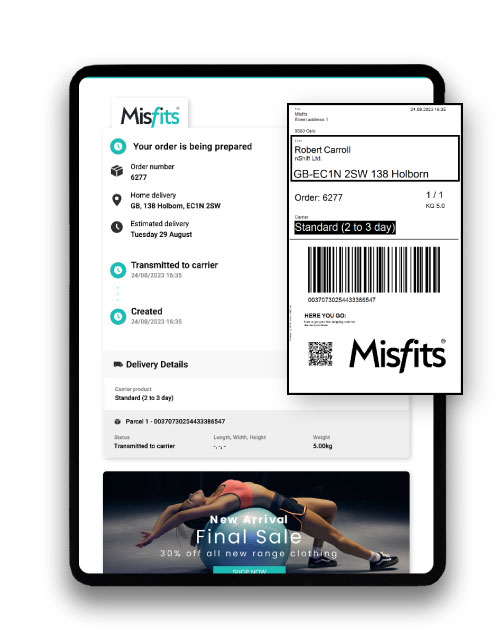
How delivery tracking software works
At its core, delivery tracking software connects ecommerce businesses with carrier networks, logistics platforms, and customer communication tools to provide real-time shipment visibility. Instead of manually tracking individual orders or relying on carrier websites, businesses can consolidate all delivery data into one seamless system.
Here’s how it works:
1. Connecting to carrier networks for real-time tracking
To provide accurate updates, delivery tracking software integrates with global and regional carriers, such as DHL, UPS, FedEx, and national postal services. These integrations ensure that tracking information is continuously updated as shipments move through the supply chain.
- Customers and businesses can instantly check a package’s location and estimated arrival time.
- Instead of juggling multiple tracking pages, all shipments—regardless of carrier—are monitored from a single dashboard.
- If a delay or issue arises, businesses can take immediate action before it impacts the customer experience.
2. Syncing with ecommerce & warehouse systems
Tracking software doesn’t work in isolation—it integrates with Order Management Systems (OMS) and Warehouse Management Systems (WMS) to maintain order visibility from checkout to delivery.
- Each shipment is automatically linked to the correct order, eliminating tracking errors.
- As soon as an order is packed and dispatched, the system triggers a status update.
- Warehouse teams gain full visibility into fulfillment progress, helping them optimize shipping workflows.
3. Sending automated customer notifications
Customers don’t want to wonder where their order is. They expect clear, proactive updates at every stage of the delivery journey.
- A branded tracking page lets customers follow their order’s journey without leaving the retailer’s website.
- Automated email and SMS notifications keep customers informed, reducing the need for support inquiries.
- If a package is delayed or requires a delivery adjustment, customers receive alerts with rescheduling options.
4. Managing multi-carrier flexibility & smart routing
Ecommerce businesses often work with multiple shipping providers to balance cost, speed, and reliability. Delivery tracking software makes this process seamless.
- Smart routing assigns orders to the best carrier based on location, shipping cost, and delivery time.
- Cross-border tracking ensures international shipments remain visible, even when transitioning between different carriers.
- Last-mile tracking helps businesses monitor local couriers, reducing the risk of failed deliveries.
5. Leveraging data & analytics for rerformance optimization
Tracking software doesn’t just monitor deliveries—it collects valuable shipping data that can be used to optimize logistics performance.
- Businesses can monitor carrier reliability, identifying patterns in on-time deliveries and delays.
- With better visibility, WISMO (“Where is my order?”) inquiries are significantly reduced, cutting customer support costs.
- Every tracking interaction provides data that, helps businesses improve delivery strategies and boost post-purchase engagement.

Why ecommerce brands need delivery tracking software
In retail the customer experience extends beyond the checkout page. The post-purchase phase is now a critical touchpoint and opportunity for building trust and driving loyalty. Here’s how parcel tracking solutions make a real difference:
Enhancing Customer Experience
Personalized tracking options and branded delivery tracking pages improve engagement. Leading retailers like Laithwaites provide real-time tracking through nShift Track, ensuring customers know exactly where their orders are. By streamlining multi-carrier integrations, Laithwaites has optimized logistics and provided its customers with greater control and visibility over their deliveries.
Reducing WISMO Calls
Customer inquiries like “Where is my order?” (WISMO) can overwhelm support teams. By adopting nShift-powered order tracking systems, ICANIWILL reduced delivery-related queries by 50% in just one year, saving the company €12,000 annually. This has enabled their customer service team to focus on proactive care, elevating the overall customer experience.
Improving Efficiency and Saving Costs
Efficient processes save both time and money. Fashion brand QUIZ, for instance, integrated nShift Track and Returns into their systems to help manage delivery and returns at scale. They achieved 25-30% staff time savings, thanks to automated updates and streamlined query handling.
Driving Sales Growth
Post-purchase tracking doesn’t just keep customers informed - it creates opportunities for growth. For instance, ICANIWILL uses customer engagement during tracking updates as a marketing channel, achieving a 25% click-through rate (CTR), compared to the industry average of 18%.
Delivery tracking software is more than just a convenience—it’s a competitive advantage. With the right tracking solution, businesses can not only improve operational efficiency but also turn shipping updates into valuable customer engagement opportunities. Investing in a robust delivery tracking system isn’t just about keeping customers informed—it’s about setting your brand apart in a crowded market.